The concept of a smart city has long been synonymous with technologies such as artificial intelligence, big data analytics, and the digitization of public services. However, for Prof. Wakhid Slamet Ciptono, M.B.A., M.P.M., M.P.U., Ph.D., technology alone is not enough. A city may be smart, but without wisdom, it risks losing its human spirit.
The Professor of the Department of Management, Faculty of Economics and Business, Universitas Gadjah Mada, was tasked with developing a research project entitled ‘Smart and Wise City’. This research originated from his student in the Master of Science in Management Study Programme at FEB UGM, Tri Wahyuningsih, who studied smart city development in the Special Region of Yogyakarta (DIY) through a qualitative approach.
Wakhid argues that the current smart city concept must incorporate more fundamental dimensions, including manners, ethics, and local wisdom. From this perspective, he formulated the idea of Smart and Wise City, a vision of a city that is not only intelligent, but also wise and humane.
“The Industrial Revolution 5.0 has given rise to a knowledge society, but without being balanced by the dimension of manners, this progress has the potential to create new social problems,” he explained.
This research involved Prof. Joe Ravets from the University of Manchester, who is widely known as a consultant on sustainable urban development. He is also the author of the book “Smart and Wise City,” which serves as the primary reference for this study.
Wakhid selected the Special Region of Yogyakarta as the research location due to its strong identity as a city of education and culture, as well as its role as a miniature of Indonesia. The study involved in-depth interviews with 29 informants, including the Deputy Governor, mayors, the Head of Bappeda, and community leaders, to explore the integration of local values into smart city development.
“Yogyakarta has local values as strong intangible assets to support the concept of a wise city,” he explained.
The interview results showed broad support from stakeholders for expanding the local government’s smart city concept into a smart and wise city. If realised, Yogyakarta has the potential to become the first city in Indonesia to implement this concept fully.
“If this can be realised, it will demonstrate that the concept of a smart and wise city can emerge from a developing country,” he said.
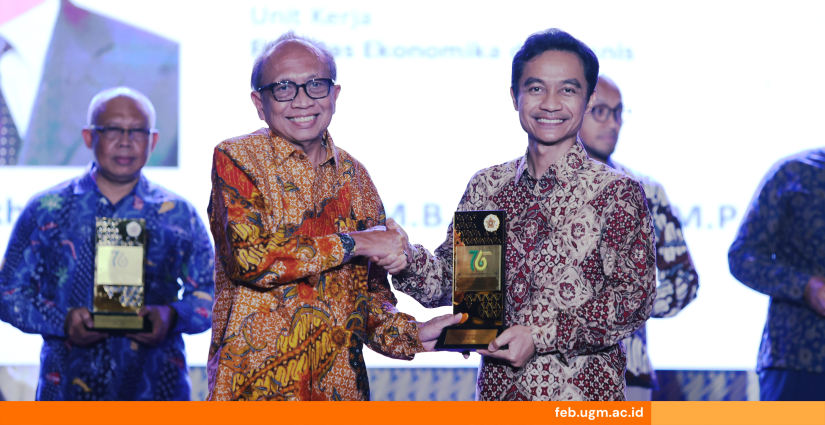
The research journey did not unfold smoothly. A Q1 journal initially rejected the manuscript, prompting him to reflect more deeply and refine the idea further. Instead of stopping, he submitted the study to a UGM research competition. The effort paid off, as the research earned the 2025 UGM Outstanding Achievement Award in the Collaborative Research category for its focus on the social and cultural resilience of communities.
“A Q1 journal once rejected this research, so I submitted it to UGM. I didn’t expect to win an award. I hoped to get a response from UGM regarding the concept of a smart and wise city,’ he explained.
Concluding the conversation, Wakhid encouraged young lecturers and researchers at FEB UGM to dare to go beyond the boundaries of their current fields of study. According to him, many brilliant ideas are born when academics step out of their comfort zones and open themselves up to cross-disciplinary collaboration.
“The business-as-usual approach is no longer sufficient to address long-term development challenges. Forward-looking and socially impactful research is a strategic necessity in supporting the Indonesia Emas 2045 vision,” he concluded.
Reportage by: Kurnia Ekaptiningrum
Sustainable Development Goals