Retirement is often perceived as a time to rest after decades of working. However, financial preparedness remains a significant challenge. According to the HSBC Future of Retirement Survey, 9 out of 10 respondents are concerned about covering their retirement expenses.
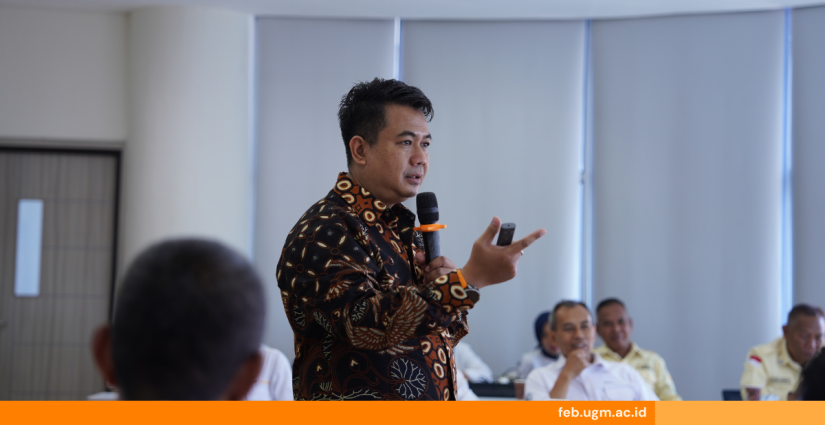
Financial Consultant Himawan Adhi, S.T., M.M., CFP®, QWP™, AWP™, CPC, AAK, QFC™ emphasized the importance of financial literacy and discipline to ensure a prosperous retirement. He delivered this message during the Practical Financial Workshop for Pre- and Post-Retirement Preparation of FEB UGM Professional Staff held on Monday (January 19, 2025) at the Faculty of Economics and Business, Universitas Gadjah Mada (FEB UGM). The workshop was organized to equip FEB UGM professional staff who are approaching or have entered retirement.
“No one wants to work for a lifetime. However, many people fail to prepare retirement funds because they do not set aside money during their working years, only rely on leftovers, maintain a lifestyle that exceeds their income, and lack discipline,” he said.
Himawan stressed that responsibility for managing personal finances lies with the individual. Therefore, it is essential to distinguish between needs and lifestyle, and to manage income and expenses carefully. Survival depends on basic needs being met, while lifestyle choices often come from a desire for status.
“Regardless of how much income we earn, expenses must be lower. That is why we need to know exactly how much we spend. A forced lifestyle makes us unable to live truly,” Himawan explained.
To remain financially productive after retirement, Himawan emphasized the importance of saving early. However, financial awareness often comes too late. Many people realize the importance of investing only as they approach retirement, after seeing that their peers already have assets while they themselves have not prepared anything.
“The asset choices made years earlier become the main differentiator. For example, there is a clear difference between consumptive and productive assets. Car loans tend to depreciate over time, while home ownership has the potential to increase long-term wealth,” he explained.
In addition, financial failure often begins with impulsive decisions. Investment schemes that promise high returns, quick profits, and minimal risk, such as multi-level marketing (MLM), usually trap victims gradually. Such instruments should arouse suspicion.
“Initially, profits do indeed accrue, but this encourages victims to invest larger sums until they eventually lose all their assets. In principle, investment returns are always proportional to risk,” he said.
According to Himawan, ideal retirement funding should come from a combination of personal savings, employer-provided pension funds, and government-managed pension programs.
“Severance pay is unexpected income. If not managed properly, funds can dry up quickly, particularly if they are used to cover unresolved debts. Debts that are taken lightly can change a person’s life in the future,” he warned.
Furthermore, Himawan also mentioned several instruments that can continue to generate income, such as deposits, bonds, and interest-bearing instruments. Wealth can also preserve itself in the form of gold and property.
“The main goal of retirement planning is to continue living decently and not depend on others. With careful planning, retirement is not the end of productivity, but the beginning of a balanced life,” he concluded.
Reporter: Shofi Hawa Anjani
Editor: Kurnia Ekaptiningrum
Sustainable Development Goals