
Every year, the central government, local governments, and even village councils prepare financial statements as a form of accountability for the management of public funds. These statements are then audited by the Supreme Audit Agency (BPK), which issues an opinion that is often seen as a symbol of successful governance, such as an Unqualified Opinion (WTP). Many local governments compete to maintain this status, demonstrating sound financial management.
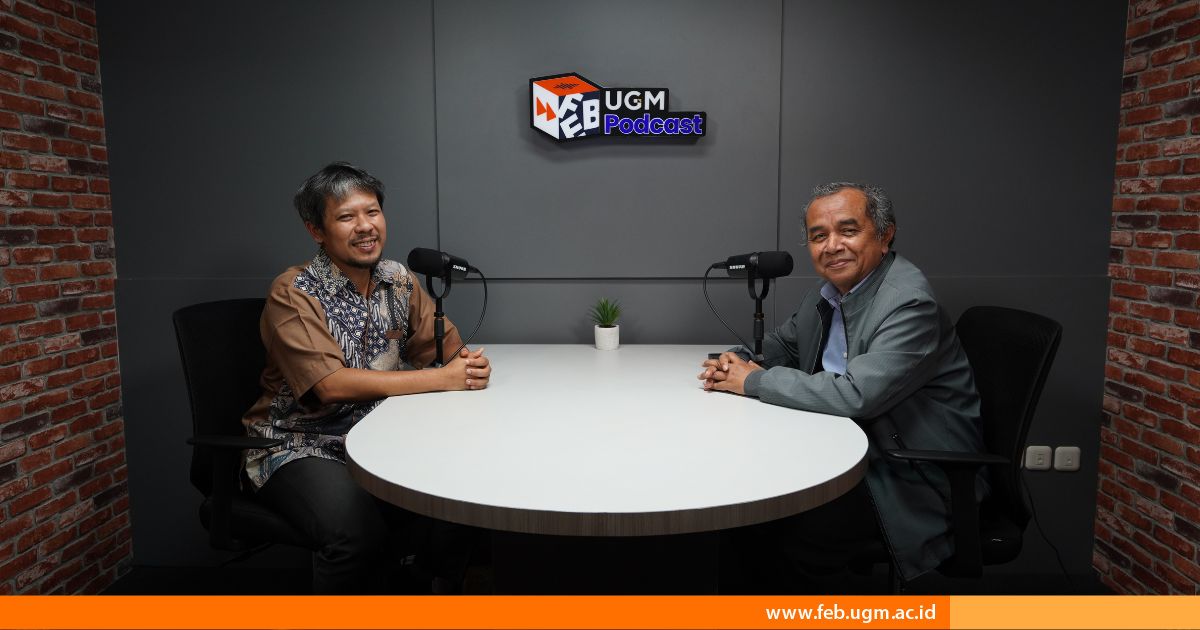
However, behind these seemingly neat and impressive financial reports, does the current public accounting system truly guarantee the proper management of public funds? This fascinating topic was explored in the FEB UGM Podcast entitled “Accountability or Formality? Unpacking the Role of Public Sector Accounting in Government Performance”, by Professor Abdul Halim, M.B.A., Ak., CA., Head of the Department of Accounting at the Faculty of Economics and Business, Gadjah Mada University (FEB UGM).
Abdul Halim explained that the government is a non-business organization because it is oriented towards public service. In this context, public sector accounting records and accounts for the management of state finances. He also highlighted that Indonesia’s government financial management system has undergone significant changes over time.
The Evolution of Public Accounting in Government
Halim explained that, prior to the reform, the government used a cash basis of accounting, which focused on cash inflows and outflows. Under this system, government assets were not fully recorded in the financial statements.
According to Abdul Halim, the reforms marked a pivotal point in the development of public accounting in Indonesia. Following the reforms, the government began implementing the accrual basis, which records assets, liabilities, and government performance over a specific period. The inclusion of a balance sheet in financial statements was also part of this change.
In addition to the accounting system, the government’s budgeting system also changed. Previously, the government budget was considered to be always balanced, so surpluses or deficits were not clearly visible. Following the reforms, revenue and expenditure were separated transparently, revealing that both the State Budget (APBN) and Regional Budgets (APBD) frequently ran deficits. These deficits could then be covered by debt, financing, or the Budget Financing Surplus (SILPA).
“In theory, the government should make optimal use of the budget; if there is an excessively large surplus (SILPA), this indicates that the budget has not been fully utilized or that the services provided to the public are not yet optimal,” said Abdul Halim.
Is a WTP Becoming a Formality?
Every year, the government compiles its financial statements, which are then audited by the State Audit Agency (BPK). Based on the audit findings, the BPK issues an opinion on the fairness of the government’s financial statements. One such opinion is the WTP. This opinion is often used as a benchmark of success, indicating that the government has managed its affairs with integrity. However, the WTP is often criticized because the government focuses solely on how to obtain it, based on financial statements that can be presented in a more “polished” manner.
“In reality, the WTP is the result of an audit opinion that assesses fairness alone, not an absolute guarantee of correctness. The risk of fraud remains,” he explained.
The Future of Government Audits
Abdul Halim explained that there is currently a shift in government auditing, moving from a focus on financial audits towards performance audits. Under this framework, certain aspects of the financial audit process can be delegated to private Public Accounting Firms (KAP) on behalf of the BPK. This step is taken to address the BPK’s limited audit resources while increasing the focus on government performance audits.
He believes that public accounting reform has brought about significant changes in Indonesia’s governance towards a more modern and transparent system. Nevertheless, the core essence of the reform does not stop at the ability to produce good financial reports.
“Nevertheless, the essence of reform is not about how to produce a good report, but how the government can ensure that the budget is actually spent on public services and how the state can truly be held accountable for the public’s money,” he concluded.
The FEB UGM Podcast video entitled ‘Sports Economics: Accountability or Formality?’ Unpacking the Role of Public Sector Accounting in Government Performance can be accessed in full via: http://ugm.id/PeranAkuntansiSektorPublik
Reported by: Najwa Anggi Namira
Editor: Kurnia Ekaptiningrum
Sustainable Development Goals