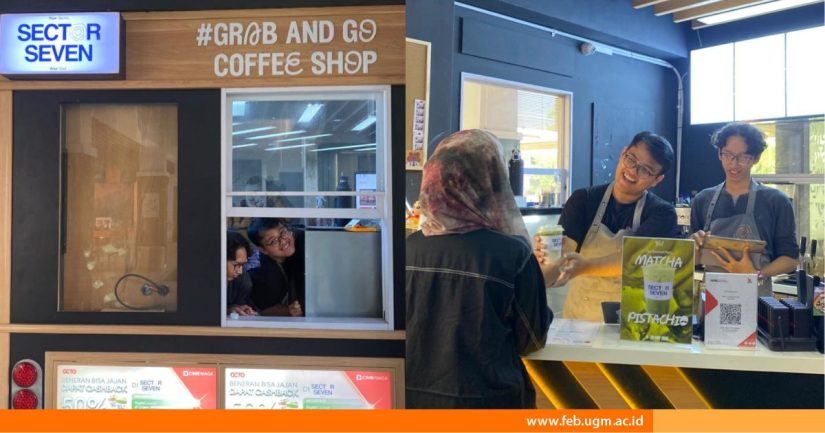
The demanding pace of university life often leaves students with two competing needs: staying productive and finding time to unwind. Interestingly, these two needs are not always fulfilled within the same space. Recognizing this opportunity, a group of students from the Faculty of Economics and Business, Universitas Gadjah Mada (FEB UGM), established Sector Seven.
Sector Seven was initiated by Claresta Zuhrah Aulia (Management 2023), Devon Otniel Del Frey (Management 2023), Siti Intan Nurasiyah (Management 2023), Dafa Hentra Anjana (Management 2023), and Salsabilla Syafa Kamila (Management 2023). Located at the CIMB Digital Lounge FEB UGM, Sector Seven offers a combination of two beverages closely associated with students’ daily routines: coffee and matcha.
Behind its name, Sector Seven represents seven core elements that serve as the foundation of the business, consisting of three values: strong branding, a balanced approach, and sustainability, and four innovations: online ordering, a point system, immersive experience, and RTD (ready-to-drink) products.
Beverage Solutions for Every Moment
Coffee is positioned as a symbol of energy and focus, while matcha offers a calmer alternative. Through this approach, Sector Seven does not merely sell beverages; it also provides relevance to the situations its customers experience.
“Sometimes students need an extra boost to stay focused, but at other times they simply need a break. We aim to respond to both needs,” explained Claresta.
In developing its products, Sector Seven relies on an intensive exploration process. Some of its signature menu items include Sectorize for the coffee category, as well as Green Flag and Red Flag for the matcha category. The selection of these menu items was not based solely on internal preferences but also incorporated feedback from the surrounding community.
To accommodate students’ fast-paced lifestyle, Sector Seven has also developed a website-based ordering system that lets customers place orders in advance and pick up their drinks without waiting.
Implementing Sustainability Principles
Sector Seven also integrates sustainability principles into its operations. One of the measures taken is eliminating the use of plastic straws, as they are among the largest contributors to global plastic waste. In addition, the cups used can be reused multiple times, and raw material management is carefully managed to minimize waste. Around 90% of the ingredients are sourced locally.
This commitment to sustainability extends beyond environmental concerns. Sector Seven also provides opportunities for students to join as baristas, with the hope that the coffee shop can serve as a learning space for those interested in gaining direct experience in the F&B business industry.
“We hope that even after the baristas leave Sector Seven, they will have the independence and sufficient skills to move forward confidently,” said Claresta.
Applying Classroom Knowledge in Real Business Practice
Sector Seven is operated by six baristas and five managers, making it a dynamic learning environment. Here, concepts learned in the classroom are applied directly, ranging from business plan development, market analysis, and customer journey understanding to making quick, real-time decisions.
“All the concepts we learned in class turned out to be highly relevant. In fact, we only truly understood them after experiencing the business firsthand,” Claresta shared.
Unlike classroom settings, there is no pause in real business operations. Every challenge requires an immediate response, and every decision carries real consequences. Yet, this is where the greatest value lies.
“Doubt is natural and does not need to disappear completely. What matters most is not allowing that doubt to stop you from taking the next step,” Claresta concluded.
Reporter: Dwi Zhafirah Meiliani
Editor: Kurnia Ekaptiningrum
Sustainable Development Goals (SDGs)