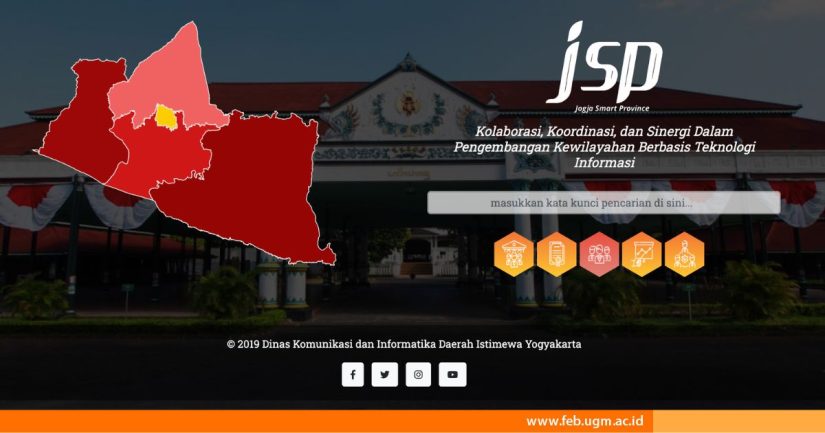
The adoption of Artificial Intelligence (AI) in regional government has gained increasing attention as public demand grows for more responsive and personalized public services. Through its Jogja Smart Province (JSP) initiative, the Special Region of Yogyakarta (DIY) has become one of Indonesia’s pioneers in integrating AI into public governance.
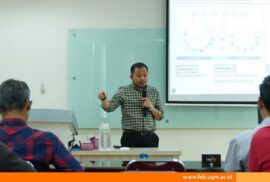
In the latest episode of the FEB UGM Podcast, titled AI in Public Governance: The Strategy Behind Jogja Smart Province, Dr. Sayuri Egaravanda from the DIY Communication and Information Office (Diskominfo DIY) shared the journey of JSP, from its inception in 2017 to its transformation into a human-centered ecosystem.
According to Sayuri, the first phase of JSP (2017–2022) focused on the digitalization of public services. However, the primary objective was not merely to digitize services but to ensure that technological interventions accelerated progress toward regional development goals.
“When we introduce technology into public services, the focus is no longer just on digitizing the services themselves, but on ensuring that these interventions help accelerate the achievement of development goals,” she explained.
Following the completion of its first phase in 2022, JSP entered its second phase, which runs until 2027. During this period, the initiative shifted from a government-centric approach to a citizen-centric one.
This transformation requires the government to understand citizens’ needs and expectations better. AI plays a supporting role by helping identify patterns and respond to public needs through data-driven analysis.
“Artificial Intelligence provides additional capabilities for the government, but it does not replace the government’s role. The government should remain a partner that ensures our development efforts align with the expectations of society,” she said.
She emphasized that successful AI implementation depends heavily on strong data foundations. Before AI can be utilized effectively, the Yogyakarta Provincial Government first established a big data architecture, strengthened data governance, improved digital infrastructure, and enhanced information security systems.
One example of AI implementation already in use is a predictive traffic management system. Historical CCTV data are analyzed to forecast traffic congestion at intersections before it occurs.
“We should not wait until something happens before responding. AI should help us identify potential problems several minutes in advance at a particular intersection,” she noted.
Regarding inclusivity, Sayuri explained that the provincial government is committed to ensuring AI-powered public services are accessible to everyone, including persons with disabilities. Various personalization features have been incorporated into digital services to accommodate users with different accessibility needs.

She also highlighted another equally important issue in AI adoption: balancing technological advancement with sustainability principles. According to her, AI is not implemented indiscriminately across every public service but is deployed where it can have the greatest impact. For example, in the public complaint service, AI strengthens the knowledge management system while leaving the responsibility for responding to complaints in the hands of human officers.
To further develop effective AI applications, Diskominfo DIY actively welcomes research collaborations with academic institutions, particularly in AI for disaster management. Such collaborations are considered essential, given the limited time and resources available within government institutions to conduct extensive research.
“We are very open to collaborative models because we recognize that research and development are the core strengths of our academic partners,” she said.
Despite the progress achieved, Sayuri acknowledged that improving digital literacy among both the public and civil servants (ASN), as well as addressing infrastructure and budget limitations, remain ongoing challenges that require continuous attention.
Addressing concerns that AI may replace civil servants, she stressed that AI is intended only to automate repetitive clerical tasks, not to replace professions or human roles altogether.
“Our goal is for AI to enhance the quality of public services we provide to society. AI should not take center stage; the government should,” she concluded.
The full episode of the FEB UGM Podcast, titled AI in Public Governance: The Strategy Behind Jogja Smart Province, is available at: http://ugm.id/DampakAI
Reporter: Dwi Zhafirah Meiliani
Editor: Kurnia Ekaptiningrum
Sustainable Development Goals: