
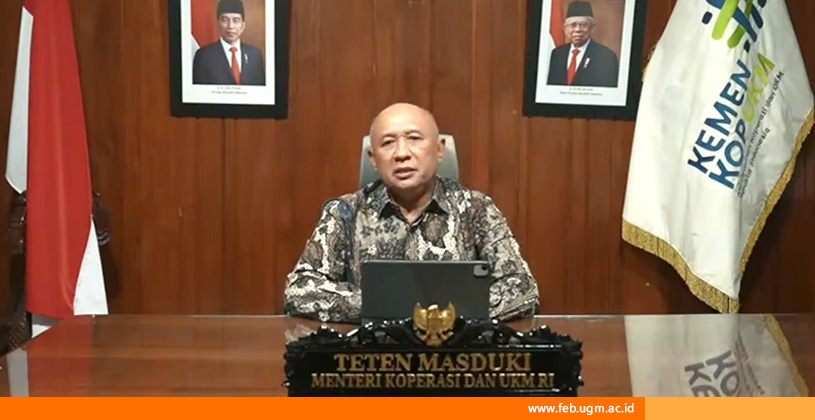
The Indonesian Minister of Cooperatives and Small and Medium Enterprises (SME), Drs. Teten Masduki said that Indonesia is aiming to become a developed country with per capita income exceeding USD 30,000 by 2045. However, as of 2024, 97 percent of jobs in Indonesia are in microenterprises, which are less productive and informal. Currently, Indonesia’s per capita income has only reached USD 5,000.
“This is a fact that we need to change; we need entrepreneurs to drive economic growth and create more productive and sustainable jobs,” he said online, Friday (10/11/2024) in a public lecture on Young UMKM: The Future of the Nation’s Economy at the Faculty of Economics and Business UGM Learning Center Building.
Teten said that countries that are becoming developed have an average entrepreneurship rate of at least 4 percent. Meanwhile, Indonesia has reached only 3.47 percent, while it has set a target of up to 8 percent in the next few years.
“Therefore, creating new entrepreneurs is a must,” he said.
Teten also said universities, including UGM, are essential in promoting and developing entrepreneurship. Students who have businesses can be incubated to become reliable business people when they graduate.
The Ministry of Cooperatives and SMEs has a program to support MSMEs through the Entrepreneur Hub. Through this program, about 500 start-ups have been brought together with investors from around the world.
FEB UGM Vice Dean for Research, Community Service, Cooperation and Alumni, Gumilang Aryo Sahadewo, S.E., M.A., Ph.D., said that the development of entrepreneurship, especially the MSME sector, in Indonesia is showing a positive trend. With technological advances and changing mindsets, more and more young people are now daring to enter the business world.
“This is very encouraging, considering that the contribution of MSMEs to our country’s economy is substantial,” he said.
He also highlighted entrepreneurs’ challenges, especially in the MSME sector, including access to capital and market competition. However, this is where the uniqueness of Indonesian MSMEs lies; with enthusiasm, creativity, and fighting spirit, many can survive and successfully penetrate the international market.
“Several local brands, including Avoskin, have successfully competed globally. This proves that young Indonesian entrepreneurs can compete globally. This is an inspiration for all of us, and with innovation and perseverance, micro and small businesses can grow and develop into big players,” he explained.
Meanwhile, the Secretary General of KAFEGAMA Central Board, Dodit Wiweko Probojakti, said that KAFEGAMA is committed to supporting the development of MSMEs, especially young MSMEs in Indonesia. One form of this commitment is to hold a public lecture for MSMEs.
A panel discussion was also held alongside this public lecture, featuring several young entrepreneurs, including Hilmi Adrianto, Head of Public Policy and Government Relations at Tokopedia, and Anugrah Pakerti, Founder of Avoskin. In addition to sharing their business experiences, they also shared tips and tricks for a successful business.
In addition to presenting business actors, the panel discussion also featured Siti Azizah, Deputy for Entrepreneurship at the Ministry of Cooperatives and SMEs, who explained the government’s support for MSME development. Then Dr. Rocky Adiguna, Secretary of the MBA Study Program FEB UGM, gave an overview of the general problems faced by MSMEs in Indonesia, how young MSMEs can survive and even grow amid unstable economic conditions, and the support needed for young MSMEs to grow and develop.
The public lecture, a collaboration between FEB UGM, KAFEGAMA, and Katadata, also launched the Rumah Digital UMKM website for MSME stakeholders. This website is a digital home for MSME actors to promote their products while building the credibility of MSME units. The MoU between KAFEGAMA and the Indonesian Ministry of Cooperatives and SMEs was also signed.
Reportage: Orie Priscylla Mapeda Lumalan
Editor: Kurnia Ekaptiningrum
Sustainable Development Goals (SDGs)