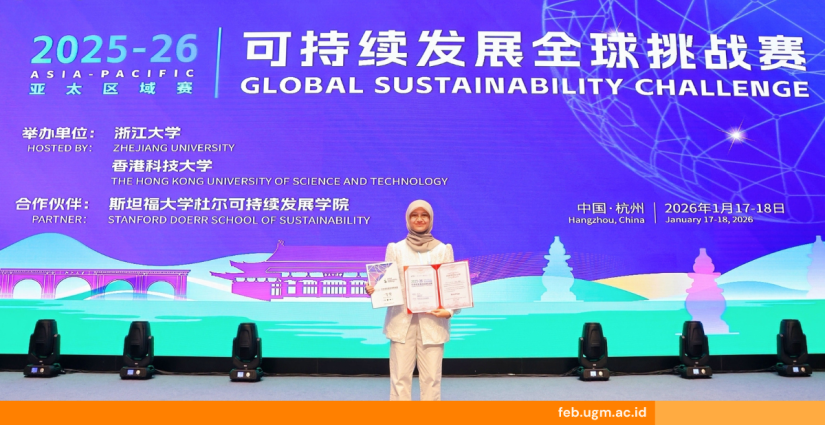
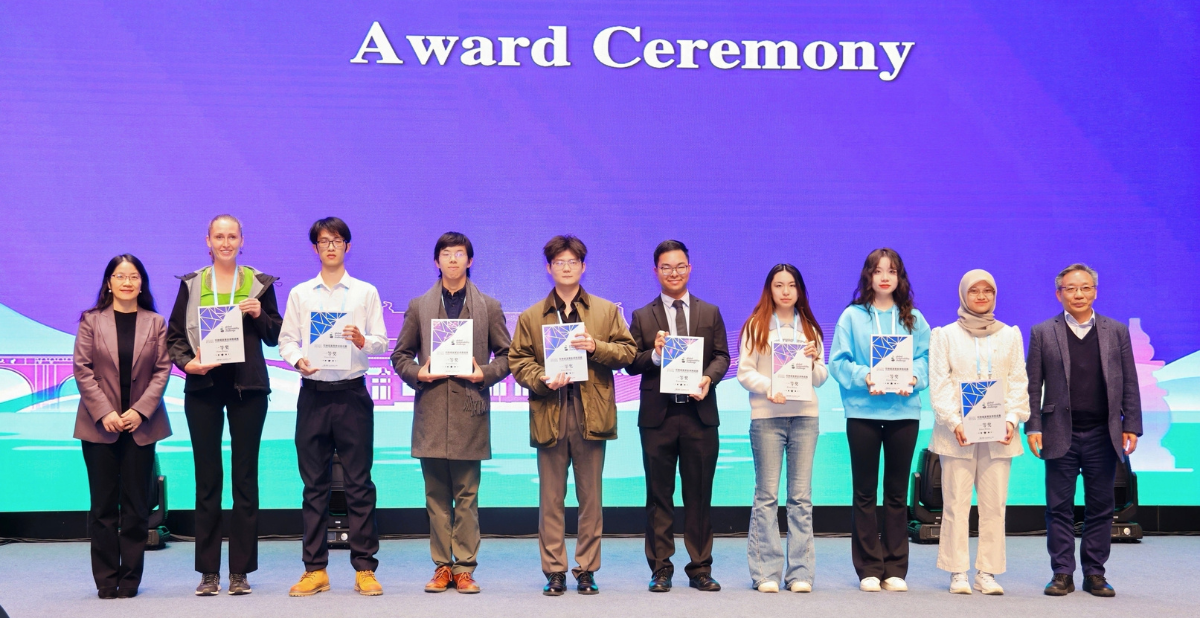
Students from the Faculty of Economics and Business, Universitas Gadjah Mada (FEB UGM), have once again achieved outstanding success on the international stage. The Tycoon Team secured First Prize at the Global Sustainability Challenge (GSC) Regional Final, held on 17–18 January at Zhejiang University in Hangzhou, Zhejiang, China.
The Global Sustainability Challenge (GSC) is an annual international competition that brings together students from around the world to design, implement, and showcase sustainability solutions. At the regional final stage, 66 teams from various countries across the Asia-Pacific region participated.
The Tycoon Team is an international collaborative team consisting of Najwa Waqiah Saleh (Management, 2022), Nikita Dinda Azizah (Management, 2022), Gustav Susanto (Management, 2022), and Satwika Nino Wandhana (IUP Computer Science, 2023). The collaboration also involved two students from The Hong Kong University of Science and Technology (HKUST), namely Pranavi Kuntrapakam (Computer Engineering + AI) and Anuk Ranaweera (Mechanical Engineering).
In the competition, the Tycoon Team presented an innovation to support disaster mitigation efforts and improve community preparedness for disaster risks, particularly in countries with high vulnerability levels such as Indonesia. The proposed solution is a mobile-based application integrated with drone technology.
This approach involves using drones to map disaster-affected areas and to help distribute emergency supplies, such as food, water, and first-aid equipment. Meanwhile, the mobile application functions as a coordination and information-sharing platform, enabling communities and volunteers to respond to disasters more effectively.
Najwa explained that the innovation emerged in response to Indonesia’s susceptibility to natural disasters. However, there is a lack of adequate preparedness systems to counteract this vulnerability.
Indonesia is one of the countries most affected by natural disasters. However, if we look from 2004 to 2018, and even recent disasters in Sumatra, there has not been a significant improvement in terms of rapid response or proactive prevention,” said Najwa.
Furthermore, she explained that low public preparedness is also a significant concern for the team. According to her, many communities still lack basic knowledge about what to do in the event of disasters.
The competition selection process began with the preliminary stage in October, followed by the announcement of qualified teams between November and December, and prototype development for approximately one month. Najwa revealed that the main challenge was not refining the idea but rather time and resource limitations, given that the solution integrates a mobile application with drone technology.
In addition to technical challenges, cross-country team dynamics also posed challenges. All team members had to coordinate online across different time zones without ever meeting in person. This situation required intensive communication and precise role distribution among team members.
Nevertheless, the international collaboration provided the team with valuable experience. Najwa emphasized that allowing each member to contribute according to their expertise was key to the team’s success.
“We tried to give space for each member to contribute based on their expertise, so that a sense of responsibility and ownership toward the idea could emerge,” Najwa said.
For Najwa, achieving First Prize does not merely represent winning a competition. More than that, the achievement serves as validation of an idea driven by personal concern about the conditions and challenges faced by her country.
She also stated that participating in this international competition provided essential lessons in risk-taking and self-development.
“The personal development is very real. You have to take risks if you want to go places. Alhamdulillah, the process went smoothly with support from my parents, family, and team,” she said.
The Tycoon Team’s success received support from their academic supervisor, Professor Wakhid Slamet Ciptono, M.B.A., M.P.M., M.P.U., Ph.D., Professor of Management at FEB UGM. He assessed that the team’s solution demonstrated depth of analysis and strong relevance to current conditions.
“The case raised by the Tycoon Team represents a developing country with the potential to become a developed country. The proposed solution has also incorporated sustainability issues, including environmental aspects, making the business solution comprehensive,” said Prof. Wakhid.
Furthermore, he explained that the proposed idea is oriented toward broader impact and benefits, although it still requires further strengthening in implementation.
“The solution developed by the Tycoon Team already focuses on impact and benefits. However, further strengthening is still needed in implementation and best-practice areas. Achieving First Prize demonstrates UGM students’ readiness to compete at the international level,” he explained.
Reporter: Dwi Zhafirah Meiliani
Editor: Kurnia Ekaptiningrum
Sustainable Development Goals