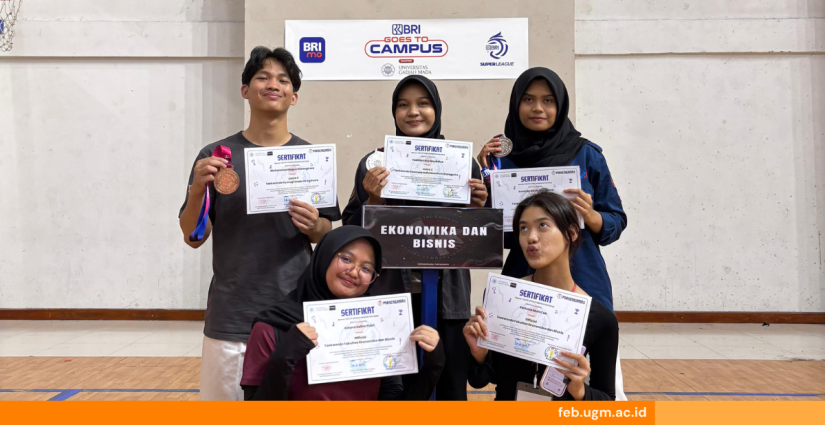
Victory does not come instantly. It grows from consistent training habits, maintaining performance, and the willingness to keep learning. Three students from the Faculty of Economics and Business, Universitas Gadjah Mada (FEB UGM), achieved outstanding results by excelling in taekwondo at the Gadjah Mada Student Sports Week (PORSENIGAMA) 2025.
They are Fadlillah Nur Maulidina (Management 2024), who won 2nd Place in Individual Poomsae Female Category A; Muhammad Bagus Diwangkara (Management 2023), who secured 3rd Place in Kyorugi U-80 Male; and Amanda Nayla Wardhana (IUP Accounting 2025), who achieved 2nd Place in Kyorugi O-73 Female.
Journey in Taekwondo
Fadlillah’s interest in taekwondo began from her habit of watching martial arts movies during junior high school. Her curiosity led her to try it firsthand, and she began training in 2019, when she was in the second year of junior high school. From the outset, her training focused on achievement, and her parents fully supported her.
“At the beginning of registration, the coach asked whether I wanted to train just to fill my free time or to pursue achievements. At that time, my parents fully supported me to train with achievement as the goal, and it was also in line with my own desire,” said Fadlillah.
Meanwhile, Bagus became familiar with taekwondo at a very young age. He developed an interest in the sport during elementary school. His early competition experience helped shape his fighting spirit. What started as a hobby eventually became a serious commitment after he won several championships.
Unlike the other two, Amanda’s journey with taekwondo had a strong family influence. Her father, a former taekwondo and judo athlete, became an inspirational figure who introduced her to martial arts from an early age. Although she had to take an extended break due to academic demands and physical condition, her desire to return to competition never faded.
Challenges
PORSENIGAMA UGM 2025 presented unique challenges, both physical, technical, and mental. For Fadlillah, who was still a first-year student at the time, the biggest challenge was managing time between academic and non-academic commitments amid a demanding lecture schedule. To maintain her condition, she continued independent training when she could not attend practice sessions at the sports hall.
For Bagus, limited training time due to academic workload and projects outside campus became the main obstacle in his preparation. He also admitted that his break from taekwondo since 2020 affected his performance during the competition.
“My biggest challenges in PORSENIGAMA were definitely physical and technical aspects. I could say I was underprepared because I had started getting busy with lectures and other projects, so it was quite difficult to find time to train,” Bagus explained.
Meanwhile, PORSENIGAMA 2025 became a very personal moment for Amanda. After six years without competing, returning to the arena brought significant physical and mental challenges. Achieving second place marked the start of her comeback as an athlete.
Learning Process
For all three of them, achievement is not merely about the final result but part of a continuous learning process. Competing in PORSENIGAMA became a space for reflection, self-evaluation, and character building amid academic demands.
“Winning or losing, everything gives lessons. From this experience, I learned time management, responsibility, and continuously improving myself to grow both as a student and as an athlete,” said Fadlillah.
In line with Fadlillah, Bagus sees PORSENIGAMA as a space to regain the competitive spirit he once left behind. At the same time, Amanda treats every competition as an opportunity to evaluate herself, refine her strategy, and maintain stamina for the future.
The stories of Fadlillah, Bagus, and Amanda show that with discipline, consistency, and a supportive environment, FEB UGM students can maintain balance between academic responsibilities and non-academic interests. The sports arena also becomes a space for growth that enriches their university experience.
Reporter: Dwi Zhafirah Meiliani
Editor: Kurnia Ekaptiningrum
Sustainable Development Goals