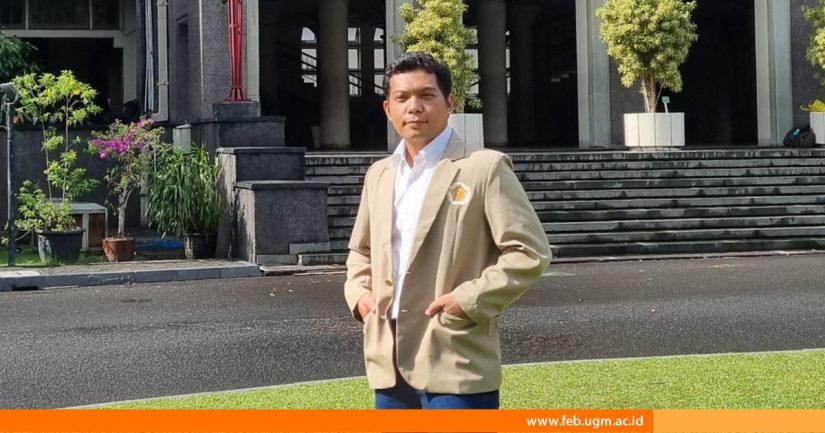
The opportunity to join a double degree program between the Faculty of Economics and Business Universitas Gadjah Mada (FEB UGM) and the University of Glasgow marked a new chapter for Heri Primadona. Behind this achievement, however, lies a long journey that began with his experience working in the fertilizer industry and witnessing Indonesia’s dependence on imported raw materials firsthand, which eventually led him to pursue economics. Today, he is enrolled in the Master of Science in Economics (MSI IE) at FEB UGM and the Adam Smith Business School, University of Glasgow, United Kingdom.
Heri, a member of the 2024 cohort, was accepted into the collaborative program between UGM and the University of Glasgow after his company opened a study assignment pathway for employees through a partnership with UGM. The opportunity did not come easily. He first had to pass a rigorous internal selection process before applying to FEB UGM’s postgraduate program and ultimately being accepted into the double degree scheme.
Heri’s motivation to continue his studies stemmed from his experience working in the fertilizer industry. During his time at PT Pupuk Iskandar Muda, a subsidiary of PT Pupuk Indonesia (Persero), he observed how heavily Indonesia still relies on imported fertilizer raw materials from various countries. This dependence, he realized, is not merely a logistical issue but also a vulnerability that could have far-reaching impacts on society, especially local farmers.
Whenever global disruptions occur, international raw material prices rise sharply. As a result, production costs rise, making fertilizer more expensive and less affordable for farmers.
“When wars occur, logistics routes are disrupted, causing our raw material costs to increase. Eventually, production costs also rise, and fertilizer prices become more expensive, making them difficult for farmers to access,” he explained.
These experiences made Heri realize that Indonesia needs more robust strategies in managing the procurement of strategic raw materials. According to him, effective strategies must be built upon a deep understanding of procurement risks and global economic dynamics. This realization encouraged him to study economics more seriously.
At FEB UGM, Heri chose to concentrate on international economics, which is closely related to the export-import activities in his professional field. Meanwhile, at the University of Glasgow, he will focus on development economics. He believes these two approaches complement one another in addressing real-world issues encountered in the field.
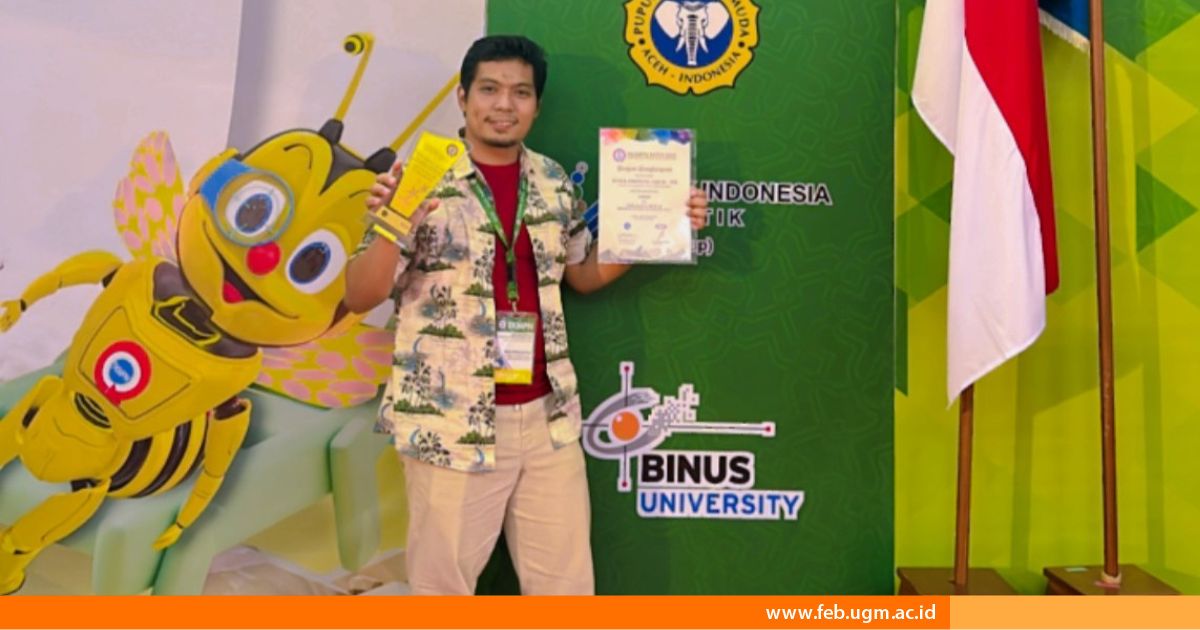
To participate in the double degree program, Heri had to meet the requirements of both institutions. From UGM, he was required to demonstrate strong academic ability with a Graduate Academic Potential Test (TPA) score of around 550 or higher. In addition, English proficiency, as evidenced by an IELTS score of at least 6.5, was also a mandatory requirement.
Regarding funding, Heri received a scholarship from PT Pupuk Iskandar Muda as part of the company’s human resource development program. Other funding opportunities are also available, such as LPDP scholarships, which officially accommodate double degree programs, allowing eligible students to take advantage of such financial support.
“For friends who are interested in joining a double degree program, this is certainly a very valuable opportunity. We can gain international exposure and broader academic experiences. However, preparation is essential, especially in terms of academic capability and English proficiency, as these are among the most important requirements,” he emphasized.
According to Heri, studying at FEB UGM provided him with a strong foundation before continuing his studies in Glasgow. The MSI IE program equipped him with an understanding of economic concepts and theories, knowledge of policy evaluation, and analytical and critical thinking skills.
In the future, Heri plans to apply the knowledge gained from both institutions to develop economic models that analyze import costs and measure supply chain management risks for raw materials. He hopes to formulate concrete policy recommendations to ensure Indonesia has the right instruments to manage strategic industries effectively.
“From there, we will be able to formulate policy analyses and recommendations so that Indonesia can have the appropriate policy instruments to manage strategic industries,” he said.
For Heri, the double degree program is not merely about obtaining an additional degree. He sees it as a pathway to expanding international networks while deepening the analytical capabilities that he hopes to bring back to Indonesia’s industries and policymaking sectors.
“This program is an excellent opportunity to broaden our knowledge, gain more diverse academic experiences, and build international networks. Therefore, prepare yourself well. Every challenge throughout this process can certainly be overcome as long as we maintain commitment and a strong willingness to keep learning,” he concluded.
Reporter: Dwi Zhafirah Meiliani
Editor: Kurnia Ekaptiningrum
Sustainable Development Goals