In the face of mounting global uncertainty driven by trade wars, geopolitical conflicts, and supply chain disruptions, the ability to lead is becoming an increasingly important factor in ensuring business sustainability. Today’s leaders are no longer expected merely to maintain stability, but also to take risks, adapt, and move quickly amid constant change.
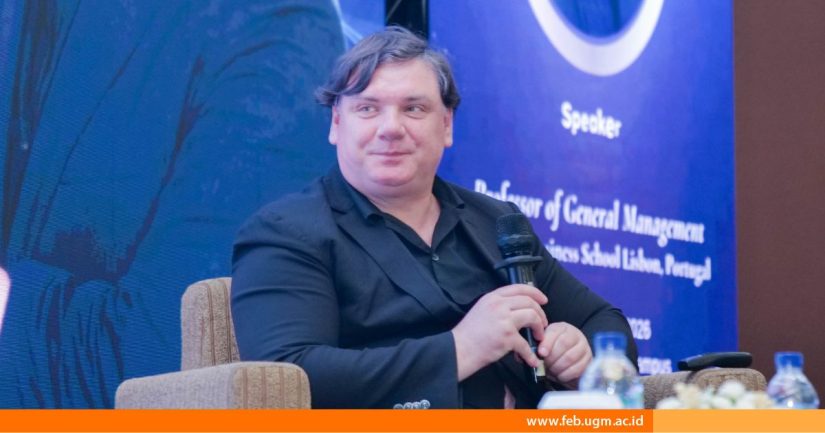
It was conveyed by Renato Pereira, Professor of General Management at ISCTE Business School, during the Executive Series titled Business Beyond Borders: Leading Through Geopolitical Change, organized by MBA FEB UGM Jakarta Campus on Friday (8/5).
According to Renato, business leaders today can no longer operate by avoiding risks; instead, they must learn to confront them. Global uncertainty demands a more adaptive leadership style.
“We need to revive the entrepreneurial spirit. Out of ten strategies launched, perhaps only one will succeed, and that is perfectly normal. The important thing is to learn from the process,” he said.
He emphasized that various business frameworks and theories only serve as supporting tools, not as substitutes for genuine human leadership. In today’s rapidly changing global environment, the ability to understand shifts and make timely decisions has become increasingly crucial.
Renato also highlighted that geopolitical changes not only pose threats but also offer tangible opportunities, particularly for countries in Southeast Asia. He pointed out how the COVID-19 pandemic encouraged many European countries to reduce their dependence on China and actively seek alternative supply chain partners. Using international trade data, he illustrated how China’s market share surged from less than 1% in 1979 to nearly 15% today, surpassing the United States, whose share declined from 11% to 8%. Unfortunately, Indonesia has yet to take on a larger role or show strong ambition in capitalizing on these opportunities.
In his presentation, Renato outlined five major geopolitical trends currently affecting the business world. First, the rivalry between the United States and China in competing for global economic dominance, including influence over international financial systems, technology, and military power. Second, instability in the global financial system, driven by high levels of national debt among major economies and excessive reliance on money printing without sufficient real value backing. Third, the impact of climate change, which increasingly threatens food supply chains and triggers new competition over natural resources. Fourth, “slowbalization,” or the weakening flow of globalization. Lastly, the ‘never normal’ era emerges amid ongoing conflicts, such as the wars in Ukraine, Gaza, and Iran.
“Conflicts continue to escalate without clear resolution, creating permanent uncertainty. This ‘never normal’ condition fundamentally changes the way we formulate business strategies,” he explained.
Meanwhile, Sari Sitalaksmi, Deputy Director of MBA FEB UGM Jakarta Campus, stated that the Executive Series theme Business Beyond Borders: Leading Through Geopolitical Change is highly relevant to the challenges currently faced by business practitioners, including MBA students, most of whom are already active professionals.
“Over the past few months, Indonesia and the world have been facing significant geopolitical turbulence. Our students deeply understand what is happening within their businesses,” she said.
During the event, MBA FEB UGM Jakarta Campus also launched a new concentration, Strategic Leadership, Organizational Design, and Culture, as part of its efforts to strengthen leadership capabilities relevant to global challenges.
Reporter: Suci Hapsari
Editor: Kurnia Ekaptiningrum
Photographer: Alfian Rama Aditya
Sustainable Development Goals