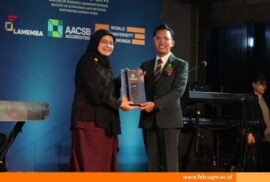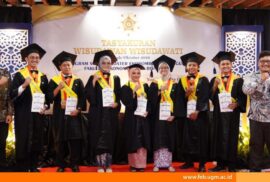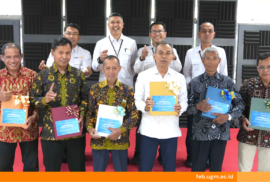
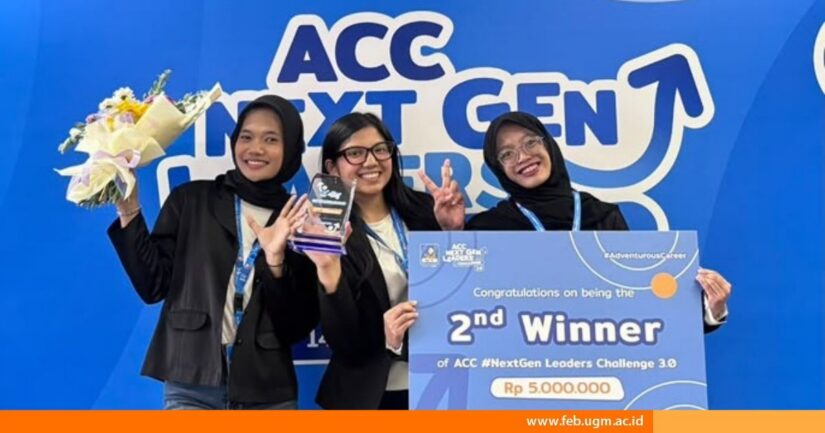
A team of Management students from the Faculty of Economics and Business, Universitas Gadjah Mada (FEB UGM), won second place in the national-level business case competition, ACC Next Gen Leaders Challenge 3.0. Organized by Astra Credit Companies (ACC), the competition took place on August 3–5, 2026, at the Berijalan Office in Yogyakarta.
The achievement was secured by Team IGA Bakar, comprising three Management students from the 2024 cohort: Azzumaraa Akmalia (Management 2024), Sovalia Intan Asri (Management 2024), and Glori E.P.R. Silaban (Management 2024). The team successfully claimed second place after competing against 115 teams from universities across Indonesia.
Azzumaraa explained that the competition challenged participants to develop creative marketing strategies to increase public awareness of ACC Danaku, particularly in Yogyakarta. The challenge stemmed from the prevailing public perception that ACC is primarily associated with car financing services.
During the preliminary round, the team independently conducted research by reaching out to various groups in Yogyakarta, including traders at Beringharjo Market, MSME owners, and residents in Mlati, Sleman. The field research served as one of the foundations for developing marketing strategies tailored to the needs and characteristics of prospective customers. Their efforts successfully secured them a place in the final round.
“In the preliminary round, we submitted a presentation deck containing our problem analysis, proposed solutions, and implementation plan. We were eventually announced as finalists and advanced to compete against four other teams,” Azzumaraa said.
In the final round, they competed against finalists from other universities, including Institut Teknologi Sepuluh Nopember (ITS), Universitas Negeri Surabaya (Unesa), and Universitas Sriwijaya (Unsri).
The journey toward the final judging session was not without challenges. Through mentoring sessions with ACC staff and professionals, the team received feedback that required them to evaluate and refine several aspects of their strategy. They also strengthened the validation of their respondent data despite the limited preparation time.
Azzumaraa explained that the team developed a marketing strategy covering three main aspects: awareness, conversion, and engagement. To increase awareness, they proposed organizing a festival and collaborating with local media. For conversion, the team proposed partnerships with local transportation platforms to reach prospective customers. Meanwhile, the engagement strategy included a customer loyalty program to foster long-term customer relationships.
Throughout the strategy development process, the team also faced challenges in managing their time. Preparing the proposal and developing ideas for the competition coincided with their final examinations. This required each member to set priorities and maintain effective coordination to ensure that the work progressed smoothly.
“Besides having to work on the competition during our final examinations, another challenge we faced was teamwork. We had to put our egos aside, be open to criticism, and challenge each other’s ideas before agreeing on the strategy we wanted to propose,” Glori added.
The three students also encouraged fellow FEB UGM students not to hesitate to participate in competitions, even if they do not succeed on their first attempt. According to them, their experiences from previous competitions provided valuable lessons that helped them evaluate and improve the quality of their ideas and strategies.
“Never be afraid to try anything. If you fail, try again and keep trying until you can come back stronger and achieve what you hope for,” Sovalia concluded.
Reporter: Najwa Anggi Namira
Editor: Kurnia Ekaptiningrum
Sustainable Development Goals