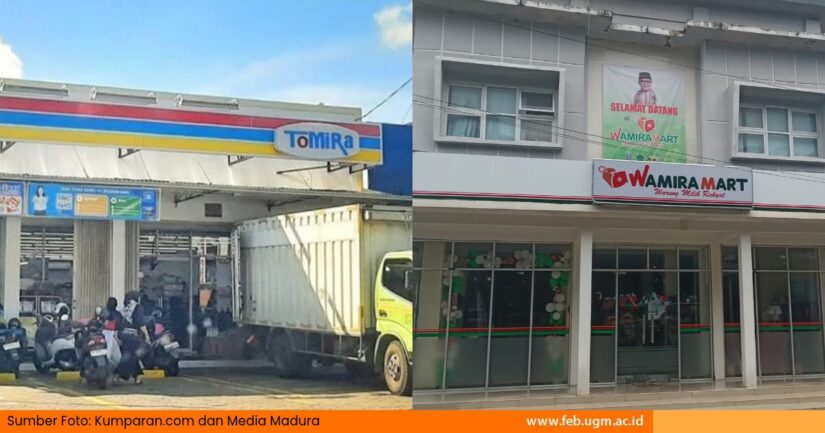
Competition between modern retailers and local businesses poses a challenge to building an inclusive regional economy. Amid the expansion of modern minimarket chains, cooperatives and micro, small, and medium enterprises (MSMEs) need greater market access and policy support to participate in economic activities. One approach is to foster partnerships between large businesses and the people’s economy by strengthening local ownership.
Yogyakarta Mayor dr. H. Hasto Wardoyo, Sp.OG(K), explained that the idea of developing TOMIRA (Toko Milik Rakyat, or People-Owned Stores) originated from concerns that the ownership structure of modern retail chains had yet to provide sufficient opportunities for local communities to benefit from economic activities directly. This condition could potentially lead to capital outflow from the region.
“There was a capital outflow, with money circulating in Kulon Progo being absorbed by chain franchises that were not owned by local communities. In the end, a small group of people accumulated capital from local communities across different regions. I think that is deeply unfair,” Hasto explained during an FEB UGM Podcast episode entitled Can the Local Economy Move Up the Value Chain? Lessons from TOMIRA & WAMIRA.
This issue prompted the Kulon Progo Regency Government to develop TOMIRA through partnerships with modern retail chains. Through TOMIRA, business ownership is expected to become less concentrated among large investors while creating opportunities for cooperatives and local communities to participate in economic activities. Hasto said that one of TOMIRA’s direct benefits for local communities is profit sharing for local cooperatives.
“The direct impact is that local cooperatives become owners and receive continuous monthly profit sharing. In the future, they are expected to become full owners,” he said.
In addition to broadening business ownership, TOMIRA also creates opportunities for local products to enter modern retail networks. Hasto noted that local products can account for up to 20% of the products displayed in stores. These include locally produced rice, eggs, and bottled drinking water.
Unlike TOMIRA, which focuses on retail ownership and market access for local products, WAMIRA was developed in Yogyakarta City with an emphasis on affordable essential goods and inflation control. Given the city’s limited natural resources, the initiative developed by Warung Segoro Amarto provides essential goods as part of efforts to maintain price stability in traditional markets.
The development of WAMIRA also involves Koperasi Kelurahan Merah Putih (Red and White Urban Village Cooperatives).
According to Hasto, cooperatives serve as the foundation for the ownership and management of these stores, ensuring that the economic benefits return to local communities. He added that WAMIRA has begun operating in four districts in Yogyakarta City.
In its implementation, the government also seeks to provide special access for low-income communities. This approach is expected to strengthen WAMIRA’s role as an instrument to ensure the affordability of essential goods while expanding the economic benefits generated by cooperatives.
Meanwhile, FEB UGM Department of Management lecturer Dr. Sahid Susilo Nugroho, M.Sc., views TOMIRA as a strategy to broaden the participation of local businesses without directly confronting large corporations. He explained that modern retail companies can continue operating while cooperatives are given opportunities to participate in business ownership.

Sahid noted that the policies implemented through TOMIRA offer two main benefits: expanding economic ownership among local communities and opening market access for locally produced goods. Local products that previously struggled to enter modern retail markets now have opportunities to compete alongside national and global brands.
Sahid views WAMIRA as a form of economic safety net. A network of cooperative-owned stores can help communities obtain essential goods at reasonable prices during periods of market distortion.
“WAMIRA functions as a kind of economic safety net. When there are distortions in the market, people, particularly low-income communities, still have a place where they can obtain essential goods at reasonable prices,” he explained.
The development of WAMIRA also involves Koperasi Kelurahan Merah Putih. According to Hasto, cooperatives form the basis of the ownership and management of these stores so that the economic benefits can flow back to the community. He said that WAMIRA has begun operating in four districts in Yogyakarta City.
In its implementation, the government also seeks to provide special access for low-income communities. This approach is expected to strengthen WAMIRA’s role as an instrument to support the affordability of essential goods while expanding the benefits of a cooperative-based economy.
Sahid explained that TOMIRA and WAMIRA have different orientations but can complement one another. TOMIRA seeks to broaden local economic ownership and market access for regional products, while WAMIRA aims to maintain the affordability of essential goods for the community.
According to Sahid, local governments play an important role in creating a business environment that enables local economic actors to grow. Various regulatory instruments, including operating hours, product categories, and licensing requirements for modern retailers, have been used by local governments to address competition between modern retailers and traditional businesses.
However, he noted that implementing such policies is not always easy. Therefore, partnership models such as TOMIRA can serve as an alternative approach to expanding local economic participation without relying entirely on restrictions on large businesses.
“Regulatory courage alone is not enough. It must be accompanied by efforts to build the economic capacity of local communities simultaneously. Otherwise, the regulations will become a paper tiger,” Sahid said.
He also emphasized that MSMEs need to continuously improve their ability to leverage technology, develop digital marketing strategies, and manage their businesses independently.
Through TOMIRA and WAMIRA, strengthening the local economy requires collaboration among governments, academia, businesses, cooperatives, and communities. The success of these approaches depends not only on regulations but also on the ability to build a productive, inclusive, and sustainable business ecosystem.
The FEB UGM Podcast episode entitled Can the Local Economy Move Up the Value Chain? Lessons from TOMIRA & WAMIRA is available at: http://ugm.id/BelajarDariTomiraWamira.
Reported by: Dwi Zhafirah Meiliani
Editor: Kurnia Ekaptiningrum
Sustainable Development Goals