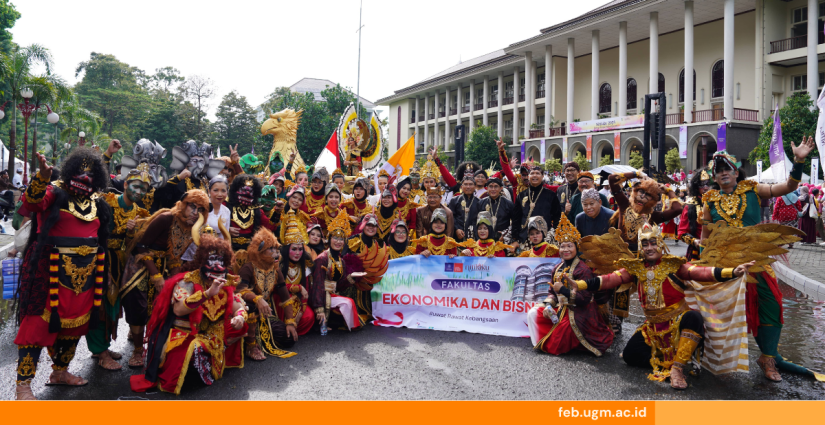
The Faculty of Economics and Business, Universitas Gadjah Mada (FEB UGM), participated in the Nitilaku series of events organized by Universitas Gadjah Mada as part of the university’s anniversary (Dies Natalis) commemoration on Sunday (14/12/2025). Carrying the theme “Wongsa Tumuwuh Saking Bhuvana”, FEB UGM presented a cultural parade rich in meaning, reflecting the relationship between humanity, nature, and civilization.
The Nitilaku Cultural Parade 2025 began at Wisma MM UGM and concluded at Balairung UGM. This parade is an annual tradition held to welcome UGM’s Dies Natalis, featuring cultural processions by members of the UGM academic community and alums.
The Vice Dean for Academic and Student Affairs of FEB UGM, Bayu Sutikno, S.E., M.S.M., Ph.D., expressed his appreciation to the FEB UGM Nitilaku parade team for their participation in enlivening Nitilaku 2025. This year’s parade featured approximately 100 professional staff members, lecturers, and alums. Despite the rainy weather, the FEB UGM team carried out the parade with great enthusiasm and joy.
“The Nitilaku momentum for us is not merely an annual ritual, but always serves as a reminder and reinforcement of our spirit to provide the best education for the sons and daughters of the nation from all corners of Indonesia and several partner countries,” he explained.
In the FEB UGM Nitilaku Cultural Parade, the team presented a dance parade aligned with the theme “Wongsa Tumuwuh Saking Bhuvana.” The Coordinator of the FEB UGM Nitilaku Cultural Parade, Kurnia Ekaptiningrum, explained that through this parade, FEB UGM invited the public to reflect on the idea that human civilization grows and develops from nature. Therefore, nature must be cared for and preserved in a sustainable manner.
FEB UGM’s participation in Nitilaku, she continued, was not only a form of cultural preservation but also a manifestation of the faculty’s commitment to supporting local wisdom values that align with UGM’s spirit as a people-oriented and culturally rooted university. This activity also served as a space for togetherness among the academic community to celebrate UGM’s identity and its long journey in nation-building.
The Nitilaku cultural parade took place festively and received enthusiastic responses from the academic community and the public along the parade route. The presence of FEB UGM at this event aims to reinforce the faculty’s role within the UGM ecosystem, which promotes a culture of sustainability and community service.
Report: Shofi Hawa Anjani
Editor: Kurnia Ekaptiningrum
Sustainable Development Goals