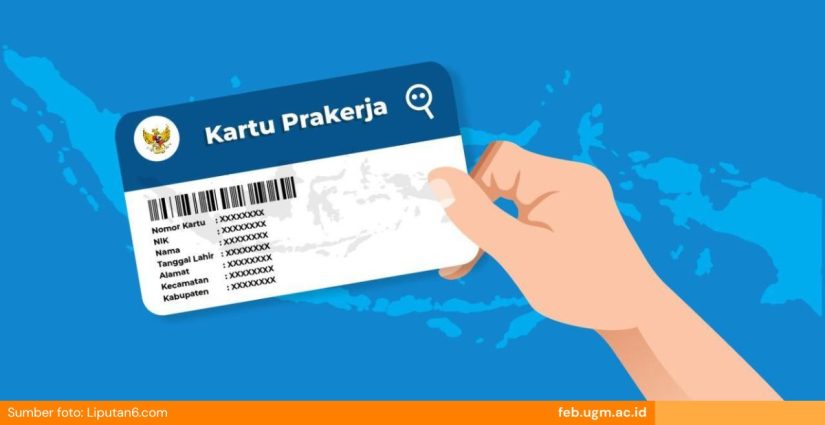
Since its launch, the Pre-Employment Card (Kartu Prakerja) Program has become one of the government’s flagship policies aimed at improving workforce skills while maintaining people’s purchasing power. However, how effective is this program in increasing income and creating employment opportunities?
Fauzan Ghazi Alauddin, an alumnus of the Master of Science in Economics (MSI IE) at the Faculty of Economics and Business, Universitas Gadjah Mada (FEB UGM), examined this question in his thesis research. He evaluated the impact of participation in the Pre-Employment Card Program on income and employment probability using data from the National Labor Force Survey (SAKERNAS) in 2021 and 2022.
In his study, Fauzan employed the Instrumental Variable (IV) method. This approach was chosen to address potential endogeneity bias in the research model, thereby enabling more accurate estimation of the program’s impact.
The findings show that overall participation in the Pre-Employment Card Program increased productivity by 5.4 percent. However, the programme had little impact on whether someone got a job.
“In theory, when skills and capacity increase, labor productivity should also rise. Two main aspects should be considered: higher income and greater employment opportunities,” Fauzan explained during the program 3 Minutes Thesis: Program Prakerja: Does It Really Increase Income and Job Opportunities? aired on the FEB UGM YouTube channel.

When examined in more detail, the income increase varies across regions and economic sectors. Outside Java and Bali, productivity increased by 5.1 percent. In the primary sector, such as agriculture and mining, productivity rose by 8.9 percent. Meanwhile, in the secondary sector—covering industry, electricity, gas, and construction—productivity increased by 27.5 percent.
“However, in terms of employment opportunities, the impact is more noticeable in Java and Bali, with an increase of around 3.6 percent,” he added.
According to Fauzan, the Pre-Employment Card Program is effective in increasing income but has a limited impact on employment opportunities. Data from Statistics Indonesia (BPS, 2022) recorded that 11.53 million people were affected by COVID-19 in the labor market, either through job losses or reduced working hours. This situation led to an oversupply of labor, skill mismatches, and economic slowdown, all of which constrained the creation of new job opportunities.
The full video of the 3 Minutes Thesis: Program Prakerja: Does It Really Increase Income and Job Opportunities? can be accessed at: http://ugm.id/BenarkahMeningkatkanPendapatanPeluangKerja
Report: Kurnia Ekaptiningrum
Sustainable Development Goals