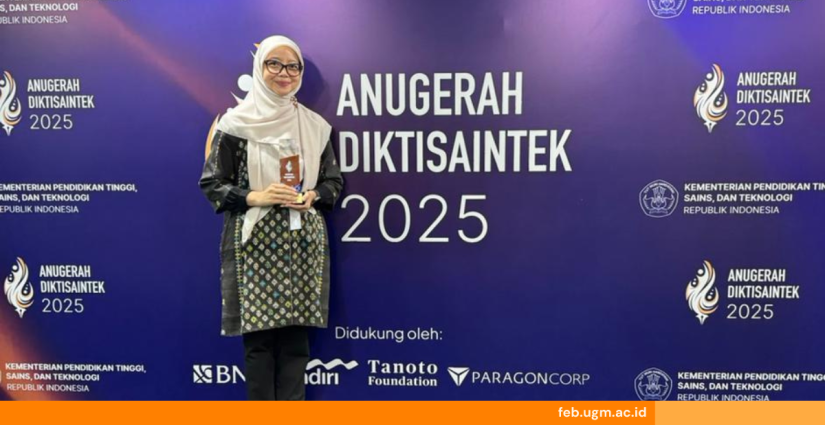
A lecturer of the Department of Accounting, Faculty of Economics and Business, Universitas Gadjah Mada (FEB UGM), Fitri Amalia, Ph.D., has been awarded the Best Young Scientist in Social Humanities Innovation at the 2025 Diktisaintek Awards. The award ceremony took place as part of the Diktisaintek Awards series, held from Thursday, 18 December, to Saturday, 20 December 2025, at Graha Dikti, located on the second floor of the Ministry of Higher Education, Science, and Technology (Kemdiknas) in Jakarta.
Fitri Amalia received the award in recognition of her contributions and achievements in producing social humanities innovations that have had a tangible impact on society. She received recognition for her successful integration of research, technology, and community service into various strategic initiatives. Two major innovations that led to this achievement are the development of the Debit-Credit Information System – Enterprise Resource Planning (SIDEK-ERP) application and the Gadjah Mada Digital Transformation Governance Index (GM-DTGI).
SIDEK-ERP Supports MSME Digitalization
SIDEK-ERP strengthens financial inclusion for micro, small, and medium enterprises (MSMEs) while enhancing digital accounting literacy among secondary and higher education students. The application has been developed since 2023 by a team of lecturers, research assistants, and developers from the Information Systems Research Group (BKSI), FEB UGM, with support from corporate partner Coca-Cola Europacific Partners (CCEP).
To date, more than a thousand users across various regions in Indonesia, including MSME actors, students, and university learners, have used the application and provided positive feedback.
Fitri explained that the application’s purpose is to help MSMEs prepare financial reports practically and efficiently, even if they do not have a strong accounting background. It is expected that SIDEK-ERP will improve the quality of MSME business management, supporting operational performance and business growth while enhancing digital accounting literacy in the learning process.
“The SIDEK-ERP application was developed to provide solutions to various business and financial management challenges faced by MSMEs, as well as to support digital accounting education at the senior high school/vocational school and university levels,” she explained.
Fitri further emphasized that MSMEs play a vital role in Indonesia’s economy, contributing significantly to the Gross Domestic Product (GDP) and absorbing employment. However, despite the growing number of MSMEs, many still face complex challenges, particularly the lack of modern business management systems, especially digital financial reporting.
One of the impacts of limited implementation of business management systems and technology is restricted access to formal financing, as many MSMEs struggle to access funding due to unstructured and non-transparent financial reporting that is still conducted manually.
“Enterprise Resource Planning (ERP) is one of the information systems that can help MSMEs overcome these challenges by integrating various business functions such as finance, production, marketing, and inventory management—into a single platform,” she explained.
By adopting ERP systems, MSMEs can enhance operational efficiency, minimize administrative errors, and expedite data-driven decision-making. Furthermore, ERP systems enable MSMEs to generate accurate and real-time financial reports, which are a key requirement for gaining the trust of financial institutions, such as banks and investors. From an educational perspective, SIDEK-ERP was also developed to address the lack of accessible and affordable digital learning applications for accounting and ERP.
GM-DTGI Strengthens Digital Transformation Governance in Local Governments
Meanwhile, the Gadjah Mada Digital Transformation Governance Index (GM-DTGI) was developed in collaboration with lecturers and assistants from BKSI FEB UGM as an instrument to measure and strengthen digital transformation governance in district and municipal governments across Indonesia. The index serves as a strategic reference for local governments in formulating more targeted, transparent, and sustainable digital transformation policies, and has involved hundreds of local governments across the nation.
Fitri explained that GM-DTGI aims to encourage improvements in digital transformation governance within local governments. GM-DTGI is an innovative index designed to assess the performance of digital transformation in district and city governments. With support from FEB UGM and the Ministry of Communication and Digital Affairs of the Republic of Indonesia, the instrument was developed to evaluate the implementation of Electronic-Based Government Systems (SPBE) and other digital innovations adopted by local governments throughout Indonesia.
Unlike existing digital indices such as the Digital Government Readiness Assessment (DGRA), the GovTech Maturity Index, the OECD Digital Index, and the IMD World Digital Competitiveness Index, which focus on national-level assessments GM-DTGI is the first index specifically designed to measure digital transformation governance at the district and municipal levels.
“GM-DTGI serves as a strategic instrument to assess readiness and implementation of digital transformation governance in district and municipal governments across Indonesia. The assessment uses 50 comprehensive indicators to provide data-driven evaluations and strategic guidance for enhancing digital effectiveness, efficiency, and transparency,” she elaborated.
GM-DTGI is built upon seven main pillars: Governance and Leadership, Regulations and Policies, Public Administration Reform and Change Management, Data Governance, Digital Ecosystem, User-Centered Platform Design, and Cybersecurity and Privacy.GM-DTGI data is sourced from official government websites, institutional verification, and reputable online sources. A total of 497–508 district and municipal governments participated in the 2024 and 2025 assessment processes, which involved direct clarification mechanisms with local governments and teams of enumerators.
Impact on Society
Fitri expressed that the achievement would not have been possible without the support of FEB UGM, Prof. Sony Warsono, MAFIS., Ak., CA., Ph.D., the SIDEK-ERP Project Management Office (PMO) team, the GM-DTGI research team, Prof. Syaiful Ali, MIS., Ph.D., Ak., CA., and the Information Systems Research Group (BKSI) FEB UGM. This accomplishment motivates her to continue developing research and innovations that generate tangible social impact.
She shared that her most excellent satisfaction from developing SIDEK-ERP and GM-DTGI comes from witnessing how the technologies bring about real change not only within academic settings but also in the daily practices of MSME actors, students, and local governments.
For example, MSME owners have shared that, for the first time, they can understand their own financial reports. Similarly, a vocational high school student from Teluk Bintuni confidently presented ERP business processes from a Teaching Factory project in an MSME as part of their learning outcomes. Local governments have also stated that GM-DTGI results help them prioritize digital transformation initiatives in a more structured manner.
“These positive outcomes and testimonials convince me that knowledge, research, and collaboration can truly create social impact. My greatest pride lies not only in the systems or indices developed, but in the growth of capacity and independence among application users and all parties involved in the process of change and social contribution,” she concluded.
The Diktisaintek Awards are an annual agenda organized by the Ministry of Higher Education, Science, and Technology to recognize outstanding academics across various fields. Fitri Amalia’s achievement further reinforces FEB UGM’s commitment to promoting research and innovation that has a societal impact and makes meaningful contributions to national development.
Reported by: Kurnia Ekaptiningrum
Sustainable Development Goals