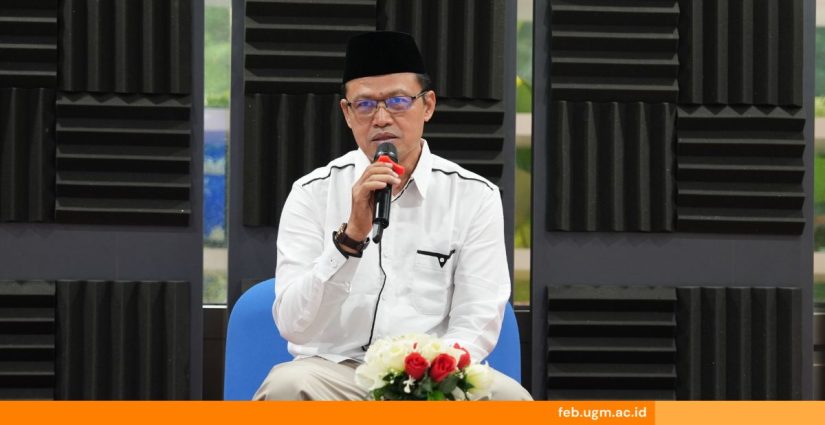
Ramadan is often described as a spiritual school where individuals train their souls and hearts to reflect and strengthen spiritual values in daily life. Through fasting, people learn to let go, purify themselves, and deepen their faith. Edy Musoffa, S.Ag., M.H.I., from the Da’wah Commission of the Indonesian Ulema Council (MUI) of the Special Region of Yogyakarta, explained that fasting contains several important lessons for Muslims. One of them is the lesson of sincerity.
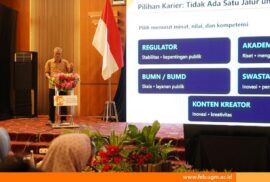
“Fasting is an act of worship that cannot be displayed or shown off. Only Allah SWT and ourselves truly know whether we are fasting. Therefore, fasting trains us to be sincere not because we want to be praised by others, but solely for the sake of Allah SWT,” he said during a Ramadan iftar lecture held at FEB UGM, attended by the FEB UGM academic community on Friday (13/3/2025).
Edy Musoffa added that fasting teaches people to purify themselves from negative traits, a process often referred to as tazkiyatun nafs. Ramadan is the right time to control various negative tendencies in humans, such as arrogance, envy, jealousy, and greed.
Arrogance can arise from many things, such as knowledge, position, or wealth. Edy Musoffa likened arrogant people to a young coconut tree, standing tall and straight. Meanwhile, knowledgeable and wise individuals are like rice plants—the fuller they grow, the more they bow.
He further explained that fasting also serves to improve the quality of worship, for instance, by maintaining the five daily prayers, performing additional voluntary prayers, observing the tarawih prayer, reading the Qur’an, and increasing supplications.
In the remaining days of Ramadan, he encouraged the FEB UGM academic community not only to refrain from eating and drinking but also to enhance their worship and maintain balance between physical and spiritual well-being. It hopes that, through this process, every Muslim will emerge from Ramadan as a better person with a purer heart and stronger devotion to Allah SWT.
Report: Shofi Hawa Anjani
Editor: Kurnia Ekaptiningrum
Sustainable Development Goals