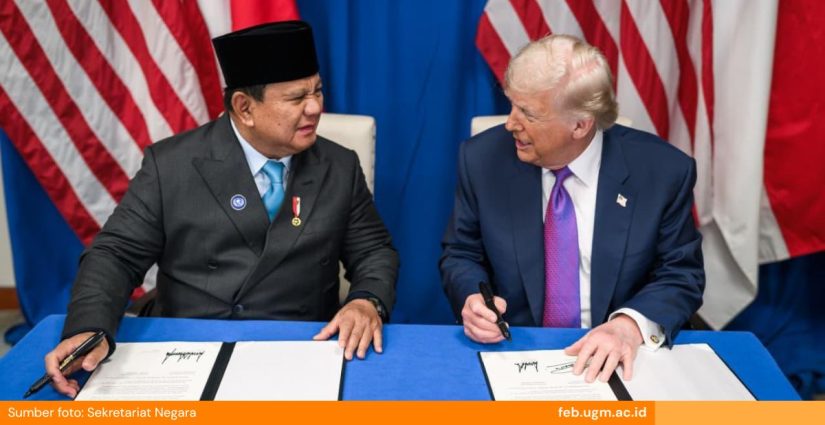
Economist from the Faculty of Economics and Business, Universitas Gadjah Mada (FEB UGM), Rimawan Pradiptyo, Ph.D., has highlighted the potential economic impacts of the Agreement on Reciprocal Trade (ART) between Indonesia and the United States, signed on February 19, 2026. According to him, the implications of this agreement need to be assessed comprehensively. One analytical approach is the Regulatory Impact Assessment (RIA) to understand the short- and long-term consequences of such agreements or policies on the national economy.
Rimawan emphasized that, ideally, the RIA should be conducted by the government before and during the ART negotiation process. However, academics only gained access to the agreement document after it was signed and published on the official website of the United States government.
“As economists, we can still conduct RIA analysis while waiting for the government’s consultation process with the House of Representatives,” he explained.
Tendency Toward Asymmetry
Rimawan explained that the Preamble of ART emphasizes sovereignty, economic prosperity, and supply chain resilience. The agreement is designed to enhance mutual benefits through trade and investment relations, including the reduction of tariff and non-tariff barriers.
Nevertheless, he noted that the main provisions of the ART contradict its Preamble. The agreement is considered asymmetrical, with the greater burden falling on Indonesia while most of the benefits are enjoyed by the United States.
“If the Agreement on Rules and Procedures for the Settlement of Disputes (ART) comes into effect, Indonesia could face potential lawsuits from other countries through the World Trade Organization (WTO), as well as possible retaliation from third countries,” said the lecturer from the Department of Economics at FEB UGM.
He added that this imbalance also manifests in the agreement’s clauses. The United States has four safeguard clauses, while Indonesia lacks equivalent protective mechanisms. This condition may increase both economic and legal risks, including potential disputes through the World Trade Organization (WTO).
Risk of Legal Violations
Rimawan also warned of potential violations of several provisions of the 1945 Constitution, indicating the need for regulatory adjustments at the national level. These adjustments could involve various legal instruments, ranging from laws to technical regulations issued by relevant authorities.
“There is a risk of violating five articles of the 1945 Constitution, not including Article 11, and potential violations of the Preamble. In addition, amendments to, and the formulation of, new laws, government regulations, presidential regulations, and financial authority policies will require amendments,” he added.
In his analysis, Rimawan used a game theory approach to understand the negotiation dynamics of ART. Ideally, when two countries are in equal positions, negotiations follow a Nash bargaining framework with a simultaneous move pattern. However, the negotiation process in this case resembles an ultimatum game, where one party holds a more dominant bargaining position.
“With such asymmetrical burdens, this reflects an ultimatum game scenario in which the United States acts as the leader and Indonesia as the follower. In this interaction pattern, the United States has a stronger bargaining position compared to Indonesia,” he explained.

Rimawan pointed out several provisions in the ART that place burdens on Indonesia, including a) the obligation to facilitate the purchase of goods from the United States, b) the adoption, harmonization, or subordination to US regulations, c) open-ended obligations (blank check obligations), and d) restrictions on domestic economic policies.
He cited Article 6.4, which requires the government to facilitate companies’ purchases of goods from the United States. The issue, however, is that the government cannot fully control private companies’ purchasing decisions. It is further complicated by restrictions on the role of state-owned enterprises (SOEs) as agents of development, as stipulated in Article 6.2.
“There is one provision I find difficult to model, namely Article 6.1(3), which requires Indonesia to open employment opportunities and investment in the United States. Job creation and investment in the US are the responsibility of the US government. If Indonesia is required to open jobs and investment in the US, I do not know how to model this in game theory,” he remarked.
Another concern lies in Articles 5.1 and 5.2, which involve the transmission of US policies to third countries through Indonesia. In other words, Indonesia may act as an extension of US policy toward third countries. Consequently, Indonesia’s long-standing free and active foreign policy, along with its historical role as the initiator of the Non-Aligned Movement and the 1955 Asian-African Conference in Bandung, would be undermined by the implementation of ART.
Furthermore, Article 5.3 grants the United States veto power over any new Free Trade Agreements (FTAs) that Indonesia intends to establish. It means that any planned FTA with other countries must receive US approval. Without such approval, Indonesia may be forced to cancel or withdraw from these agreements, potentially triggering retaliation from partner countries and weakening Indonesia’s position in international trade relations.
Mercantilist Doctrine
In a broader context, Rimawan views ART as part of a resurgence of mercantilist practices that were prominent in international trade during the 16th to 18th centuries. He argues that unilateralism is being applied under the Trump administration, even though the global system has operated based on multilateralism for more than 80 years. This shift signals a move from voluntary trade principles toward coercive trade practices.
“This phenomenon reminds us of mercantilist practices in the past. In 1614, the Governor-General of the Dutch East Indies, Jan Pieterszoon Coen, said, ‘No trade without war, no war without trade.’ It is the approach being used by Trump,” he explained.
The Cost of Sovereignty
In a historical reflection, Rimawan also linked these dynamics to Indonesia’s early post-independence experience, particularly after the Dutch recognized Indonesia’s sovereignty on December 27, 1949. At that time, Indonesia had to bear significant economic consequences under agreements reached at the Round Table Conference (RTC), including the obligation to repay the Dutch East Indies government’s debt of 4.5 billion guilders (approximately US$1.12 billion), which was fully repaid only in 2003.
In addition, many of Indonesia’s strategic economic policies, including nationalization efforts, required consultation and approval from the Dutch authorities. Dutch companies were also allowed to continue operating and freely repatriate their profits.
Rimawan emphasized that this historical lesson should serve as a reminder for Indonesia to exercise greater caution in negotiating and entering international agreements, ensuring that national sovereignty and economic interests are not compromised.
“In my view, paying war reparations under the RTC was more rational because it ultimately led Indonesia to full sovereignty. The issue with ART is that it was signed without war or a debt crisis, yet it transforms Indonesia’s position from a sovereign state into a subordinate one,” he concluded.
Reportage by: Kurnia Ekaptiningrum
Sustainable Development Goals