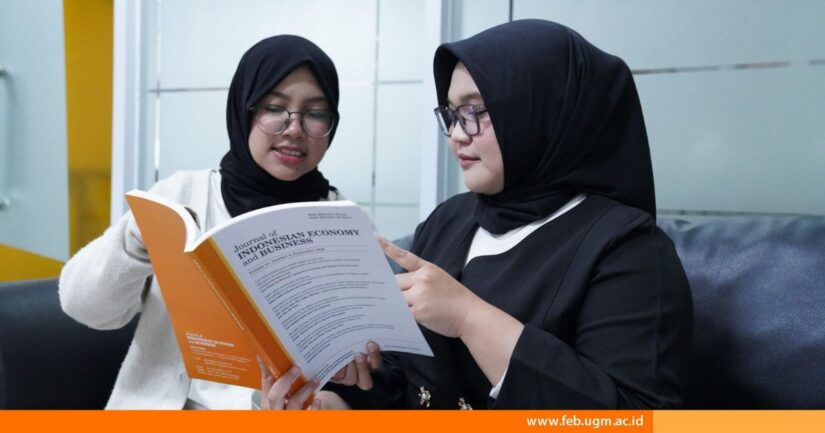
The Journal of Indonesian Economy and Business (JIEB), published by the Faculty of Economics and Business, Universitas Gadjah Mada (FEB UGM), has achieved a Q2 ranking in Scopus CiteScore. This achievement reflects the journal’s continuous improvement in quality and its growing international reputation.
JIEB Associate Editor, Muhammad Ryan Sanjaya, Ph.D., explained that the improvement in ranking goes hand in hand with efforts to enhance the quality of published articles. Each manuscript undergoes a rigorous editorial and review process, with particular attention to its novelty and strong theoretical and scholarly contributions.
“This achievement serves as an encouragement for us to improve JIEB’s quality continuously. The higher ranking not only reflects the journal’s quality but also helps strengthen authors’ confidence in JIEB as a platform for scholarly publication,” he said.
Ryan further explained that one of the key stages in maintaining publication quality is the editors’ pre-review process. At this stage, editors conduct an initial assessment of each manuscript’s suitability and scholarly contribution before forwarding it to reviewers. This ensures that the review process is more focused and that published articles meet the expected academic standards while offering meaningful scholarly contributions.
The quality of journal management is also strengthened by the diversity of its editorial team, which comprises editors from various countries with different academic backgrounds and areas of expertise. This composition broadens academic perspectives while reflecting JIEB’s international academic network.
Furthermore, Ryan noted that maintaining publication quality presents challenges, particularly in the review process, which can take considerable time. Thorough evaluation is essential to ensure that every published article meets high standards of quality and provides sufficient scholarly contributions.
To address this challenge, JIEB seeks to expand its reviewer network, including by engaging early-career researchers with experience publishing in international journals. This initiative is expected to maintain a balance between article quality and the efficiency of the review process.
In addition, JIEB continues to develop strategies to increase the journal’s visibility and attract a wider pool of high-quality authors. One such strategy involves collaborating with various academic conferences as a journal partner. These collaborations provide opportunities for JIEB to expand its exposure while attracting high-quality manuscripts.
“Through these collaborations, we hope JIEB will gain wider exposure and create more opportunities to attract high-quality articles,” he explained.
Looking ahead, JIEB aims to achieve a Q1 ranking within the next five years. This target builds on the progress made over the past five years, during which JIEB successfully improved its position from Q4 to Q2.
“To achieve this target, we will implement various programs focused on improving the journal’s quality. Ultimately, we hope JIEB will continue to develop, supported by an editorial team with increasingly strong academic reputations and standing,” he said.
Beyond improving its ranking, JIEB aspires to strengthen its reputation beyond UGM and Indonesia. With the support of an editorial team with strong academic credentials and international networks, JIEB is expected to grow into a scholarly publication increasingly recognized and valued by the international academic community.
Reportage: Shofi Hawa Anjani
Editor: Kurnia Ekaptiningrum
Sustainable Development Goals