Today, social media is closely intertwined with most people’s daily lives. We often encounter various phenomena related to their use across fields, ranging from professional motives in job searches to personal motives in mate searches. In using social media, it is undeniable that people tend to judge others based on what they post. This has also become an inspiration to dig deeper into the self-presentation strategies of social media users to secure positive reviews from other users.
Inspired by this phenomenon, a study was conducted, and the results were presented during the MD REFO Webinar on Friday (10/12). MD REFO is a webinar aimed at scientific development, held periodically, with presenting lecturers from the FEB UGM. This 1st REFO MD Webinar featured Widya Paramita, M.Sc., Ph.D., as the presenter, with the discussion title “Don’t Judge a Person by His/Her Social Media Account: Self-Presentation Strategy Through Social Media,” which increased insight and knowledge in the field of marketing.
This research examines the conditional factors that influence variations in the effectiveness of the humblebragging strategy. Humblebragging is objectively a violation of norms, but the researcher wants to determine when it is acceptable and when it is not. The research method used an experimental design involving influencers (individuals with lower social status) and celebrities (individuals with higher social status), with participants engaging in humble bragging or direct bragging.
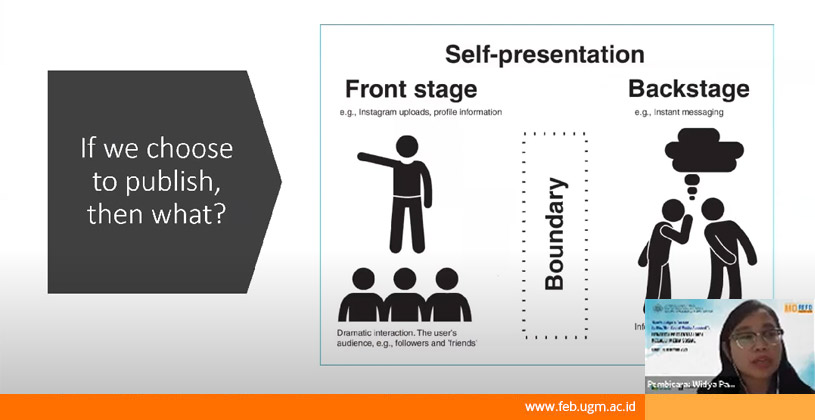
Based on Widya’s presentation, a self-presentation strategy is a person’s effort to manage other people’s impressions because, in general, people want to be perceived positively by others. There are various categorizations of self-presentation strategies; one example is bragging and humblebragging, which are the main topics of research. Humblebragging is a self-presentation strategy that masks the intention to brag by presenting oneself in a humble way. Humblebragging is seen as effective at promoting positive aspects, but it also creates negative perceptions. In fact, the research by Sezer, Gino & Norton (2018) found that overt bragging was rated more positively than humblebragging.
The conclusion of his research: although, in general, humblebragging is considered negative, social users rate it more positively when done by celebrities than by influencers. People think it’s perfectly natural for influencers to brag openly to increase their status. In fact, when they do humble bragging, they are judged as less grateful or incompetent, which can cause anger (irritation) among other social media users.
Reportage: Kirana Lalita Pristy/Sony Budiarso.