

Since its launch, the Pre-Employment Card (Kartu Prakerja) Program has become one of the government’s flagship policies aimed at improving workforce skills while maintaining people’s purchasing power.

Efforts to alleviate poverty have largely relied on consumption- or income-based measurements.

The development of the mining industry often plays a key role in driving regional economic growth.
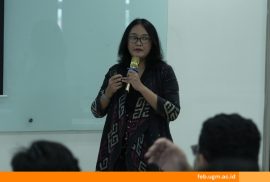
Access to part-time formal childcare plays a vital role in increasing women’s labor force participation in Indonesia, particularly for mothers with preschool-aged children.
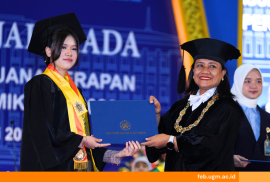
It had never crossed Cynthia Fransisca’s (22) mind that she would become the best graduate of the Faculty of Economics and Business, Universitas Gadjah Mada (FEB UGM).
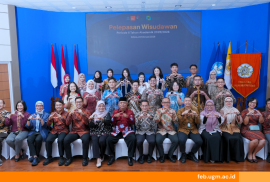
The Faculty of Economics and Business, Universitas Gadjah Mada (FEB UGM), graduated 54 undergraduate students in the Graduation Period II of Academic Year 2025/2026.

The digital transformation of Indonesia’s taxation system has entered a new phase with the introduction of Coretax, a platform envisioned as a “central hub” integrating all tax administrative services into a single system.
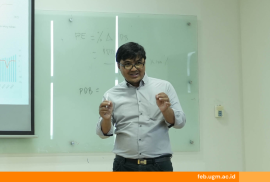
The Indonesian government has expressed optimism about achieving a national economic growth target of 8 percent.
By: Wisnu Setiadi Nugroho
Department of Economics, FEB UGM
Head of Poverty and Inequality Alleviation Studies (EQUITAS)
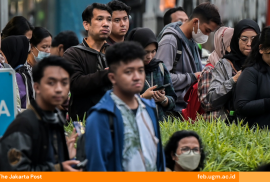
The number may seem small: a decline of 1.2 million people in a year.
Can we help you?