
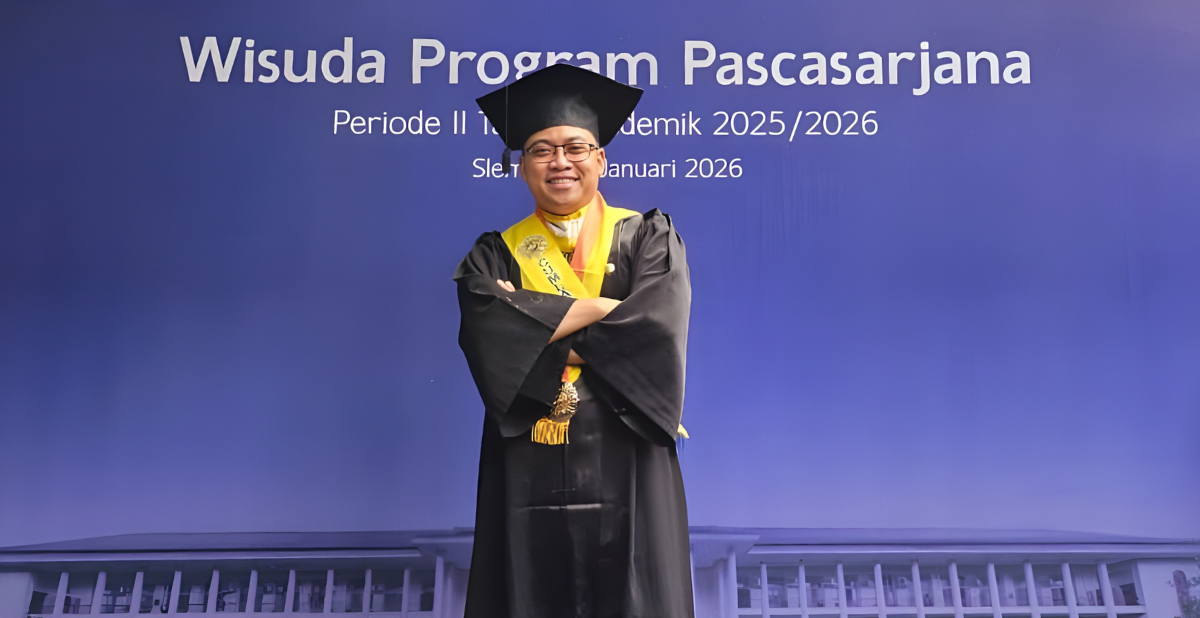
A long career in the business world did not stop Zaki Permana (38) from returning to the classroom. He successfully made history as the first and best graduate of the Sustainability Management concentration in the Master of Management Program, Faculty of Economics and Business, Universitas Gadjah Mada (MM FEB UGM), achieving an almost perfect Grade Point Average (GPA) of 3.98. This accomplishment reflects not only academic excellence but also Zaki’s strong commitment to advancing sustainability values.
Before pursuing his studies at MM FEB UGM, Zaki had been actively involved in the business sector since 2015, with a primary focus on business-to-government (B2G) activities. He manages several business entities engaged in procurement, human resource development, software development, non-construction consulting, and financial consulting. These professional activities provided him with solid practical experience while also leading him to recognize the limitations of business practices driven mainly by intuition.
This realization became a turning point that motivated Zaki to return to academia. He felt the need to reorganize intuitive business practices into a more systematic and sustainable conceptual framework. The MM FEB UGM programme is a learning space that combines real-world experience with analytical rigour and a solid scientific basis.
“Previously, I ran my business mostly based on instinct. When I entered the academic environment at FEB UGM, I began to understand the bigger picture of why decisions are made, what the risks are, and how they impact the long term,” he explained.
After officially enrolling as an MM UGM student in 2023, Zaki encountered a learning experience that differed from his initial expectations. A learning process that demanded in-depth analysis, extensive reading of scientific literature, and intensive class discussions turned out to be something he truly enjoyed. This academic environment gradually shaped a more critical and systematic way of thinking.
“I do not come from an economics background. However, at MM FEB UGM, I found enjoyment in reading journals, engaging in discussions, and completing assignments that reshaped the way I think,” he said.
To strengthen his academic foundation, Zaki participated in a matriculation program, focusing on finance and management. Academic challenges ranging from the heavy reading load in scientific journals to the demand for in-depth analysis made the adaptation process far from easy. Over time, however, these challenges became one of the aspects he appreciated most in his academic journey.
During his time at MM FEB UGM, Zaki played an active role as one of the initiators in establishing the Sustainability Management concentration for the Senior Executive class. Upon learning that the concentration was not yet available, he proposed the idea to the program management. The proposal was subsequently accepted, opening new opportunities for the development of sustainability studies within MM FEB UGM.
“In my view, sustainability is not only about environmental issues, but also about business continuity, social welfare, and the direction of future development. That is why I believe this concentration is important to be offered, especially for students who are actively engaged in business practices,” he explained.
Throughout the concentration, Zaki’s learning extended beyond the classroom. He was involved in various initiatives, including early-stage communication with local governments, representatives of international institutions, and policy stakeholders related to strengthening the Sustainable Development Goals (SDGs) agenda. These experiences deepened his understanding that sustainability issues cannot exist in isolation from cross-sector collaboration.
For his final thesis, Zaki explored the topic titled “Analysis of Critical Success Factors of the Lumbung Mataraman Project in the Special Region of Yogyakarta.” The study aimed to identify critical factors influencing the success of a community-based food security program supported by the Special Allocation Fund in the Province of the Special Region of Yogyakarta. Through a positive inquiry approach, Zaki highlighted the role of village leadership, institutional support, social capital, and the cultural value of cooperation (gotong royong) as key elements in the program’s success.
“I adopted this approach to understand the factors that contribute to the success of public programmes, to adapt and further develop best practices,” he said.
The thesis-writing process proved to be the most challenging phase of his academic journey under the supervision of Prof. Nurul Indarti, Sivilokonom., Cand.Merc., Ph.D., Zaki learned about academic rigor, methodological discipline, and responsibility in producing high-quality scholarly work.
For Zaki, FEB UGM not only shaped his academic competence but also his personal and professional character. Integrity, a strong learning spirit, and ethical business practices became key values he experienced throughout his studies. This experience led him to understand that simple principles often determine the quality of the learning process.
“Enjoy the process. Do not focus solely on results or rely excessively on technology; go through the process sincerely. That is where true personal development takes place,” Zaki advised.
Reported by: Dwi Zhafirah Meiliani
Editor: Kurnia Ekaptiningrum
Sustainable Development Goals