
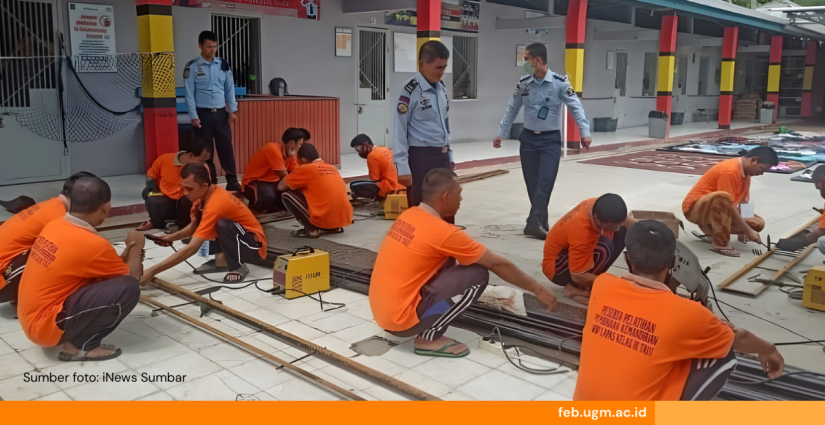
Entrepreneurship programs have the potential to serve as a bridge of hope for formerly incarcerated individuals who still carry the determination to start a new life. The findings come from a study conducted by Prof. Nurul Indarti, Professor of Innovation and Entrepreneurship at the Faculty of Economics and Business, Universitas Gadjah Mada (FEB UGM).
Through this research, Nurul and her team explored a lesser-seen side of life behind bars, examining how entrepreneurship training can influence inmates’ intentions to pursue entrepreneurship after reintegrating into society. The study, involving 204 inmates as respondents at a correctional facility, focused on the role of psychological factors, including self-efficacy and entrepreneurial resilience.
“Prisons are often perceived merely as places of punishment. After serving their sentences, freedom can still feel fragile because the label’ former inmate’ often closes doors to opportunities such as employment, trust, and even the chance to pursue dreams,” she explained.
The study was also motivated by the phenomenon of recidivism, or the recurrence of criminal behavior. Two out of three former inmates eventually return to prison within 2 to 3 years of their release.
“This is a cycle that is difficult to break because our social system has not fully provided space for second chances. Is there truly no way out of this cycle?” she asked.
Nurul emphasized that prisons can function as spaces for guidance and learning places where individuals can rediscover the meaning of life. Through a programme known as Work Guidance (Bimbingan Kerja/Bimker), inmates learn the skills they need to become self-reliant by participating in activities such as sewing, carpentry, food processing, and handicraft production.

The study’s results show that the program does not necessarily prompt inmates to become entrepreneurs immediately. However, it plays a significant role in fostering self-efficacy and mental resilience, key foundations for anyone seeking to rebuild life from scratch.
“One respondent even expressed a strong belief in their ability to change after participating in the program. It is where true transformation begins, because rehabilitation programs are not only about correcting behavior, but also about restoring self-worth and opening pathways toward a more meaningful life,” she said.
Furthermore, Nurul explained that if such programs are implemented sustainably with a humane approach, they can help reduce crime rates and provide genuine opportunities for individuals to start anew. Therefore, programmes should do more than teach skills and know-how; they should also cultivate the reasons and meaning behind them, the ‘know-why’.
“When someone understands why they need to change, that change is more likely to last. From that belief emerge new skills and renewed hope. Ultimately, prison should not merely be a place of punishment, but a school of life,” she added.
Entrepreneurship behind bars is a story of second chances, of how people, even after falling, still have room to rise and contribute to society.
“Everyone deserves a second chance. Because a small opportunity we offer today can become the beginning of a thousand steps toward a new and more meaningful life,” she concluded.
Reported by: Shofi Hawa Anjani
Editor: Kurnia Ekaptiningrum
Sustainable Development Goals