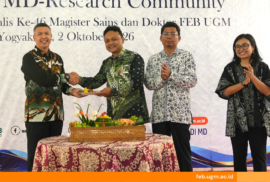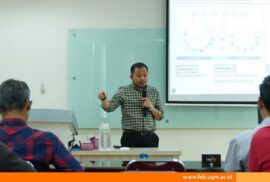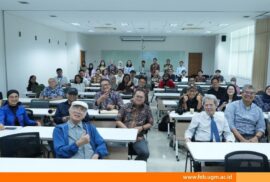

The phenomenon of high-performing employees suddenly resigning often raises questions in many organizations. High-performing individuals, strong in dedication and commitment to their work, choose to leave their jobs.
Lecturers and researchers from the Department of Management, Faculty of Economics and Business, Gadjah Mada University (FEB UGM), Prof. Drs. Gugup Kismono, M.B.A., Ph.D., and Anggraeni Pranandari, S.E., M.Sc., conducted research to uncover the factors behind employees’ intention to resign, particularly in the banking sector. Through a study titled ‘Exploring the Complexities of Job Embeddedness, Job Engagement and Work–Family Conflict on Turnover Intention’, this research aims to examine the role of job embeddedness and job engagement in influencing employees’ decisions to stay or leave their jobs, particularly through the role of work–family conflict.
Gugup Kismono explained that the research was conducted by surveying 243 banking employees in Indonesia. This sector was chosen due to its challenging work dynamics, characterized by high-pressure roles and long working hours, particularly in the post-pandemic context. The analysis was conducted using Structural Equation Modeling (SEM) with AMOS to examine the relationships among job embeddedness, job engagement, and work–family conflict.
“In this study, we explore two key constructs in organizational behavior: Job Embeddedness and Job Engagement,” he explained during a recent Research Series event entitled ‘Job Engagement vs Work–Family Conflict’.
Gugup Kismono explained that job embeddedness can be understood as a “web” that holds individuals within an organization, encompassing value alignment with the job, attachment through social relationships, and the extent of the sacrifices one must bear if deciding to leave. Meanwhile, job engagement reflects an employee’s psychological energy—that is, the extent to which an individual engages their physical, cognitive, and emotional aspects in performing their work.
“However, the key question is whether such job attachment and engagement are sufficient to curb employees’ desire to leave the organization? It is at this point that this study introduces a variable that is often overlooked: Work–Family Conflict—the conflict that arises when work demands clash with roles and responsibilities in family life,” he explained.
However, the findings of this study reveal unexpected results. Neither job embeddedness nor job engagement directly reduces employees’ intention to resign. The determining factor lies instead in work–family conflict, which fully mediated this relationship.

This study found that high levels of job engagement, whilst reflecting dedication, can lead to burnout if not managed properly. When employees’ energy is drained at work, the potential for conflict with family roles increases. It is this conflict that subsequently drives the desire to leave the organization.
Conversely, job embeddedness acts as a protective factor. Social ties and a sense of belonging in the workplace provide emotional support that can mitigate work–family conflict.
“As a result, employees are more likely to view the decision to stay as the right choice, not only professionally but also for their lives as a whole,” he said.
Meanwhile, Anggraeni Pranandari added that these findings have strategic implications for organizations. Efforts to boost productivity cannot rely solely on increasing engagement without accounting for employees’ personal constraints. Unmanaged engagement can lead to conflict, particularly when work demands clash with family responsibilities.
Therefore, organizational leaders need to view family-friendly policies as an integral part of their human resources strategy. This goes beyond mere work flexibility to include fostering an organizational culture that values the balance between professional roles and personal life.
“When employees feel they must choose between career and family, that is the point at which the organization actually begins to lose them. In the long term, failing to maintain this balance risks the organization losing its best talent,” she explained.
Anggraeni Pranandari also urged organizations or companies to rethink how they define engagement and organizational success. A strong company is not merely one that grows in business terms, but one that can create a working environment that enables employees to thrive, develop, and maintain a balanced quality of life.
“A truly strong company is not just one that grows in business terms, but one that ensures that when its employees return home, they still have the energy, peace of mind, and a smile left for their loved ones,” he concluded.
The full video of the Research Series program entitled ‘Job Engagement vs Work–Family Conflict’ can be accessed via: JobEngagementvsWorkFamilyConflict
Report by: Kurnia Ekaptiningrum
Sustainable Development Goals