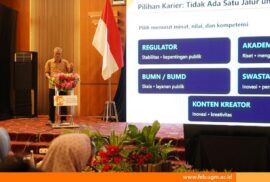

The government’s plan to close several academic programs deemed irrelevant to future economic needs has sparked controversy and debate in the public sphere. An economist from the Faculty of Economics and Business at Gadjah Mada University (FEB UGM), Wisnu Setiadi Nugroho, S.E., M.Sc., Ph.D., noted that there is a dangerous oversimplification in the policy of closing programs with low enrollment or deemed irrelevant, which is often framed under the “link and match” rhetoric. According to him, this narrative risks forcing universities to submit to the logic of short-term market demands.
“Closing academic programs because they’re deemed unnecessary by industry sounds rational, until we ask: since when has the job market become the sole determinant of higher education’s direction?” Wisnu stated in a written statement on Friday (May 22, 2026).
Chasing the Industry’s Shadow
Wisnu explained that the first issue arising from this policy is the assumption that industry needs can be predicted and followed consistently. Meanwhile, technological change occurs far more rapidly than educational cycles. A World Economic Forum (WEF) report indicates that approximately 44 percent of job skills are expected to change within the next five years.
“This means that what is considered relevant today can very quickly become obsolete. Under these circumstances, forcing universities to chase after industry needs is like running after a shadow,” said Wisnu, who has extensively studied the economics of education and gender economics.
Ironically, policies that place too much emphasis on immediate job readiness often lead to a short-term trap. Wisnu explained that many technical skills, ranging from basic coding to administrative tasks, are increasingly vulnerable to automation and artificial intelligence. A McKinsey & Company report estimates that up to 30 percent of global work activities could be automated by 2030. If universities focus solely on trending technical skills, the graduates they produce risk becoming quickly irrelevant.
Conversely, the skills that endure across eras are fundamental ones, such as critical thinking, analytical ability, communication, and social understanding. Data from the National Association of Colleges and Employers (NACE) consistently shows that competencies like problem-solving, communication, and teamwork consistently rank at the top of employers’ needs, surpassing specific technical skills.
“It is precisely these fundamental skills that are systematically honed in the basic sciences, humanities, and social sciences—fields that are often labeled as ‘unmarketable’ programs,” emphasized the Secretary of the Department of Economics at FEB UGM.

The Myth of Technical Dominance
Wisnu further noted that the narrative suggesting that only STEM fields (Science, Technology, Engineering, and Mathematics) hold economic value is not supported by facts. Studies of leaders at major corporations show that their educational backgrounds are highly diverse.
Many global leaders do not come solely from technical backgrounds. Susan Wojcicki, for example, had a background in history and literature before leading YouTube, one of the world’s largest digital platforms. Howard Schultz (former CEO of Starbucks) came from a communications background, while Ken Chenault (former CEO of American Express) studied history. In fact, various analyses of Fortune 500 companies show that a significant proportion of CEOs have non-technical backgrounds, including the humanities and social sciences.
According to Wisnu, this fact is crucial. Success at the pinnacle of organizational leadership is not determined solely by technical skills, but by the ability to read the context, understand human complexity, and make strategic decisions. An education that is too narrowly focused on technical needs risks neglecting the very foundations of leadership itself.
Wisnu noted that innovation does not arise from conforming to trends, but from the ability to transcend them. Breakthroughs in the digital economy, healthcare, and public policy almost always emerge from interdisciplinary interactions, not from narrow specializations that merely conform to today’s market demands.
“If universities are reduced to mere providers of labor, the intellectual space that fosters innovation will be eroded,” he said.
A Compass for Civilization, Not a Factory
Wisnu noted that the policy of closing academic programs with low enrollment or those irrelevant to industry is not solely driven by economic considerations. Entrusting the direction of higher education entirely to the market means neglecting the campus’s social and political functions. Universities are spaces for the production of knowledge, criticism, and reflection. When these functions are weakened, society loses the capacity to understand change, let alone correct it. The philosopher Martha Nussbaum has long warned that neglecting the humanities risks diminishing the quality of public deliberation and the critical capacity of citizens.
In the Indonesian context, he continued, a simplistic approach to relevance risks narrowing the horizons of higher education. If success is measured solely by short-term job placement, fields that contribute to long-term development, including culture, critical thinking, and basic research, will be increasingly marginalized. Yet, a nation capable of weathering disruption is one with the capacity for reflection and innovation, not merely a supplier of compliant labor.
“Higher education is not an additional vocational training center for industry. Closing academic programs simply because they do not align with today’s market preferences is a short-sighted decision that ignores future dynamics,” he emphasized.
In his view, universities should not function as factories churning out workers to order, but rather as institutions that shape individuals with the ability to think, adapt, and create. Higher education institutions should once again become the compass guiding civilization, not merely weather vanes spinning in the direction of economic winds.
“If we continue to impose market logic as the sole measure of relevance, what we produce will not be a generation ready to face the future, but a generation trained for the past,” he concluded.
Reportage by: Kurnia Ekaptiningrum
Sustainable Development Goals