In a business world that is increasingly interconnected beyond national borders, a leader’s capabilities are no longer measured solely by strategy and decision-making skills. Understanding the ways of thinking, values, and cultures of various countries has now become an essential skill in running a global business.
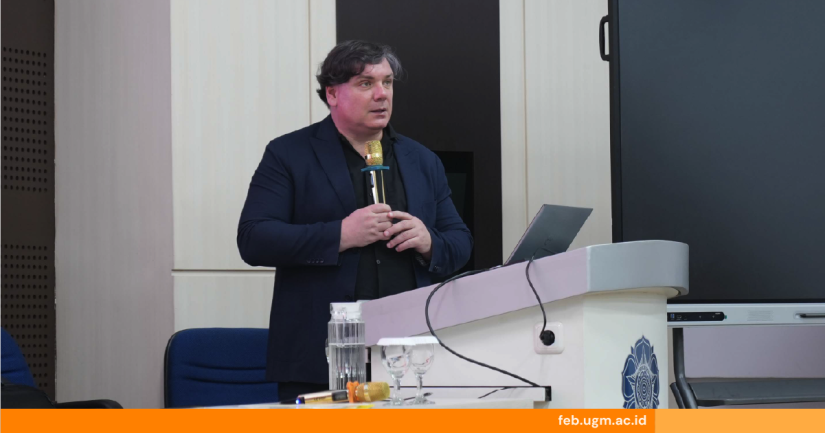
This was highlighted by Prof. Renato Pereira, Professor of General Management at ISCTE Business School, during a guest lecture titled “Managing Business across Cultures: How to Communicate and Negotiate” on Wednesday (May 6, 2026) at the Faculty of Economics and Business, Universitas Gadjah Mada (FEB UGM).
Renato opened the discussion by comparing how Belgium and Taiwan view COVID-19 case data. Although both countries faced the pandemic, they responded differently to rising case numbers. In Belgium, the high case numbers were initially perceived optimistically because they were seen as indicating a high volume of testing. Conversely, in Taiwan, those numbers were viewed as a failure to control the outbreak.
From this example, Renato emphasized that culture is not merely about traditions, food, or clothing, but rather how a society perceives reality and makes decisions, including in a business context. In his view, no culture is inherently better or more correct than another, as a long historical journey shapes every culture.
To understand how culture influences people’s behavior, Renato introduced Hofstede’s Dimensions theory, developed by Geert Hofstede. This theoretical framework is used to understand cultural differences across countries by examining people’s values, mindsets, and behaviors in work, communication, decision-making, and social and organizational interactions.
The first dimension in this theory is power distance, which measures the extent to which power imbalances are accepted as normal within a society. In countries with high power distance, people tend to show deference toward their leaders. Conversely, in countries with low power distance, people are more open in expressing their opinions and do not view power differences as a barrier to communication.
The second dimension is uncertainty avoidance, which measures the level of comfort people have in facing future uncertainty. Renato explained that countries with high uncertainty avoidance tend to create many rules, procedures, and regulations to foster a sense of security. However, countries with low uncertainty avoidance are comfortable with ambiguity and more willing to take risks. In the business world, this influences the pace of innovation and decision-making processes.
The third dimension is individualism versus collectivism. Renato explains the fundamental differences between these two poles. In an individualistic society, each person is expected to be self-reliant and responsible for themselves. In a collectivist society, individuals are strongly bound to their group, and loyalty to the group is the highest value. An interesting pattern emerges from this dimension: historically, individualistic nations have been more economically prosperous. However, he refuses to use this pattern as justification for the superiority of any single model.
“We do not yet have a sufficiently long history, because liberal economics as an ideology is actually still relatively new in the grand scheme of human history,” he stated.
The final dimension is masculinity versus femininity. This aspect measures the dominant values held in high regard by society. Masculine cultures emphasize competition, achievement, and material success. Conversely, feminine cultures prioritize life balance, solidarity, and quality of life. Japan serves as an example of a country with high masculinity values, while the Scandinavian countries are known for having the most feminine cultures in the world.
Renato reiterated that there is no single formula for leading a cross-cultural business. The key to global leadership is a willingness to understand and learn from cultural differences. By understanding culture, a leader can improve communication, avoid misunderstandings, and create a more inclusive and productive work environment.
“The bottom line is understanding what we need to learn from other cultures and different business environments so that we can be effective leaders in those situations,” he concluded.
Reportage by: Najwa Anggi Namira
Editor: Kurnia Ekaptiningrum
Sustainable Development Goals