
When discussing deforestation, public attention is often directed toward companies that clear forests. Yet behind every such decision lies a flow of financing that shapes the course of development. The way financial institutions allocate loans and investments can play a crucial role in either accelerating or slowing efforts to protect the environment.
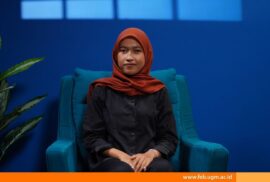
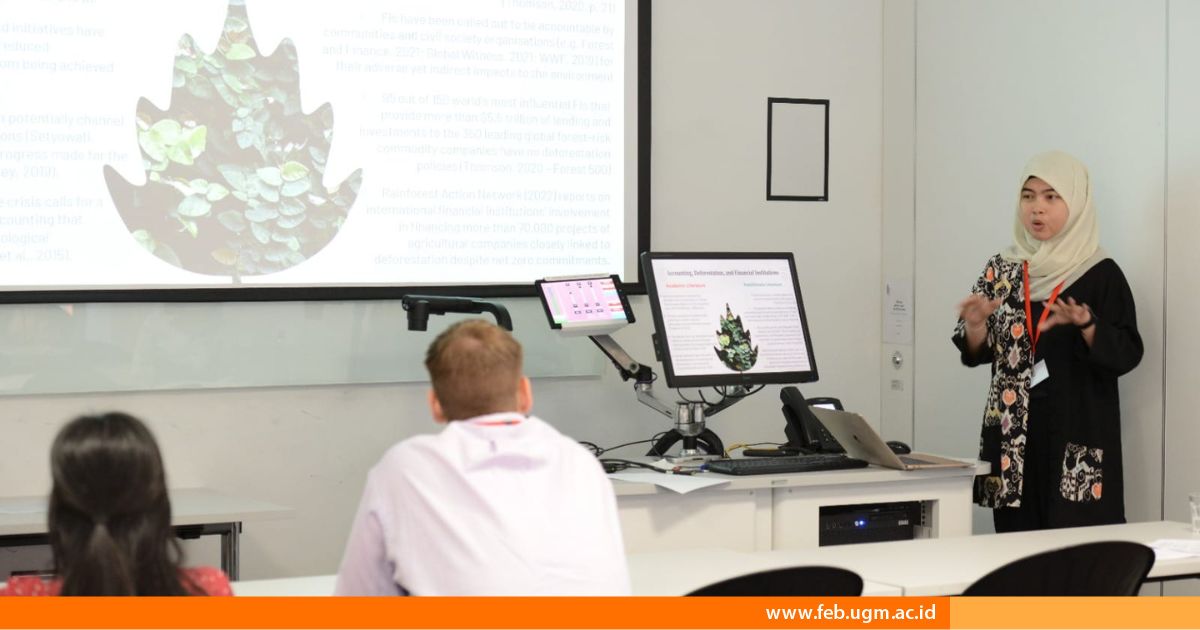
This perspective inspired Dewi Wulansari, S.E., M.Sc., a lecturer at the Department of Accounting, Faculty of Economics and Business, Universitas Gadjah Mada (FEB UGM), to pursue her doctoral research at Cardiff University. In July 2026, she successfully defended her dissertation titled Exploring Sustainability and Accountability Practices and Their Role in Halting Deforestation in Indonesia’s Financial Institutions, which examines how sustainability practices in financial institutions can help reduce deforestation in Indonesia.
Examining the Financial Sector’s Role in Deforestation
Dewi’s interest in this topic emerged after attending sessions at the 26th United Nations Climate Change Conference (COP26). She observed that discussions on climate change largely focused on industries with direct environmental impacts, such as mining, energy, and plantation companies. However, she believed that financial institutions play an equally important role through their financing and investment decisions that can encourage more sustainable economic activities.
“The financial sector holds a highly strategic position in supporting efforts to reduce deforestation,” she explained.
To explore this issue, Dewi analyzed 296 sustainability reports published by Indonesian financial institutions during the 2020–2021 period. She also conducted interviews with regulators, banking industry representatives, investors, civil society organizations, researchers, and Indigenous community representatives. Her research employed Erving Goffman’s Dramaturgical Theory to examine whether the sustainability narratives presented by financial institutions were consistent with their actual practices.
Her findings reveal that many sustainability initiatives remain primarily oriented toward building corporate image rather than integrating sustainability into core business operations. Various initiatives—including CSR-based reforestation programs, ESG policies, sustainability governance, certifications, and partnerships—have been widely implemented. However, behind these sustainability narratives, implementation remains largely driven by regulatory compliance, investor expectations, and business interests.
According to Dewi, sustainability initiatives will have a far greater impact when environmental principles are fully embedded within the core business strategies of financial institutions. She hopes her research can provide valuable input to Indonesia’s Financial Services Authority (OJK) to strengthen the implementation of sustainable finance policies.

“The OJK has already established a sustainable finance roadmap, and I hope these policies will continue to evolve. If sustainability initiatives are integrated into financial institutions’ core business activities, their impact will be much greater than simply carrying out reforestation programs as a form of corporate image-building,” she said.
Following the completion of her doctoral studies, Dewi plans to publish her dissertation as three articles in internationally reputable academic journals. She also hopes to strengthen sustainability education at FEB UGM by developing courses and curricula that integrate sustainability into the Accounting Study Program.
“I hope that the knowledge I share with students and the sustainability research I conduct can create meaningful benefits for Indonesian society,” she added.
Balancing Multiple Roles
Completing a doctoral degree was far from easy for Dewi. Beyond academic perseverance, the journey required her to balance multiple responsibilities while making personal sacrifices.
She began her doctoral studies in 2021 during the height of the COVID-19 Delta variant pandemic. Together with her husband and their 14-month-old son, she traveled to the United Kingdom while Indonesia was still on the UK government’s red list. Before beginning her studies, the family was required to undergo a ten-day quarantine.
“It was truly a mix of emotions. Throughout my doctoral studies, I had to balance my responsibilities as a scholarship-funded PhD student, fulfill my obligations to FEB UGM, and at the same time carry out my roles as a wife and mother,” she recalled.
For Dewi, her doctoral journey not only broadened her academic knowledge but also taught her invaluable lessons in balancing family life and education. Amid the demands of completing her research, she learned to manage her time while embracing her responsibilities as a mother.
Her journey became more manageable thanks to her husband, who served as her primary support system. While living in the UK, they shared parenting and household responsibilities, allowing each of them to have dedicated time for work and study.
“When my husband was working, I took care of our child. Once he returned home, it became my turn to focus on my research. My husband’s support was the biggest factor that enabled me to complete my doctoral studies successfully,” she said.
Studying at Cardiff University, with its open and collaborative academic culture, became one of the most memorable aspects of her experience. Within the Accounting and Finance Section, doctoral students were treated as early-career researchers, giving them opportunities to participate in discussions and exchange ideas directly with academics.
“This culture differs from what we commonly experience in Indonesia, where the academic activities of lecturers and students are often conducted separately. Involving doctoral students in academic discussions allows them to gain fresh perspectives and enrich their research through interactions with senior scholars,” she explained.
For Dewi, these experiences have not only shaped her as an academic but have also strengthened her commitment to advancing sustainability education and research that can make meaningful contributions to the development of knowledge and society in Indonesia.
Reporter: Shofi Hawa Anjani
Editor: Kurnia Ekaptiningrum
Sustainable Development Goals