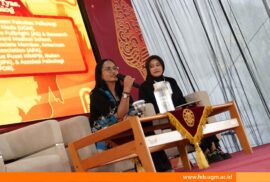

Rafida Salma Rahmawati, a staff member of the Quality Assurance and Accreditation Unit at the Faculty of Economics and Business, Universitas Gadjah Mada (FEB UGM), was named Best Portfolio in the Data Analyst with SQL & Python Bootcamp Batch 23, organized by DQLab. She earned the recognition after independently developing her data analysis skills despite coming from a non-data-related academic background in Geophysics.
A graduate of the Bachelor’s Program in Geophysics at the Faculty of Mathematics and Natural Sciences, Universitas Gadjah Mada (FMIPA UGM), Rafida began exploring data analysis after completing her studies. Uncertainty about career prospects after graduation, coupled with the COVID-19 pandemic, prompted her to seek ways to develop new skills relevant to industry demands.
Rafida said her interest in data had actually developed during her university years. Laboratory work and field activities had familiarized her with data processing. Her interest in exploring data analytics more deeply grew as she sought to broaden her career opportunities.
“After graduating, I started taking free online courses from various technology education platforms. Although I had previously learned Python at university for basic data processing, taking additional courses helped me gain a better understanding of databases, SQL, Data Studio, and other areas. I also decided further to develop my skills through training programs and certifications,” she said.
For Rafida, becoming a data analyst was an appealing career option because it allowed her to explore professional opportunities beyond the field she had studied at university. She also saw the flexibility of fieldwork as a factor that encouraged her to continue learning.
Through the Data Analyst Bootcamp, Rafida learned the data analysis process more comprehensively, from data cleaning and exploratory data analysis (EDA) to dashboard development. The program not only introduced her to various data analysis tools but also helped shape her approach to transforming data into information that can support decision-making.
“Through this bootcamp, I learned not only how to use tools but also how to process data into insights that can support decision-making. The most noticeable impact was that I became more aware of the characteristics and patterns within a dataset,” she explained.
Coming from a non-IT background, Rafida faced several challenges, particularly when encountering errors because she was not yet accustomed to coding. Nevertheless, she viewed the learning process as an opportunity to sharpen her attention to detail, problem-solving abilities, and analytical thinking, all of which are crucial in data analysis.
For the portfolio that earned her the recognition, Rafida explored the issue of layoffs during the pandemic. One of her main challenges was finding meaningful insights while presenting the data in a way that was easy for readers to understand.
“I had to find ways to present analytical insights, such as layoff dates and numbers, in an engaging and easy-to-understand way. A good portfolio should not only demonstrate data processing skills but also tell a story and generate relevant insights,” she explained.
Her hard work paid off when Rafida was selected as the recipient of the Best Portfolio award in the Data Analyst with SQL & Python Bootcamp Batch 23. She never expected to receive the recognition, especially after seeing other participants with stronger technical skills. For her, however, the award became an appreciation of the learning process she pursued alongside her professional responsibilities.
“I am grateful because this proves that the effort I put into creating this portfolio was serious, even while managing my work routine and deadlines,” she said.
In addition to the achievement, Rafida earned a Data Analyst certification, which recognizes the foundational competencies she has developed in data analysis.
In her daily work managing data to support accreditation processes, Rafida said her data analysis skills have helped her develop an analytical mindset applicable across different areas of work.
“Although Excel is still the tool I use most often in my current work, I now have a better understanding of the overall analysis workflow through what I learned in the bootcamp,” she explained.
Rafida believes that the learning process does not end after completing a certification. She is committed to continuing to develop her competencies through various learning opportunities.
“I hope I can continue to maintain the knowledge and skills I have gained so far so that they can be useful in any industry where I work. If I have the opportunity, I would also like to take other training programs to continue upgrading my skills,” she said.
Rafida’s journey demonstrates that professional development need not begin with a linear academic background. Learning experiences, the willingness to try, and the courage to take on new challenges can serve as valuable foundations for expanding professional capabilities.
Report: Shofi Hawa Anjani
Editor: Kurnia Ekaptiningrum
Sustainable Development Goals