Accounting education plays a role not only in providing theoretical knowledge but also in equipping students with practical skills relevant to industry needs. However, the gap between learning in educational institutions and accounting practices in the workplace remains a challenge. Amid the growing digitalization of accounting, technology-based learning innovations have emerged as one approach to addressing this issue.
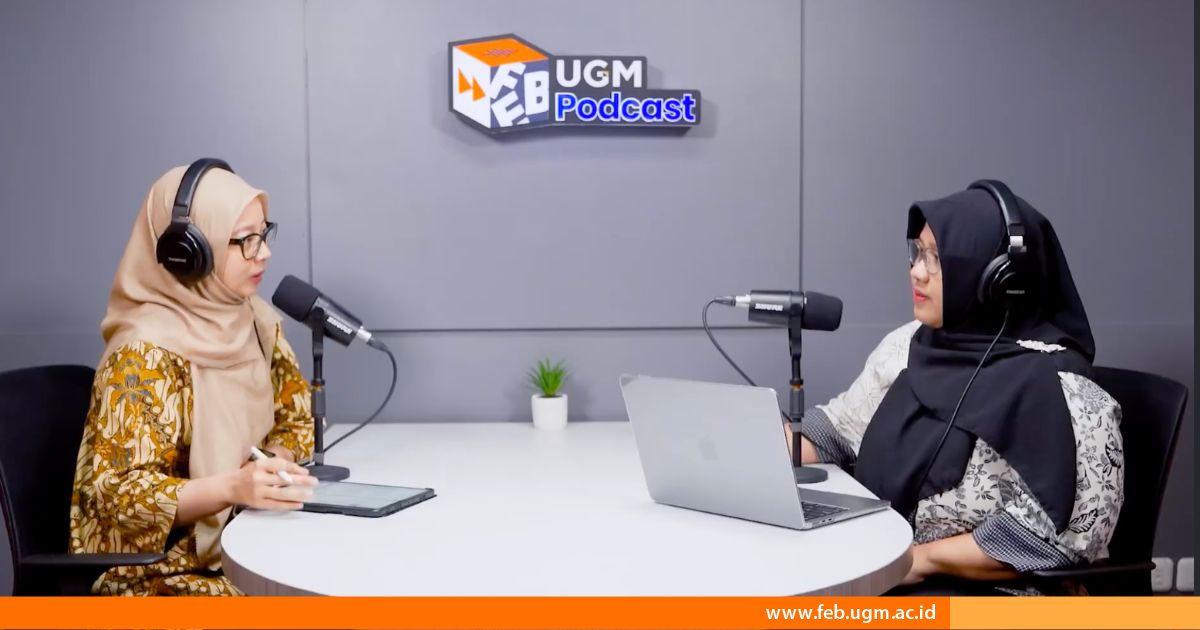
In an FEB UGM Podcast episode titled AI for Sustainability: From Impact to Institutional Transformation, lecturer at the Department of Accounting, FEB UGM, Arika Artiningsih, S.E., M.Acc., M.Com., M.Res., Ph.D., CFE., CFrA., CPA (Aust.), discussed the development of SIDEK Edu as a digital accounting learning platform. The innovation was developed to bridge the gap between accounting education and industry needs.
According to Arika, the development of SIDEK Edu stemmed from concerns over the gap between the competencies of accounting graduates and the skills required in the workplace. The initiative, pioneered by Prof. Sony Warsono of the Department of Accounting, FEB UGM, has been under development for approximately eight years.
“It began with a concern about accounting education, particularly the gap between what industry needs and the outcomes of accounting education,” she explained.
This gap is a challenge not only for vocational education but also for Vocational High Schools (SMKs). Meanwhile, industries increasingly rely on digital systems, including Enterprise Resource Planning (ERP), to manage business and accounting processes. This situation calls for learning methods that not only teach concepts but also provide students with practical experience relevant to workplace needs.
In response to these challenges, SIDEK Edu was designed to integrate two learning environments: theory and practice. The theory section helps students understand accounting concepts, while the practical section facilitates learning through an integrated accounting cycle.
One of the major challenges in its development is ensuring the innovation’s sustainability. Changes in user needs, developments in accounting cases, and the evolving educational landscape require SIDEK Edu to be continuously updated to remain relevant.
“Developing the technology itself may take around one or two years, but the more difficult part is ensuring that the technology remains relevant, continues to be used consistently by users, and can address their needs,” she said.
In this context, she emphasized the important role of universities in ensuring that research outcomes do not remain confined to academic publications but are applied to address societal problems.
“The hope is that when universities or lecturers conduct research, it does not end with an academic publication, but can be taken further to address problems in society. I think this is how innovation can ultimately create social impact,” she explained.
To date, SIDEK Edu has reached approximately 10,000 users, with around 3,000 active users over the past three years. Its use has spread across various regions of Indonesia, including Java, Sumatra, and Papua. One example is a collaboration in Teluk Bintuni, West Papua, which has received support from the local government for educational development.
As technology continues to advance, the integration of artificial intelligence presents another opportunity for SIDEK Edu’s development. Arika explained that SIDEK Edu currently does not incorporate AI into its system. However, a financial statement analysis feature is currently under development, opening up opportunities for AI integration in the future.
AI has the potential to help users interpret financial statements and financial ratios, while also assisting teachers in developing questions and learning case studies. For students, the technology could also serve as a learning companion in understanding the results of financial analysis.
Maintaining a balance between technological assistance and independent learning is also an important consideration. The development of AI-based learning platforms needs to ensure that the convenience technology offers does not reduce students’ opportunities to build their own understanding and analytical skills.
Drawing on her experience developing SIDEK Edu, Arika emphasized that socially impactful innovation need not begin with the intention of creating a particular technology. Instead, the innovation process should start by identifying problems faced by society and then using technology to develop solutions.
“The question is not which AI technology is currently popular, but rather what problems users are actually facing and how AI can help address them,” she said.
The development of SIDEK Edu demonstrates that educational innovation requires more than technology alone. Sustainable use, stakeholder engagement, impact evaluation, and attention to user needs are essential to ensuring that innovation delivers long-term benefits.
Watch the full episode of the AI for Sustainability Podcast titled “Transformasi Digital Akuntansi: Tantangan dan Peluang AI di Dunia Pendidikan”
Reportage: Dwi Zhafirah Meiliani
Editor: Kurnia Ekaptiningrum
Sustainable Development Goals