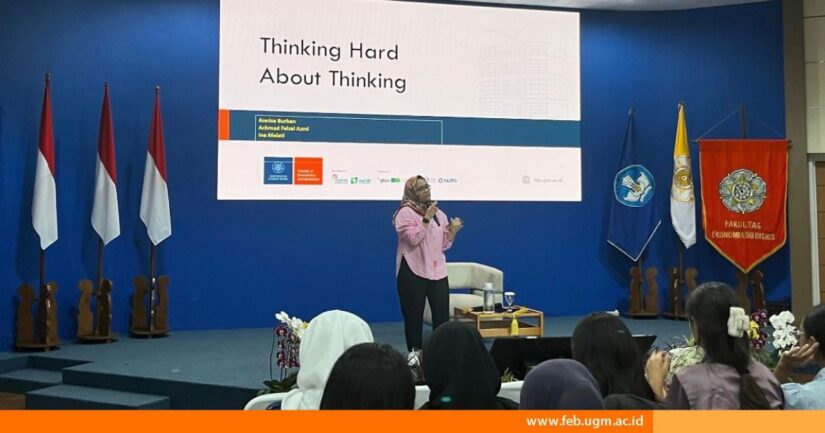
Critical thinking is an essential skill for students to navigate the rapid flow of information on social media and the development of artificial intelligence (AI). This ability enables students not merely to accept information at face value, but also to examine evidence and evaluate its validity.
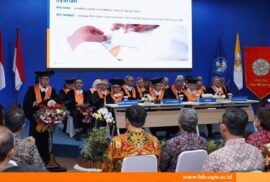
Dr. Ina Melati, S.E., M.M., a lecturer at the Department of Management, Faculty of Economics and Business, Universitas Gadjah Mada (FEB UGM), emphasized that students need to develop the habit of thinking critically when dealing with information, solving problems, and expressing their opinions in a structured manner.
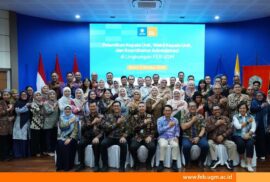
“When we think critically, we can make effective and wise decisions by presenting statements supported by evidence and data. In this way, we can express our opinions more thoughtfully,” she explained during the Mandatory Softskills: Critical Thinking session organized by the Career and Student Development Unit (CSDU) on Friday (September 25). The session was held as part of FEB UGM’s efforts to equip students with critical thinking skills in navigating the rapid flow of information.
Ina explained that one risk of failing to apply critical thinking is the emergence of anecdotal evidence, in which conclusions are drawn from personal experiences and limited information. Such experiences are often perceived as the truth because people tend to use their personal experience as a reference.
“Everyone has their own experiences, and we often feel that our own experiences are the most accurate. When sharing information, we tend to use our personal experiences as a reference,” she said.
To avoid this, Ina encouraged students not to rely on opinions or personal experiences as the sole basis for sharing information. Students should conduct research and seek relevant data so that the opinions they express are supported by stronger evidence.
Amid the rapid flow of information, irrelevant and misleading information is also increasingly widespread on social media. Ina gave an example of individuals who have a positive persona and public image, leading people to trust everything they say.
However, the information they provide is not necessarily true. Therefore, every piece of information needs to be examined and evaluated before being accepted or shared with others.
“The foundation of critical thinking is questioning and identifying problems, as well as gathering and evaluating information. In other words, we need to filter all the information available to us,” she said.
Ina explained that critical thinking can be developed through practice and daily habits. Students can strengthen this ability by comparing, analyzing, categorizing, and evaluating information. Reading is also one way to develop such habits.
When reading an article, for example, students can ask whether the statements presented are supported by sufficient evidence. In this way, readers do not simply accept information but also evaluate how a conclusion is constructed.
Beyond the ability to evaluate information, critical thinking also requires individuals to view an issue from different perspectives. According to Ina, critical thinking is not merely about finding flaws in other people’s opinions, but also about being willing to accept facts that may contradict one’s own views.
“This is also a form of critical thinking and fairness, because we should not only be critical of others but also of ourselves,” she said.
In addition, Ina emphasized that the ability to present arguments is also an important part of critical thinking. A strong argument is not intended to make others feel defeated or force them to accept a particular opinion, but rather to present reasons and evidence logically.
“Winning an argument does not mean making the other person lose. A good argument is one in which we can present reasons and evidence logically, including when we discover that a statement is indeed incorrect,” she concluded.
Report: Shofi Hawa Anjani
Editor: Kurnia Ekaptiningrum
Sustainable Development Goals