Islamic accounting has distinct characteristics and reporting objectives that differentiate it from conventional accounting. These differences extend beyond the use of Islamic terminology to include the nature of transactions and reporting, sources of knowledge, and the underlying principles of accountability in accounting practices.
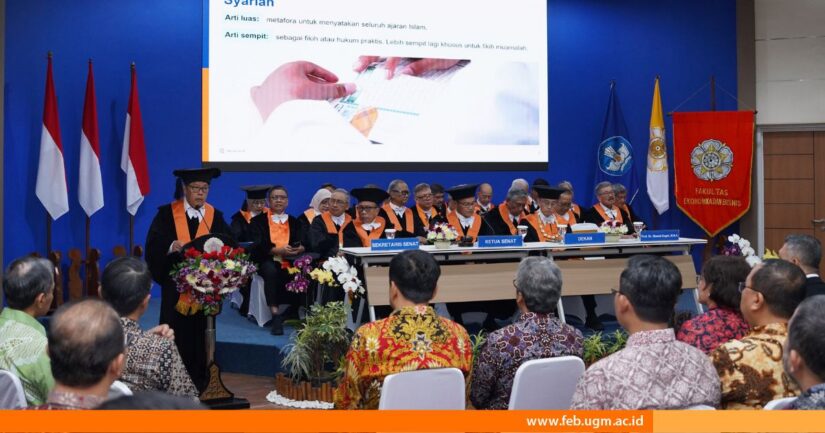
This was conveyed by Prof. Dr. Drs. Slamet Sugiri, M.B.A., in his scientific oration entitled “Knowing Only the Basics of Islamic Accounting” at the Open Senate Meeting of the Faculty of Economics and Business, Universitas Gadjah Mada (FEB UGM), held on September 21, 2026. His oration examined Islamic accounting in terms of Sharia principles, the need for specific accounting standards, and its ontological, epistemological, and axiological foundations.
The oration began by questioning whether Islamic accounting possesses a distinct academic identity or is merely conventional accounting with the additional label “Islamic.” Slamet Sugiri explained that Sharia, in the context of finance, refers to fiqh muamalah, or Islamic jurisprudence governing commercial and economic transactions. These transactions must be free from riba (usury or interest prohibited under Islamic law), maisir (gambling), gharar (excessive uncertainty), bribery, and other prohibited elements.
“The purpose of Sharia is to achieve public benefit and prevent harm. Believers are obliged to honor their contracts, and the Qur’an establishes the Islamic message as a mercy to all creation,” he stated.
Slamet Sugiri explained that the development of Islamic banking created a need for accounting standards aligned with the characteristics of Sharia contracts and objectives. He cited Bank Muamalat Indonesia (BMI), the first Islamic bank in Indonesia, which initially applied Statement of Financial Accounting Standards (PSAK) No. 31 on Banking Accounting, designed for conventional banking. The bank subsequently made adjustments to align its financial reporting with Sharia principles.
“These differences in practice prompted the development of more specialized accounting standards that ensure Sharia compliance while providing a uniform financial reporting framework for entities conducting Sharia-based transactions,” he explained.
He emphasized that Islamic transactions involve more than the technical aspects of recognition and measurement. They also take into account the substance of contracts, the rights and obligations of the parties involved, compliance, trustworthiness, and social functions.
Furthermore, Slamet Sugiri noted that Indonesia’s Sharia Financial Accounting Standards continue to be refined in response to developments in transactions and institutions, as well as the needs of financial statement users. One example is PSAK 401, the Conceptual Framework for Sharia Financial Reporting (Kerangka Dasar Penyusunan dan Penyajian Laporan Keuangan Syariah, or KDPPLKS). These frameworks guide Sharia entities in providing information on financial position, performance, and cash flows; on Sharia compliance, transparency, accountability, and trust management; on profit-sharing arrangements; on zakat funds; and on benevolent funds.
“To fulfill economic objectives and social functions, the components of Sharia financial statements depend on the characteristics of the entity and the applicable standards. Distinctive elements include temporary syirkah funds, mudarabah and musyarakah financing, non-halal income and its distribution, zakat funds, and benevolent funds,” he added.
According to him, these distinctive features demonstrate that the information needs of Sharia entities cannot be fully met by the reporting systems used by non-Sharia entities. The application of Islamic accounting is also not limited to entities that operate entirely on Sharia principles. He cited Bank Indonesia (BI), the central bank, which is not an Islamic financial institution but also applies Islamic accounting to investments and financing involving Sharia-based models.

“For example, the management of SukBI (Bank Indonesia Sukuk), issued by BI and backed by Sharia-compliant securities owned by BI, illustrates this practice. Similarly, conventional business organizations that enter into contracts with Islamic banks also apply Islamic accounting, specifically to transactions related to those contracts,” he explained.
According to KDPPLKS, the obligation to apply Sharia Financial Accounting Standards is not limited to Sharia entities but also extends to other entities that engage in Sharia transactions. Therefore, the use of Islamic accounting by institutions that are not entirely Sharia-based is already on the right track.
From an ontological perspective, Slamet Sugiri explained that Islamic accounting has distinctive objects and reporting orientations. It does not merely add Sharia terminology to conventional accounting but possesses its own academic identity within the broader discipline of accounting.
“Islamic accounting is not simply a matter of attaching the term Sharia to accounting or Arabizing conventional accounting. It has its own academic identity within the discipline of accounting and deserves to be taught at universities,” Slamet stated.
From an axiological perspective, Islamic accounting is also concerned with the values and objectives pursued through the application of knowledge. These include honesty, justice, transparency, the avoidance of speculation, mutual consent between parties, and freedom from riba. These principles are expected to promote responsible business practices and guide business actors and stakeholders toward falah, or prosperity and well-being in this world and the hereafter.
Slamet Sugiri also highlighted the importance of ethics in Islamic accounting. According to him, Islamic accounting serves not only as an information system for recognizing, measuring, presenting, and disclosing transactions but also as a discipline oriented toward improving societal welfare.
In education, Islamic accounting, as both professional knowledge and an academic discipline taught at universities, is expected to contribute to achieving national education goals. As a field of professional knowledge and academic study in Indonesian higher education, Islamic accounting should help develop students’ potential to become individuals who have faith, devotion to God, and noble character, in accordance with national education objectives.
“Teaching Islamic accounting is also expected to support the educational goals of the national education system, UGM, FEB UGM, and the Department of Accounting at FEB UGM in producing graduates who are excellent, competent, and possess strong moral integrity,” he concluded.
Reporting: Shofi Hawa Anjani
Editor: Kurnia Ekaptiningrum
Sustainable Development Goals