The Undergraduate Management Study Program of the Faculty of Economics and Business, Universitas Gadjah Mada (FEB UGM), continues to strengthen the relevance of its learning process to workplace needs by implementing a tracer study. In addition to serving as part of the program’s evaluation, the study involves graduate users to provide input, ensuring that the learning process remains relevant to developments in industry and the professional world.
The graduate user survey conducted by the Admissions, Partnerships, and Alumni Unit (AKA) of FEB UGM assessed nine aspects of graduates’ competencies: moral integrity and ethics, professionalism, English proficiency, technology use, communication skills, teamwork, data analysis skills, awareness of sustainability issues, and leadership.
The tracer study results show that all nine competency areas were rated positively by graduate users, with scores ranging from 3.33 to 3.78 on a 4-point scale. Among these aspects, moral integrity and ethics received the highest score of 3.78. Three other competencies—information technology use, communication skills, and data analysis skills each received a score of 3.67.
Meanwhile, professionalism and teamwork each received a score of 3.56. English proficiency, awareness of sustainability issues, and leadership each received a score of 3.33. All nine aspects were categorized as good.
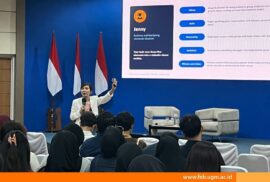
Head of the Undergraduate Management Study Program at FEB UGM, Rr. Tur Nastiti, S.E., M.Si., Ph.D., stated that the tracer study results provide an overview of how graduates’ competencies are positively assessed by users across various aspects required in the workplace. Alum experiences also demonstrate how the knowledge and skills gained during their studies can develop and be applied throughout their professional careers.
Abdillah Rasyid Baswedan, an alumnus of the Undergraduate Management Study Program at FEB UGM from the 1999 cohort who currently works in the investment sector as a Partner at Quvat Management Pte Ltd., noted that students’ experiences during their studies play an important role in developing the skills needed when entering the professional world. In addition, student activities, interactions with lecturers, organizational experiences, and opportunities to deal with various challenges are important parts of the learning process. These experiences complement the knowledge acquired in the classroom.
“There are many things that may not be explicitly taught in the academic curriculum but are useful in the workplace. One of them is problem-solving skills. When we encounter various challenges, these general skills often prove to be very helpful after graduation,” he said.
As a graduate user, Abdillah also noted that graduates of the FEB UGM Undergraduate Management Program possess academic capabilities that serve as a foundation for entering the professional world. In professional settings, graduates are involved in a range of tasks, from conducting research and preparing basic financial models to developing research reports, information memoranda, and other investment-related documents.
According to him, these experiences form part of the adaptation process for new graduates as they learn how to apply the knowledge gained during their studies to professional situations. He also encouraged students to continuously develop critical thinking, problem-solving, communication, and technology skills, including the use of artificial intelligence (AI). AI, he explained, can be used as a supporting tool to deepen research, gain diverse perspectives, and improve the quality of work without replacing human thinking processes.
Through the tracer study and input from graduate users, the Undergraduate Management Study Program at FEB UGM continues to gain perspectives on the needs of the professional world. By continuously evaluating and developing its learning process, the program seeks to prepare students not only to enter the workforce but also to continue learning, adapting, and contributing amid changes in the professional world.
Report: Shofi Hawa Anjani
Editor: Kurnia Ekaptiningrum
Sustainable Development Goals