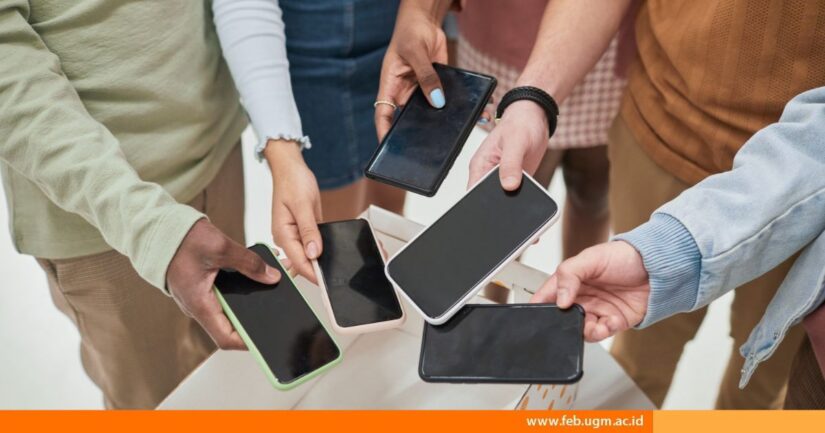
The government is planning to provide free mobile phones to the public as part of efforts to support the distribution of social assistance. Responding to the plan, economist and lecturer at the Department of Economics, Faculty of Economics and Business, Universitas Gadjah Mada (FEB UGM), Wisnu Setiadi Nugroho, Ph.D., said the government needs to reassess the proposed mobile phone distribution program in terms of its urgency, effectiveness, and fiscal sustainability. Given the limited fiscal space, the policy should also be weighed against alternative programs that could potentially deliver greater social and economic benefits.
Wisnu argued that financial inclusion and the digital divide in Indonesia are not solely driven by limited access to devices. Data from Statistics Indonesia (BPS) in 2025 showed that 93.5% of households already owned mobile phones. This indicates that Indonesia’s financial inclusion challenges are no longer primarily about device ownership.
“Frankly speaking, the urgency is limited. The real problems lie in inactive bank accounts, low digital literacy, and the uneven availability of cash withdrawal points. The Financial Transaction Reports and Analysis Center (PPATK) found that more than 10 million bank accounts belonging to social assistance recipients had remained dormant for years. The accounts exist, the phones exist, but they are not being used,” he explained.
According to Wisnu, the government needs to carefully establish its budget priorities. Every public spending policy should weigh the benefits generated against the costs incurred, particularly when people’s basic needs still require attention.
He noted that allocating funds to basic education, healthcare services, and stunting prevention could potentially generate clearer long-term social benefits than distributing digital devices whose effectiveness has yet to be adequately demonstrated.
“Every rupiah spent on mobile phones is a rupiah that does not go toward repairing damaged classrooms, supporting non-permanent teachers, addressing staff shortages at community health centers, or tackling stunting. By comparison, basic education and healthcare services offer much clearer long-term social returns than distributing devices whose benefits remain speculative,” Wisnu said.
Fiscal Risks and Potential Budget Inefficiencies
Wisnu warned that a free mobile phone distribution program could create a substantial fiscal burden. Program costs would include not only device procurement but also distribution, activation, internet access, system maintenance, and replacement of damaged or lost devices.
He illustrated that if a device costing IDR 1 million were distributed to 20 million recipients, procurement costs alone could reach IDR 20 trillion. If the number of recipients reached 74 million, procurement costs could potentially rise to IDR 74 trillion. These estimates do not yet include other supporting costs.
“A program like this also tends to create recurring expenditure rather than a one-off cost,” he said.
In addition to fiscal risks, Wisnu highlighted potential inefficiencies in the procurement process. Centrally managed procurement fully financed by the government, he said, would require strict oversight to prevent inflated prices, specifications that do not match actual needs, and the procurement of unnecessary licenses.
He also pointed out that distributed devices could be sold, pawned, or transferred to others. If this happens, the program’s original objective of expanding access to digital and financial services may not be achieved.
“If that happens, access to the bank account may also be transferred. At that point, the government has already paid a substantial amount for something that is no longer being used for its intended purpose,” he explained.
Therefore, if the program is still implemented, Wisnu emphasized that the government should consider alternative financing schemes, such as partnerships with device manufacturers, telecommunications operators, and banks. Price subsidies or vouchers that allow people to choose devices available on the market could also offer greater flexibility than centralized procurement.
Device Ownership Does Not Automatically Increase Productivity
Wisnu noted that the program’s impact on household purchasing power and digital economic growth should distinguish between the benefits generated by cash assistance and those generated by providing devices. Cash transfers have the potential to stimulate household consumption, particularly among low-income groups. However, the economic impact of distributing mobile phones does not automatically generate a substantial multiplier effect for the domestic economy.
According to him, part of the value of device procurement may flow to manufacturers and importers. Therefore, the benefits to local economic activity need to be carefully assessed. Claims that the program would stimulate the telecommunications sector, digital commerce, and other sectors should also be supported by adequate evaluation.
Wisnu said that many studies have demonstrated the limited impact of mobile phone distribution programs when interventions stop at simply providing devices or bank accounts. He cited experiments involving free bank accounts in Malawi, Uganda, and Chile, which found low levels of usage and no significant changes in savings. A smartphone distribution program in Chhattisgarh, India, also indicated that inexpensive digital literacy training produced more lasting impacts.
“What matters is sustainability. If it is only a one-shot intervention—distributing mobile phones once or simply opening bank accounts—the effects will quickly fade. Claims about multiplier effects on the telecommunications sector and digital commerce need to be examined more thoroughly before being used as the basis for policy,” he stressed.
Wisnu added that mobile phone ownership does not automatically improve the productivity of low-income communities. Agricultural laborers, fishers, and other informal workers are more likely to need capital, skills, market access, and adequate infrastructure to improve their productivity than to benefit simply from owning a mobile phone.
“Mobile phones can help if there is a supporting ecosystem, such as access to price information, online marketing, or credit. But those benefits do not emerge simply because devices are distributed,” he explained.
On the other hand, the use of digital devices without adequate literacy and consumer protection may increase exposure to risks such as online gambling, illegal online lending, and impulsive spending. Therefore, the program should be designed with consideration for recipients’ readiness to use digital services safely and productively.
Expanding Financial Inclusion Requires a Supporting Ecosystem
Wisnu emphasized that expanding financial inclusion and improving the effectiveness of social assistance distribution cannot be achieved merely by distributing devices. The government needs to ensure three key prerequisites: digital financial literacy, widespread and reliable internet access, and affordable internet costs.
In the distribution of social assistance, he argued that improvements to payment systems and the accuracy of recipient data are more important factors. Direct transfers to recipients’ bank accounts can reduce reliance on intermediaries, but their effectiveness still depends on accurate targeting and recipients’ ability to access the funds conveniently.
“Free mobile phones will not fix inaccurate data. If the data are wrong, the phones could instead end up in the hands of people who are not entitled to receive them,” he said.
If the program is nevertheless implemented, Wisnu suggested that recipients should be selected on a limited basis according to actual need. Priority could be given to poor and vulnerable households verified through the National Socioeconomic Single Data (DTSEN), particularly households that do not own any mobile devices.
“Since 93.5% of households already own mobile phones, this group is actually relatively small, meaning the required budget could be significantly reduced,” he explained.
Wisnu also suggested prioritizing women who manage household finances as holders of both the mobile phone and the bank account. Research in India and Niger has shown that funds controlled by women are more likely to be spent on household needs and to strengthen women’s bargaining position within the household.
In addition, mobile phone recipients should ideally live in areas with adequate network coverage and accessible banking agents or cash withdrawal points. Another consideration is their willingness to participate in digital and financial literacy training as a condition for receiving the devices.
Active social assistance recipients expected to use digital financial services could also be considered, with each household’s specific needs taken into account. The government would need to conduct multi-layered verification using population and socioeconomic data as well as field assessments, accompanied by a public grievance mechanism.
However, Wisnu cautioned that digital devices are not necessarily the best solution for every group. Older people, persons with disabilities, and people with limited digital literacy may benefit more from assistance, payment cards, or agent-assisted financial services.
Infrastructure and Evaluation Are Key to the Program’s Success
Infrastructure also needs to be a key consideration in implementing the program. Wisnu noted that internet connectivity alone is insufficient if people still struggle to find banking agents or locations to withdraw their social assistance funds.
The government should therefore adapt service models to local conditions. In areas with adequate internet connectivity and well-developed financial agent networks, mobile-based digital services could be an option. Meanwhile, in areas with limited connectivity, chip-based cards, offline services, or distribution through post offices and field officers should remain available.
“The sequence should be reversed: build the infrastructure and agent network first, then talk about providing devices,” he stressed.
Furthermore, Wisnu emphasized that the program’s success should not be measured solely by the number of mobile phones distributed or bank accounts opened. The government needs to establish indicators that capture tangible changes in beneficiaries’ lives.
These indicators could include the percentage of active bank accounts after six and 12 months, the timeliness and completeness of social assistance distribution, distribution costs per rupiah of assistance delivered, device usage rates after one year, and the time and costs incurred by recipients in accessing their assistance. Assessments should also measure increased use of formal financial services, with a focus on accuracy, grievance resolution, and risks related to the misuse of digital services, including illegal online lending and online gambling.
To ensure the policy’s effectiveness, Wisnu recommended implementing the program gradually and conducting rigorous impact evaluations. The government could compare areas receiving the program with control areas before deciding whether to expand it on a larger scale.
He also argued that audits should begin at the planning stage and that procurement information should be transparent. Data on prices, device specifications, suppliers, and the number of recipients should be publicly available to enable oversight of government spending.
“If, after one or two years, these indicators show no meaningful improvement, the government must be willing to discontinue or redesign the program,” he concluded.
Report by: Kurnia Ekaptiningrum
Sustainable Development Goals