Have you ever felt unsure about what to do when a friend is going through a difficult time? You want to help but worry about saying the wrong thing or making the situation worse. In such circumstances, having basic skills to provide psychological support to peers becomes essential.
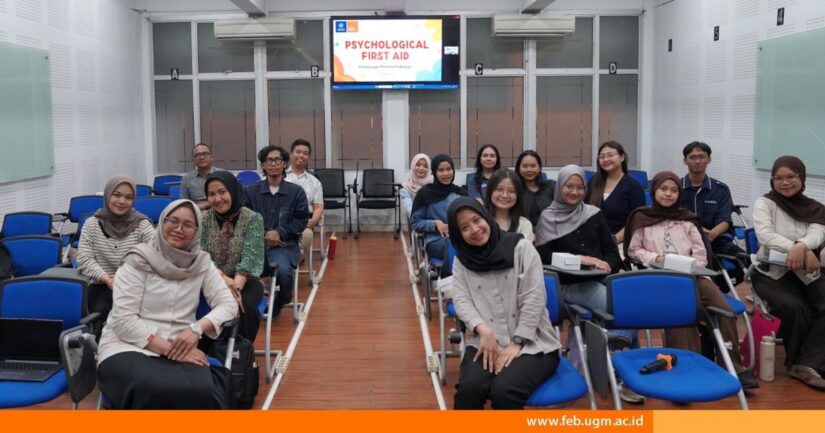
“When a friend is facing a problem, we sometimes find ourselves unsure of how to respond. However, we do not always need to have a solution to help them. We can start by listening, understanding how they feel, and showing them that we are willing to be there for them,” explained Nadya Salmadevi, S.Psi., M.Psi., Psychologist from the Career and Student Development Unit (CSDU) of the Faculty of Economics and Business, Universitas Gadjah Mada (FEB UGM), during a Psychological First Aid (PFA) training session for students held by FEB UGM on Tuesday (17/11) at Room U-101, FEB UGM.
The training was part of FEB UGM’s efforts to raise students’ awareness of mental health while equipping them with basic skills to provide psychological support to their peers. Through this program, students were encouraged to understand that psychological first aid does not always have to be provided by mental health professionals. Initial support can also be provided by people close to those experiencing difficulties, including peers, through empathetic communication and a willingness to listen.
Nadya explained that PFA is a communication skill used to support individuals experiencing psychological distress. Its purpose is not to replace the role of psychologists or psychiatrists, but rather to help individuals feel cared for, reduce feelings of isolation, and connect them with appropriate assistance based on their needs.
In practice, PFA is guided by three main principles, known as the 3Ls: Look, Listen, and Link. Look involves observing an individual’s condition and surrounding environment. Listen means providing a safe space for someone to share their experiences without being pressured or judged. Meanwhile, Link refers to connecting individuals with appropriate support systems or professional services when necessary.
During the Listen stage, participants were also introduced to active listening techniques, including being fully present, asking open-ended questions, reflecting feelings, paraphrasing, and offering appreciation. Nadya emphasized that responses should be delivered calmly, without rushing to judge or compare another person’s experiences with one’s own.
Furthermore, she highlighted the importance of recognizing personal boundaries when supporting friends. Being someone else’s confidant does not mean resolving all the problems they face. Those providing support must also take care of their own well-being to ensure they can continue to offer support healthily.
“We also need to recognize our own limits. We are not responsible for all of another person’s feelings or problems. If the situation is beyond our capacity, that does not mean we have to handle it alone. We can continue to accompany our friend and help connect them with mental health professionals,” she said.
The training continued with a practical session through role-play activities. Participants were invited to respond to situations commonly encountered in student life, such as the pressure of completing a final thesis, anxiety about examinations, and interpersonal relationship problems. Through these exercises, students had the opportunity to practice applying the 3L principles and active listening techniques in everyday situations.
Nadya reminded participants that even simple support from people close to someone experiencing difficulties can make a meaningful difference. Being present and willing to listen can be the first step in helping others feel that they are not alone.
Report: Dwi Zhafirah Meiliani
Editor: Kurnia Ekaptiningrum
Sustainable Development Goals