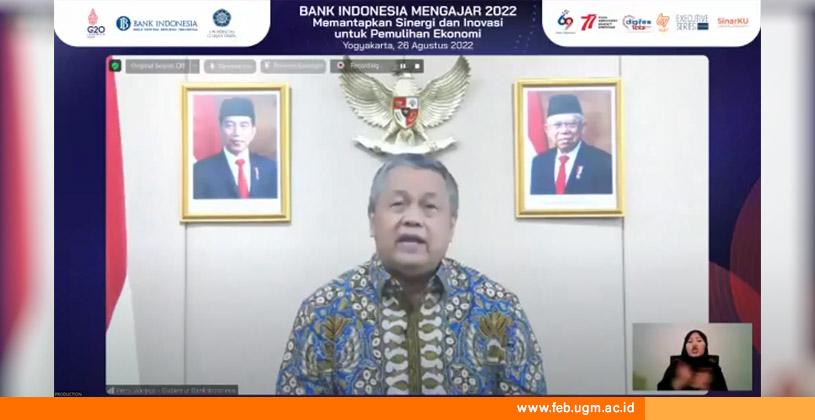
In the purpose of education and improving economic literacy for the advancement of education in Indonesia, the Bank Indonesia Institute (BI Institute), Universitas Gadjah Mada (UGM), and the BI DIY Representative Office collaborated to implement the BI Teaching program. BI Teaching also aims to provide participants with a deeper understanding of BI’s vision, mission, role, and policies, which are crucial to the nation’s economy. This includes the growing role of BI in the digital era, enabling it to make a meaningful contribution to Indonesia. The BI Teaching program has been held at several selected universities across Indonesia, and this time it was held at UGM on Friday (26/8). The BI Teaching event was held in conjunction with the 69th BI Anniversary and the 7th RI Anniversary. This activity is part of the Executive Series of Master of Management (MM) FEB UGM in the context of the 67th Anniversary of FEB UGM. BI Teaching is also part of the Seminar and Public Lecture (SinarKU) of the Department of Economics, Faculty of Economics and Business (FEB) UGM. BI Teaching was attended by undergraduate and postgraduate students of FEB UGM, as well as invited guests.
BI Teaching invited the Governor of Bank Indonesia, Perry Warjiyo, S.E., M.Sc., Ph.D., as the speaker. BI Teaching was also attended by the Rector of UGM, Prof. dr. Ova Emilia, M.Med.Ed., Sp.OG., Ph.D., and the Dean of FEB UGM, Prof. Dr. Achjari, M.Com. Ak, CA., Head of Bank Indonesia Institute, Dr. Yoga Affandi, Dicky Satria as Chair of the BI Teaching Committee, Head of BI Representative for the Special Region of Yogyakarta, Budiharto Setiawan, S.H., M.Sc., Chair of the DIY Indonesian Economic Bachelors Association (ISEI), Eko Suwardi, M.Sc., Ph.D. , Chairman of Kafegama, Dr. Bogat Agus Riyono, M.Sc. Ak, CA., Vice Dean for Research, Community Service, Cooperation, and Alumni, Gumilang Aryo Sahadewo, S.E., M.A., Ph.D., Head of the Master of Management (MM) Study Program Jogja Campus, Amin Wibowo, S.E., M.B.A., Ph.D., Head of the MM Study Program Jakarta Campus, Tandelilin Eduardus, Prof., Dr., M.B.A., Head of the Department of Economics, Rimawan Pradiptyo, S.E., M.Sc., Ph.D., and Professor of the Department of Economics Prof. Dr., Insukindro, M.A.
BI Teaching began with an opening by the presenter, followed by the chanting of Indonesia Raya and the Hymn of Gadjah Mada. The event continued with the Governor of BI presenting certificates from the Bank Indonesia Social Program (PSBI) to the Dean of FEB UGM. BI Teaching continued with a prayer session and a group photo. Then, the Rector of UGM, Prof. dr. Ova Emilia, M.Med.Ed., Sp.OG., Ph.D., delivered remarks on BI Teaching. Followed by remarks from the Dean of FEB UGM, Prof. Dr. Didi Achjari, M.Com. Ak., CA.
The BI Teaching discussion was moderated by Muhammad Fawdy Renardi Wahyu, an Academic Assistant at FEB UGM. Fawdy invited Perry to start the discussion. Perry then started a discussion by explaining the urgency of BI Teaching and stating the main theme of BI Teaching is “Consolidating Synergy and Innovation for Economic Recovery. Perry divides the series of discussions into five broad outlines. On the first point, Perry explained the role of BI in Indonesia’s economy. As the central bank, BI plays a crucial role in maintaining monetary stability, the financial system, and the payment system, thereby supporting healthy, sustainable, and inclusive economic growth and enhancing people’s welfare. BI manifests this with Monetary Policy, Macroprudential Policy, and Payment System Policy. In the second point, Perry discusses the Framework for the Synergy Mix of National Policy & BI, illustrated by a graph of the growth of economic capacity and economic conditions in the influence of national policies. In this case, Central Bank Policy, Fiscal Policy, and Structural Reforms are intertwined and continuous in their efforts to instill national stability, explained Perry. Within BI itself, the three central bank policies were also formulated to blend and synergize, assisted by supporting policies, as Perry added. In the third point, Perry explained the urgency of innovation at the leading digital central bank. Perry presented an infographic titled ‘Digital Financial Economic Ecosystem 2025’ which underlines financial inclusion and digitalization of the Real Sector, particularly by applying the Indonesian Standard Quick Response Code (QRIS) in markets and tourist areas in order to strengthen Indonesia’s advanced competitiveness in the global arena. In this regard, Indonesia has launched the Payment System Blueprint 2025, which aims to integrate Indonesia’s digital financial economy on a national level.
In the fourth point, Perry elaborated on the current economic challenges. Indonesia’s domestic economy is in a strong position, marked by positive economic growth, robust consumption, and sustained exports over several quarters. However, turmoil in the international economy, triggered by COVID-19 and Geopolitical Conflicts, has resulted in stagflation and rising food and energy prices, as explained by Perry. Responding to economic challenges, Perry explained that BI has 5 pillars (policies), namely monetary policy, macroprudential policy, payment systems, money market development, and an inclusive and green financial economy. Monetary policy focuses on supporting stability (pro-stability), while the other four policies support development (pro-growth). Its implementation in the Decision of the BI Governor’s Meeting 22-23 August 2022, as a pre-emptive and forward-looking step, BI increased the BI 7-Day Reverse Repo Rate by 3.75%, the Deposit Facility (DF) Interest Rate by 3.00%, and the Lending Facility (LF) Interest Rate by 4.50%. In addition, BI has also set other policies to strengthen stability and support development, including market operations to hold food inflation, continuing transparency of basic lending rates (SBDK), and broad application of QRIS for the campaign to digitize Indonesia, as well as international cooperation through forums, e.g., G20 and ASEAN Connectivity. At the end of the BI Teaching, Perry opened a question session, guided by Fawdy.
Reportage: Hayfaza Nayottama