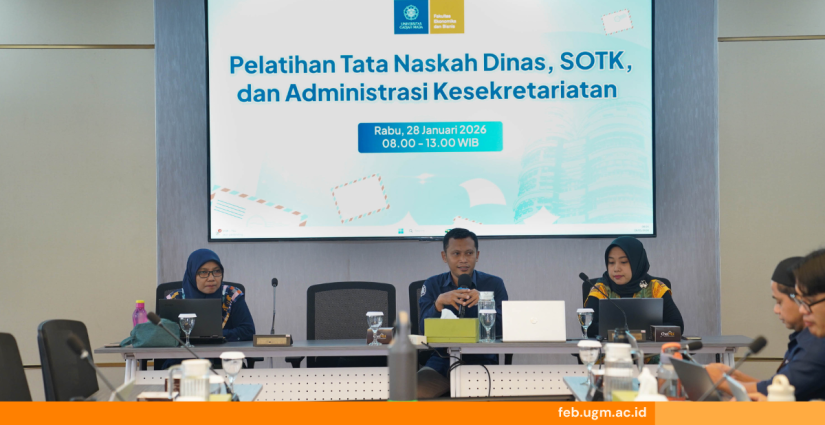
The Faculty of Economics and Business, Universitas Gadjah Mada (FEB UGM), held a training program on Official Correspondence, Organizational Structure and Governance (SOTK), and Secretariat Administration as part of efforts to enhance the competencies of FEB UGM professional staff in administrative and correspondence management. The activity took place on Wednesday (January 28) at the Kertanegara Room, FEB UGM.
The Head of the Administrative Office of FEB UGM, Nur Bakti Susilo, S.E., Ak., CA., ASEAN CPA., emphasized the importance of a shared understanding and continuous knowledge updates regarding official correspondence and secretariat administration. It is expected that, through this training, professional staff involved in correspondence processes will gain a stronger understanding of official document management. It will enable them to draft letters accurately and efficiently in accordance with prevailing regulations.
The training featured several speakers from Universitas Gadjah Mada. In the first session, Deni Clara Sinta, S.H., M.H., from the UGM Bureau of Law and Organization, delivered a presentation on Organizational Structure and Governance (SOTK) and Official Correspondence. She explained that SOTK plays a crucial role in determining authority and accountability, streamlining communication flows, ensuring administrative order, preventing procedural errors, and reducing ambiguity.
She also elaborated on the types of official documents and the authority to sign them based on organizational hierarchy, as well as on administrative ethics, including the management of official letter numbering.
“Official documents have legal force and can be used as evidence in court with strong evidentiary value, as long as they are prepared in accordance with regulations and meet the requirements of authenticity, clarity, and appropriate context of use,” she explained.
Meanwhile, Farida Yuliani, S.S., M.A., from the UGM Bureau of Strategic Management, presented a session titled Techniques for Drafting Official Correspondence. She invited participants to critically examine common mistakes in official letters, such as improper use of logos and letterhead, and inaccuracies in writing recipients and carbon copies. She also highlighted the importance of using proper and correct language in official correspondence.
“The language used in official correspondence must be standard and effective to avoid multiple interpretations, as official letters represent the institution and must be clearly understood by their recipients. Avoid ineffective wording or forms that do not comply with the rules of the Indonesian language,” she stated.
The training concluded with a presentation on Secretariat Administration by Brita Hapsari, S.Pd., M.Sc., from the UGM Office of Institutional Relations, who emphasized the role of administrative staff in the era of digital transformation. She explained that while technology supports many administrative tasks, it does not replace the human role; instead, it requires staff to be more adaptive, responsive, and meticulous in filtering information.
“Secretaries or administrative staff are no longer merely part of the administrative support system, but also serve as strategic partners to leaders, problem solvers, and agents of change to ensure that decision-making processes become more effective and efficient,” she added.
Through this training, FEB UGM reaffirms its commitment to enhancing professionalism in administrative services, strengthening orderly and accountable correspondence governance, and supporting the performance of leadership and the academic community.
Report by: Shofi Hawa Anjani
Editor: Kurnia Ekaptiningrum
Sustainable Development Goals