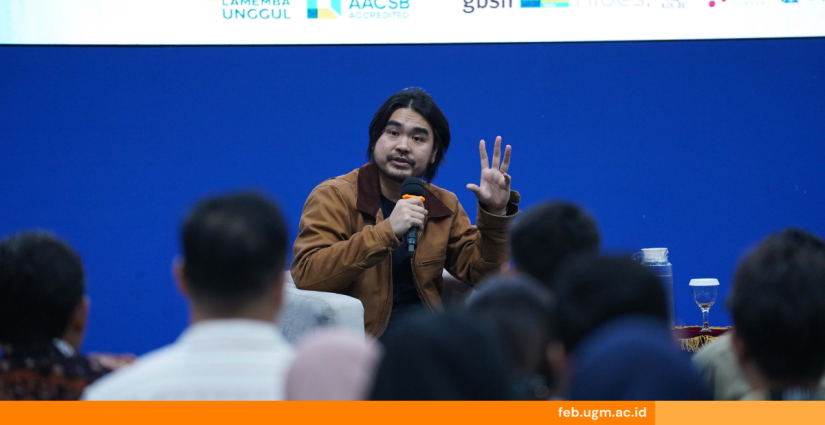
The role of universities as centers of knowledge development was a key focus of the talk show titled Higher Education for Impact & Adaptive Graduates, organized by the Faculty of Economics and Business, Universitas Gadjah Mada (FEB UGM). The discussion featured Bagus Muljadi, Assistant Professor at the University of Nottingham, and was moderated by Wisnu Setiadi Nugroho, Economics lecturer at UGM.
During the discussion on the 8th Floor of the FEB Learning Center on Thursday (5/2/2026), Bagus discussed the challenges universities face in producing impactful, interdisciplinary research. He emphasized that universities should not only function as educational institutions but also as spaces where scientific ideas relevant to societal needs and global developments are born.
One of the fundamental issues highlighted was the limited ability of higher education institutions to articulate concrete research questions. According to Bagus, many strategic issues, such as food self-sufficiency, digitalization, and artificial intelligence, have been widely discussed but have not been followed by systematic problem formulation. He noted that every discipline has the potential to address societal challenges if directed toward the right research questions.
“We live in an era of incompetence where the highest authorities in education do not articulate research questions. They do not translate high-level language such as food self-sufficiency, digitalization, or AI into research questions,” he stated.
Bagus stressed that research quality is determined not only by the methodology used but also by the accuracy of the research questions formulated. He noted that many major research breakthroughs began with simple yet fundamental questions. He cited Bell Labs, which produced many important innovations because its research started with clear, fundamental questions.
The issue of how to formulate a research question also relates to the academic incentive system, which still relies heavily on publications and citations as the leading performance indicators. Attention must be paid to the social impact of research so that universities can contribute to solving societal problems.
In developed countries, university research is supported not only by governments but also by the private sector through industry collaboration. Collaboration among universities, governments, and the private sector enables research to grow while remaining relevant to public needs. By contrast, research funding in Indonesia remains relatively limited, with little strong collaboration.
Bagus also emphasized the importance of interdisciplinary collaboration in driving scientific innovation. Many scientific advancements emerge from the intersection of multiple fields unified by shared research questions. However, closed academic practices and tendencies towards academic inbreeding limit the diversity of perspectives in higher education.
In the context of rapid technological change, the development of artificial intelligence has also become an essential part of the discussion. Bagus believes AI has the potential to create a gap between those who can use technology wisely and those who become passive users.
“AI will create something like that as well. An AI divide. You either capitalize on it or you become the slaves of it.”
He explained that AI works through simulation and language prediction. Without analytical thinking skills, humans risk becoming mere consumers of technology. Therefore, higher education must ensure that students have strong foundations in logical thinking, language, and argumentation.
He also highlighted the importance of academics engaging in public spaces so that knowledge remains connected to society. In the digital era, the roles of scientists, lecturers, and researchers are increasingly essential for bridging science and social life.
“Scientists, lecturers, researchers, academics, you have to talk to the people,” he said.
Bagus also emphasized the importance of developing perspectives grounded in local wealth through research across various fields. He cited archaeological discoveries in Sulawesi and research on the Merapi region as significant Indonesian contributions to global scientific development. According to him, approaches based on local strengths can enhance universities’ relevance to societal needs.
Reporter: Dwi Zhafirah Meiliani
Editor: Kurnia Ekaptiningrum
Sustainable Development Goals