
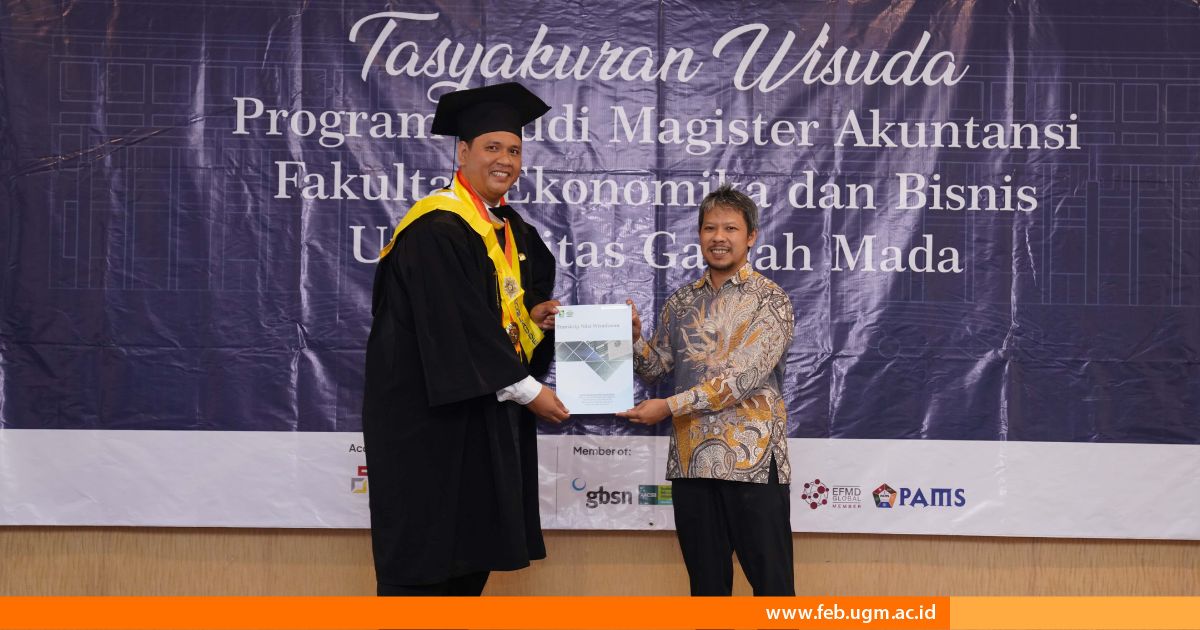
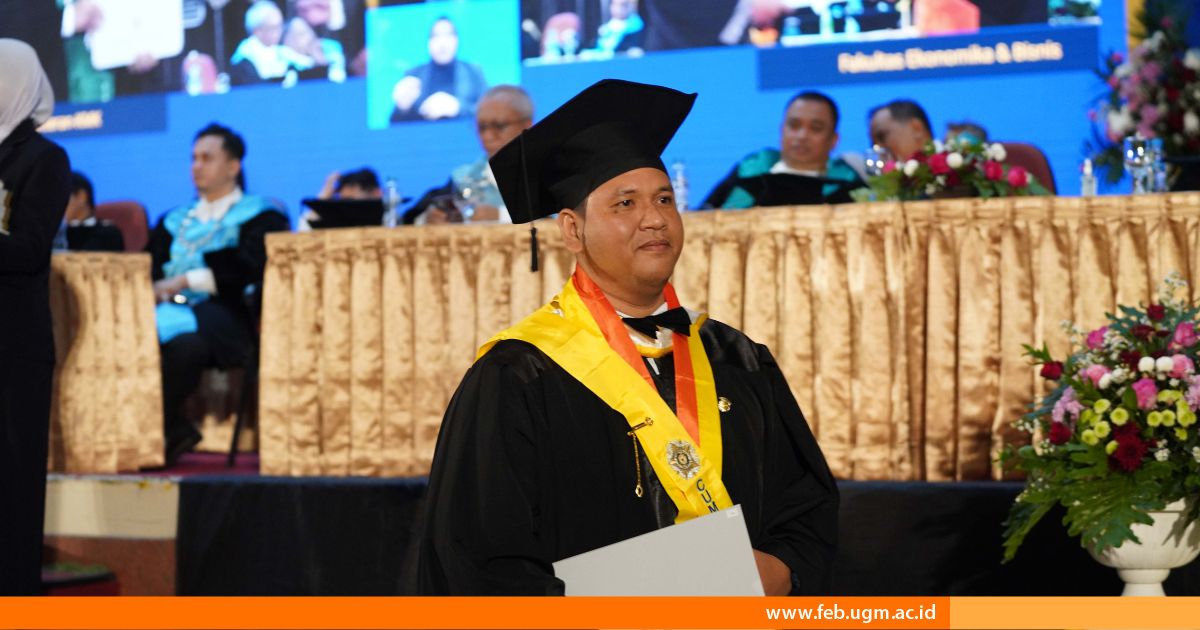
After six years working as an auditor at the Financial and Development Supervisory Agency (Badan Pengawasan Keuangan dan Pembangunan/BPKP), Rifathi Syadzli had no hesitation about returning to the classroom. He graduated from the Master of Accounting (Maksi) Program at the Faculty of Economics and Business (FEB) UGM during the fourth postgraduate graduation period, earning a cumulative GPA of 3.97 and completing his studies in 1 year, 9 months, and 24 days.
He achieved this accomplishment while balancing the demands of his career and family. For Rifathi, the result was the product of a long and demanding process rather than something that came overnight.
“Over nearly two years of studying in the Master of Accounting program, the academic pace was quite demanding, and that was not even including my responsibilities outside of university. So, in my opinion, this result is quite satisfying,” he said.
Before pursuing a career in auditing, Rifathi worked as an accounting staff member at a manufacturing company and later as an accounting supervisor at a logistics company between 2015 and 2018. In 2019, he joined BPKP as an auditor. For the past four years, he has been assigned to the investigative audit division, which calculates state financial losses in various cases.
His professional experience encouraged him to apply to two master’s programs through the Indonesia Endowment Fund for Education (LPDP) scholarship: the Master of Accounting program at UGM and a similar program at the University of Indonesia. After considering the differences in their academic focus, he ultimately chose FEB UGM.
“I found that UGM places more emphasis on the public sector, whereas the Universitas Indonesia focuses more on the private sector,” he explained. He added that the strong track records of FEB UGM faculty members in the public sector further reinforced his decision to choose the university.
 The idea for Rifathi’s thesis emerged from his own experience in the field as an auditor. He witnessed firsthand how the orientation of internal government auditing had shifted from merely assessing compliance to evaluating performance, in line with the growing number of performance audit assignments conducted by government internal auditors each year.
Using Weick’s sensemaking framework, Rifathi’s qualitative research explored this issue through three research questions. His first finding revealed a clear pattern: auditors generally adhere to formal guidelines and audit methodologies, while auditees tend to prioritize flexibility in response to the realities they face in the field.
“For example, take the performance indicator for guidance and development. According to auditors, guidance must be strictly in line with the rule. The regulations cover three aspects: supervision, training, and monitoring. All three must be included in the performance indicators,” he explained.
On the other hand, auditees often face circumstances in which implementing all three elements simultaneously is impossible due to various field-related limitations. As long as the program’s objectives are achieved, written rules are often set aside, even though the implementation remains substantively effective.
These differences in interpretation shape the interaction between auditors and auditees in the field. Rifathi compared the situation with that in countries such as Sweden, where communication between the two parties is much more intensive to establish a shared understanding of an indicator. In his view, such a space for dialogue remains relatively uncommon in performance audit practices in Indonesia.
Auditees tend to be defensive and remain silent, while auditors tend to be more assertive, insisting that every point be met. But the auditees’ silence does not mean that they agree,” he said.
According to Rifathi, such silence is an avoidance strategy to prevent them from becoming targets of further scrutiny by auditors. This pattern eventually leads to audit recommendations being followed up merely to fulfill administrative requirements, without addressing the underlying problems. He likened the situation to cutting off branches without ever reaching the roots, reflecting a longstanding issue in government performance auditing in Indonesia.
Throughout the thesis process, Rifathi was supervised by Suyanto, S.E., M.B.A., Ph.D. He recalls one of the most challenging stages of his research, when his work came to a halt for nearly a month because the thematic analysis approach he was using could not accommodate several field codes. In response to this impasse, Suyanto suggested the Gioia Methodology, an approach that was relatively new and not yet commonly used at the master’s level.
Beyond the academic process, Rifathi considers the discussions with his classmates among the most memorable aspects of his time in the Master of Accounting program. In his view, the two hours spent in class for each course were far shorter than the time they spent discussing topics together afterward.
This habit eventually developed into a community called Governomics, an acronym for Governance and Economics, which Rifathi initiated with several classmates from professional backgrounds.
“Even now, although I have graduated and several other Governomics alumni have also graduated, we still hold discussions. We hope Governomics can continue to exist as a platform that facilitates interaction between academics and practitioners,” he said.
Amid a routine divided between academic responsibilities and family life, one book accompanied Rifathi throughout his master’s journey: Atomic Habits by James Clear. He would reread the book whenever he needed a reminder of how to view achievement.
“We often get it backward. We first determine what we want to achieve and only then think about how to achieve it. According to James Clear, however, significant results do not come from ambitious goals, but from small habits practiced consistently every day,” he explained.
This perspective shaped the way Rifathi approached his daily life throughout his master’s studies. Rather than setting a specific GPA as his initial target, he focused on making little, steady progress, such as making time to discuss ideas with lecturers and peers whenever possible and completing assignments as soon as they were given, rather than allowing them to pile up.
In the end, the 3.97 GPA came not as the result of a goal he relentlessly pursued, but as the consequence of the small habits he consistently maintained along the way.
Report: Dwi Zhafirah Meiliani
Editor: Kurnia Ekaptiningrum
Sustainable Development Goals