
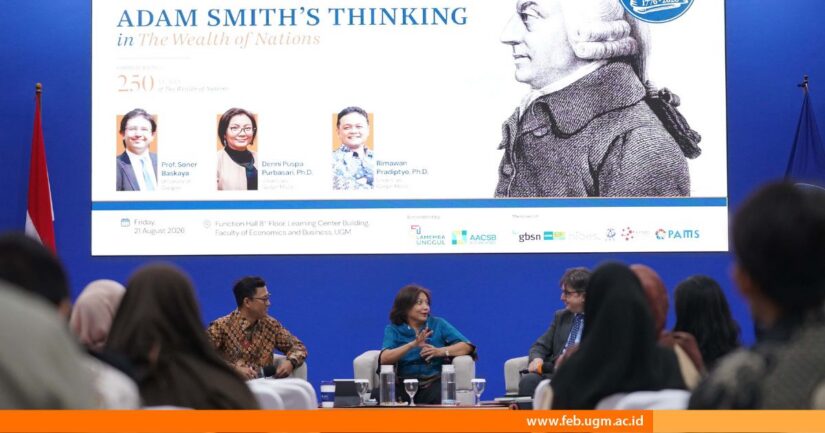
Banking regulation, the design of public policy incentives, and justice in behavioral economics—topics that may seem far removed from one another—actually converge at a single point: the ideas of Adam Smith. In a discussion forum, three academics demonstrated that Smith’s ideas are often misunderstood as advocating free markets, when in fact he proposed something far more nuanced.
This issue was the focus of a discussion forum titled “The Relevance of Adam Smith’s Thinking in The Wealth of Nations for the Current Economic Development,” organized by the Faculty of Economics and Business, Universitas Gadjah Mada (FEB UGM), together with the Adam Smith Business School, University of Glasgow, on Friday (August 21, 2026), at the Auditorium of the FEB UGM Learning Center Building.
Financial Regulation That Is Often Misunderstood
Prof. Soner Baskaya from the University of Glasgow explained that Smith’s ideas on financial regulation are often misinterpreted. He referred to the party-wall metaphor used by Smith to illustrate the need for boundaries between financial institutions, so that risks arising at one bank do not spread throughout the entire system.

“Adam Smith stated in 1776 that the actions of banks could create systemic risks within the banking system, and to prevent this, some kind of separating wall was necessary,” he explained.
Soner explained that financial markets are fundamentally different from markets for goods such as apples or oranges. According to him, long-term lending transactions involve much greater information asymmetry, as lenders must trust borrowers without knowing the feasibility of their projects or their intentions to repay.
“If you’re trading apples, the worst thing that can happen is that you only realize the inside is rotten after you get home. But with a 30-year loan transaction, you have to start by trusting the person applying for the loan, even though all of this takes place amid very significant information asymmetry,” he said.
He added that financial deregulation since the late 1970s, which eventually contributed to the 2008 global financial crisis, was actually contrary to Smith’s original ideas. According to him, an unregulated financial sector tends to generate risks because it focuses solely on private gains and fails to account for negative externalities.
Incentives and the Government’s Role in Skills Development
FEB UGM economist Denni Puspa Purbasari, Ph.D., brought a labor-policy perspective by relating Smith’s ideas to her experience leading the Kartu Prakerja Program in the early stages of the COVID-19 pandemic. The program provided cash incentives to participants who completed training, based on the assumption that people are more likely to complete a process when an incentive motivates them.

“I hypothesized that we would gain complete knowledge if we completed the training with full commitment as well. If the training was not completed, or only partially completed, the knowledge would also be incomplete. People respond to incentives, and the clearest incentive is money,” she said.
She recalled that on the first day registration for the program opened, the results far exceeded initial expectations. She said the surge in registrations actually confirmed Smith’s idea that the state has a role to play when there are significant positive externalities. She cited education and skills training as examples, noting that people do not always have the financial capacity to access them independently.
“Adam Smith did not say that we should have a minimum government or a small government. Adam Smith asked us to be more careful and more precise about the forms of intervention carried out by the government in the economy,” she stressed.
Moral Sentiments and Behavioral Economics
Rimawan Pradiptyo, Ph.D., a lecturer in the Department of Economics at FEB UGM, highlighted another rarely discussed aspect of Smith’s thinking: The Theory of Moral Sentiments. From the perspective of behavioral economics, he argued that the work cannot be viewed in isolation from The Wealth of Nations, as both explain human behavior, including phenomena such as the recency effect and loss aversion.
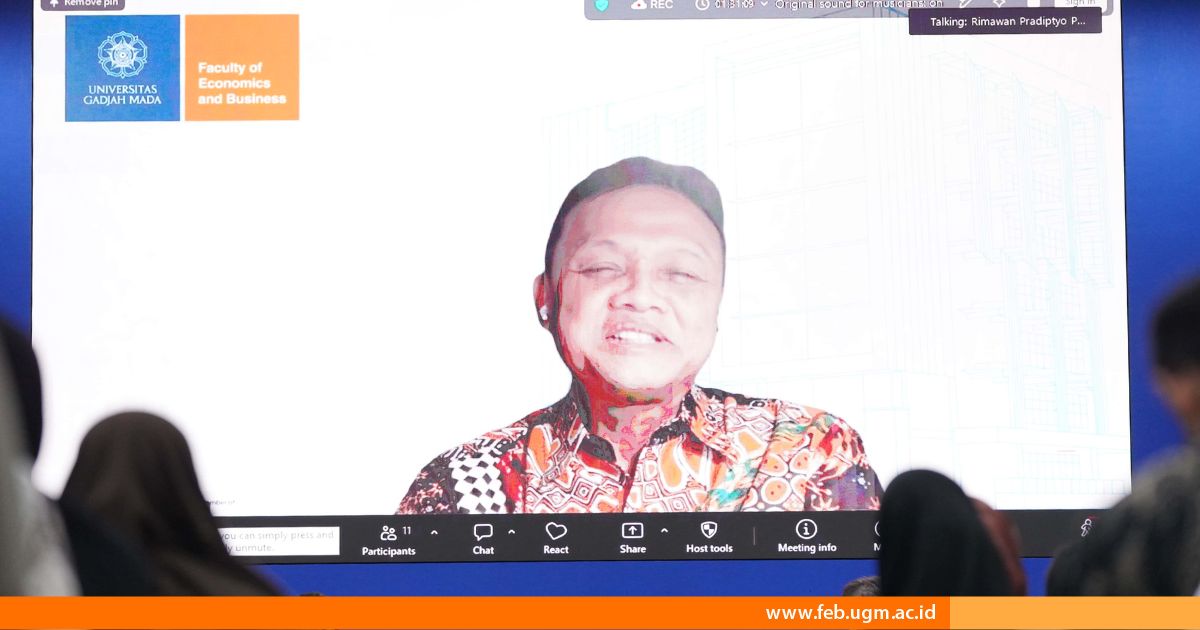
“From the perspective of behavioral economics, the theory of moral sentiments and The Wealth of Nations should be viewed as two complementary works. When we talk about the recency effect and loss aversion, we can examine them from two perspectives at once—from the perspective of Moral Sentiments as well as The Wealth of Nations,” he said.
Rimawan gave the example of his experience establishing Sonjo, or Sambatan Jogja, a mutual-help movement based on a WhatsApp group with approximately 2,300 members that remained active throughout the pandemic. The movement was designed without monetary transactions, so assistance was provided purely on the basis of trust and a sense of fairness among members. Based on this principle, Sonjo successfully facilitated free vaccination with 175,000 doses, which, according to the Ministry of Health, was among the lowest-cost vaccination systems in Indonesia.
“We created a kind of self-selection bias in the way people helped one another. When a philanthropic institution offered to finance all of our vaccination needs, I refused. If we had accepted it, the social capital that had already been built would have collapsed,” he said.
The discussion also addressed several contemporary issues, ranging from the housing crisis driven by property speculation and land-ownership inequality to the impact of artificial intelligence on the world of work. The three speakers agreed that Adam Smith never supported unlimited free markets. Rather, markets still require strong institutions, law enforcement, and redistribution mechanisms to ensure that the benefits of economic growth are not enjoyed only by a small group of people.
At the close of the discussion, the three speakers encouraged the students and young academics in attendance to continue reflecting and avoid rushing to take positions when addressing complex economic issues.
Report: Dwi Zhafirah Meiliani
Editor: Kurnia Ekaptiningrum
Sustainable Development Goals