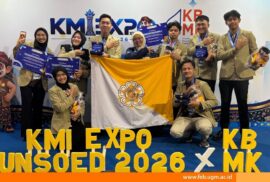
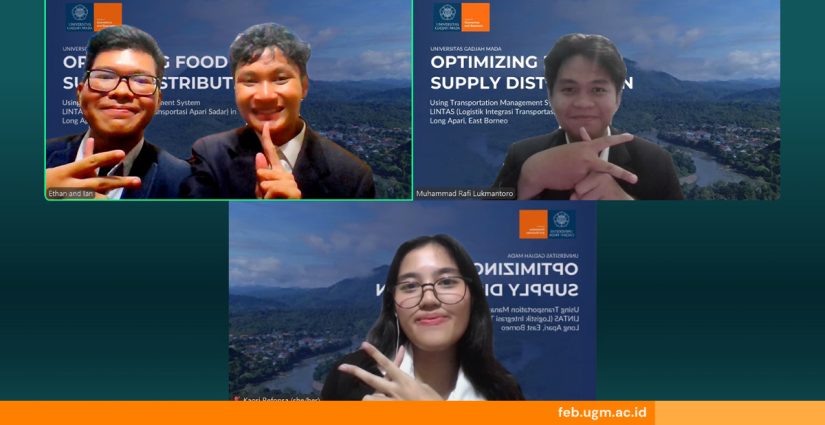
A student team from the Faculty of Economics and Business, Universitas Gadjah Mada (FEB UGM), successfully won second Place in the GBSN 2025 Social Logistics Challenge, organized by the Global Business School Network. This global competition, held online on 13 November 2023, challenged students to develop technology-based and sustainable social logistics solutions.
Developing LINTAS
The UGM students competing under the name Kiki’s Logistic Service—Jacques Ethan Nathanael Gultom (Accounting, 2022), Muhammad Rafi Lukmantoro (Accounting, 2022), Nabila Kaori Refonsa (Economics, 2022), and I Putu Adhimas Radiansyah Aryawan (Archaeology, 2022) proposed the development of LINTAS (Logistik Integrasi Transportasi Apari Sadar). LINTAS is a transportation management system (TMS) designed to optimize food distribution in Indonesia’s remote regions, including Long Apari District in Mahakam Ulu Regency, East Kalimantan Province.
Ethan explained that the proposed solution aims to help address the persistent challenges faced by geographically remote and isolated areas in maintaining consistent access to food supplies. The system integrates various modes of transport, community-based logistics networks, real-time supply data, and Continuous Replenishment (CRP) monitoring.
“The goal is to reduce delivery delays and enhance logistics accessibility. By leveraging digital logistics management, this framework demonstrates how technology can strengthen supply chain resilience and food security in areas with limited infrastructure and connectivity,” Jacques said on Wednesday (3/12/2025).
Enhancing Food Distribution
According to Ethan, LINTAS is expected to address social logistics issues caused by Long Apari’s reliance on the Mahakam River as its primary distribution route. During the dry season, water levels drop, and vessels are unable to operate. This situation disrupts the entire supply chain rice prices can soar to IDR 1–1.2 million per 25 kg, fuel becomes scarce, electricity is rationed, and communication networks weaken.
The idea for LINTAS emerged after the team conducted an in-depth study of the region’s geography, infrastructure, food prices, and distribution chain. According to Ethan, the pattern was clear: Long Apari has a single point of failure along the Mahakam River. LINTAS was therefore designed to ensure distribution is no longer dependent on just one route.
“Through LINTAS, we aim to break this annual cycle by building a more integrated transportation system supported by logistics hubs, multimodal routes, and TMS+IoT to monitor goods flow in real time,” he explained.
Competing Against Hundreds of Teams
Kiki’s Logistic Service earned this achievement after persevering through several stages, from selection to the final round. They competed against 100 teams from 48 higher education institutions across 48 countries. During the final, they were required to present their solution.
“In the final round, we had only ten minutes to present our solution through a PPT deck we developed, so every detail had to be concise, sharp, and on point,” Ethan recalled.
Meanwhile, Nabila shared that participating in the competition provided invaluable experience. One memorable moment was watching the presentation by Better Vietnam from BI Norwegian Business School, which won first Place. She noted that their content and presentation design were particularly compelling.
“The biggest lesson from joining this competition is not to be afraid to try. You will never know the result unless you try,” Nabila said.
Nabila added that their achievement was made possible thanks to the team’s hard work and strong collaboration, as well as the guidance of their supervisor, Ahmad Zaki, S.E., M.Acc., Ph.D., and support from FEB UGM through mentoring sessions. They hope to continue excelling and bringing pride to the faculty and the university.
Reportage: Kurnia Ekaptiningrum
Sustainable Development Goals