
The floods and landslides in Aceh, North Sumatra, and West Sumatra on 25-27 November 2025 not only left deep sorrow among the communities affected but also caused significant damage. The disaster also caused paralysis in various sectors of life, including education.
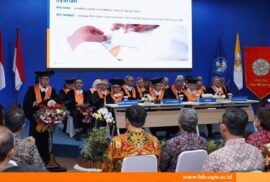
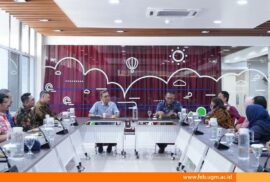
Professor of the Faculty of Economics and Business, Universitas Gadjah Mada (FEB UGM), Prof. Dr.rer.soc. R. Agus Sartono, M.B.A., believes that local governments need to immediately map and determine locations for the reconstruction of damaged educational infrastructure and hospitals after the emergency response period. This is because it is highly likely that the region’s capacity will be insufficient, mainly since local governments generally rely on central government transfers from the state budget, which are usually disbursed gradually and only become available at the beginning of the following year. The government can optimize fiscal space while using reserve funds for disaster management.
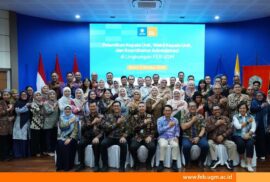
“Let’s take a closer look at one of the programs that can be streamlined to be more realistic, namely the Free Nutritious Meals (MBG) program,” he said on Friday (19/12/2025) at FEB UGM.
Agus mentioned that MBG is a strategic program included in Asta Cita to strengthen human resource development. This program has a significant multiplier effect, improving child nutrition, preventing stunting, enhancing the quality of children’s learning, instilling positive character and promoting healthy living, creating job opportunities, preventing urbanization, encouraging economic growth, and supporting MSMEs.
“Of course, the multiplier effect will be much greater if the potential for leakage or misallocation of MBG funds can be avoided,’ said the man who once served as Deputy for Education and Religion, Coordinating Ministry for People’s Welfare/PMK 2010-2021.
The government has allocated the MBG program’s 2026 budget at Rp 335 trillion. This requirement is met by the education sector at Rp223.6 trillion, followed by reserve funds at Rp67 trillion, the health sector for pregnant women and toddlers at Rp24.7 trillion, and the economic sector at Rp19.7 trillion.
Will all the funds be absorbed? The Basic Education Data (Dapodik) indicates that the number of potential beneficiaries is estimated at 55.28 million students, with a budget of Rp 15,000 per student. However, since the effective number of school days is only 190 days, the estimated funding requirement for the MBG program in 2026 for both school and boarding school students is only Rp 157.55 trillion.
“This is assuming that the MBG program can be implemented to cover all 55.28 million students. It would be highly irrational to calculate the MBG budget based on 360 school days,” he said.
Agus also questioned how to distribute MBG during school holidays. It is inappropriate to continue providing MBG in dry form when children are not attending school. This could lead to a waste of the MBG budget and deviate from the original idea of providing nutritious food. A new problem arises if MBG is distributed during school holidays, as children must collect it from school. First, children lose their holiday time, and parents must take their children to school to collect their MBG rations. Second, there are the costs and time that children and parents must spend. Third, parents find it challenging to spend their school holidays with their families. In fact, families really need this time to build better family bonds. Providing MBG during school holidays has the potential to cause significant budget distortions and leaks.
Agus mentioned that there is a potential surplus of MBG funds from the education sector that cannot be absorbed, amounting to Rp66.05 trillion. This potential does not include MBG funds for pregnant women and toddlers. According to him, the National Nutrition Agency (BGN) and Bappenas need to carefully calculate and design the implementation of the MBG program. A good program should not become ineffective and cause problems in the future due to careless implementation.
“The MBG program can still run, while the potential surplus funds from the MBG can be optimized. It is equally important to ensure that the MBG program provides Rp15,000 per student per day, but the actual amount is far below that,’ he explained.
He believes that the government needs to rationalize strategic programs. One such program is the Free Nutritious Meals (MBG) program in the education sector, whose potential surplus budget could be used to assist in disaster relief efforts in Aceh, North Sumatra, West Sumatra, and other areas, as well as to rebuild severely damaged school infrastructure.
“Absorption capacity must be more realistic, especially when disasters occur that require urgent handling. Remember that the devil is in the details, and we all need to ensure that the funds collected through taxes are realized appropriately,” he explained.
According to him, reserve funds can be diverted to provide cash assistance after an emergency response. A critical step is to immediately map the educational infrastructure that requires relocation, determine new locations, and implement a policy that includes the relocation of permanent residents. This is important so that, after construction, residents do not incur high costs to obtain educational services.
Reportage by: Kurnia Ekaptiningrum
Sustainable Development Goals