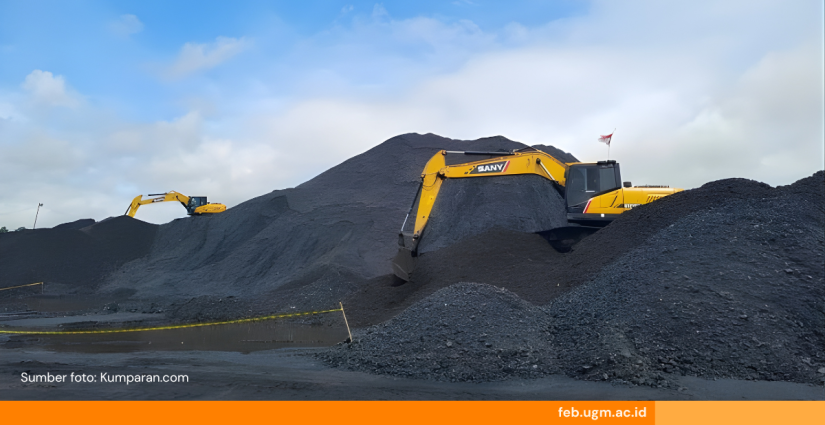
Amid government efforts to safeguard state revenue and energy stability, the discourse on cutting coal production has resurfaced. A lecturer from the Department of Economics, Faculty of Economics and Business, Universitas Gadjah Mada (FEB UGM), Ardyanto Fitrady, Ph.D., believes that reducing coal production would not be an effective solution to influence coal prices in the international market. Although Indonesia is one of the world’s largest coal exporters, it does not possess the largest coal reserves globally.
Ardyanto, commonly known as Arfie, explained that Indonesia’s limited coal reserves are the main reason why production cuts would not have a significant impact on the global market. Indonesia holds only around 3 percent of total global coal reserves, far below countries such as the United States, which controls about 22 percent of international reserves, followed by China, India, and Australia.
“This means our economy is highly exploitative; we extract as much as possible now, while other countries tend to conserve their reserves,” he said on Wednesday (6/1/2025) at FEB UGM.
He further explained that cutting coal production in Indonesia would not automatically affect the global market balance. As long as global demand remains high, supply can easily be met by other producing countries if prices increase. This situation differs from commodities such as nickel, where Indonesia holds a strategic position as a major player in both reserves and production.
“When nickel production is reduced, the impact on global prices is immediately felt. Coal does not have the same characteristics,” he explained.
Arfie noted that the discourse on cutting coal production may only have short-term effects. However, in the medium to long term, such a policy is unlikely to have a significant impact on the global market. When Indonesia reduces its production, the resulting supply gap will be quickly filled by other coal-producing countries.
In addition to supply factors, the quality of Indonesian coal is also a concern. Most of Indonesia’s coal production consists of low-calorie coal, while current global demand trends favor high-calorie coal. Low-calorie coal tends to produce higher emissions, making it less aligned with many countries’ commitments to reducing carbon emissions. This condition has prompted several countries to become more selective in choosing coal types or even to begin shifting toward more environmentally friendly alternative energy sources.
Arfie explained that coal is only one of many energy sources. In addition to coal, there are natural gas, a fossil fuel with lower emissions, as well as renewable energy sources such as solar and wind power.
“So substitution does not only come from other supplier countries, but also from other types of energy. Therefore, if the goal of reducing production is to raise coal prices, the impact will be minimal and short-lived. There may be a price increase, but it will not be substantial and only for a very short period,” he said.

Regarding the impact on state revenue, Arfie believes that cutting coal production would not have a significant effect. According to him, state revenue still depends on the product of price and production volume. If prices rise but production volumes fall more sharply, total revenue could actually decline.
“In terms of effectiveness in increasing state revenue, this policy needs to be evaluated,” he said.
Responding to the impact of such a policy on the trade balance, Ardyanto argued that cutting coal production could actually have an adverse effect. A decline in production would directly reduce coal export volumes, while demand from several major export destination countries is also weakening.
He cited that Indonesia’s coal exports to China have decreased by around 30 percent, while exports to India have fallen by approximately 15 percent. This condition, he said, limits coal’s contribution to the trade balance surplus.
Arfie added that the most significant risk lies with coal companies, as the policy could reduce sales volumes and company profitability. According to him, profit visibility in the coal sector is relatively straightforward as long as reserves are available, so such a policy disrupts certainty for companies that rely heavily on long-term planning and policy stability.
Furthermore, Arfie stated that if production restrictions were applied to other mineral commodities, the impact would be far more pronounced for nickel. Indonesia’s position as a major player in the global nickel market, both in terms of reserves and production, is a key factor. With such a strategic role, limiting nickel production could directly affect global prices, unlike coal, whose market is more easily substituted.
He also warned of significant risks that must be anticipated from policies aimed at reducing coal production, particularly for mining companies. Before exploitation, the coal industry conducts long-term planning that includes reserve estimation, investment, and projections of returns and profits. Sales volumes will drop when production restrictions are suddenly implemented.
“From a financial perspective, coal is actually very profitable, and its profit visibility is quite clear as long as reserves remain. This policy can disrupt that certainty,” Arfie explained.
Arfie noted that Indonesia already has a Domestic Market Obligation (DMO) mechanism, which allocates 25 percent of coal production for domestic needs with a maximum price of USD 70 per ton. With this mechanism, cutting production is unlikely to disrupt the national electricity supply significantly. However, from the perspective of energy transition, the DMO policy and the application of domestic coal prices may actually hinder the development of renewable energy.
“Coal prices for electricity in Indonesia appear very cheap compared to renewable energy. This condition makes it difficult for renewable energy to compete,” he concluded.
Reporter: Shofi Hawa Anjani
Editor: Kurnia Ekaptiningrum
Sustainable Development Goals