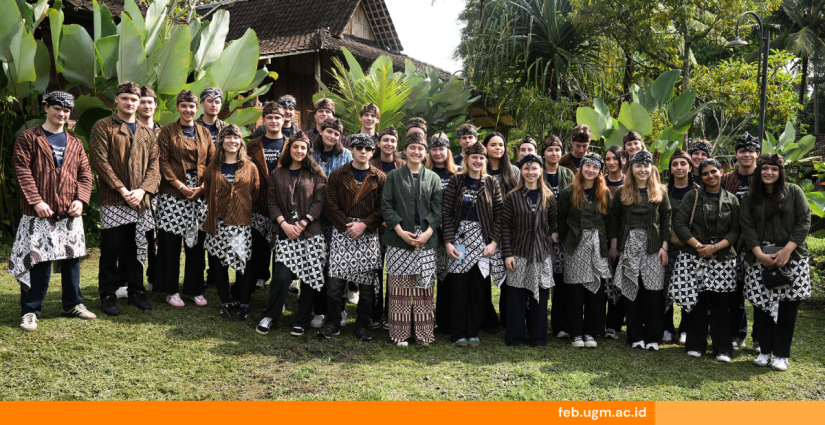
The sound of kentungan (traditional bamboo slit drums), mask dances, and the warm welcome of villagers marked the beginning of an unforgettable cultural experience for international students of the Faculty of Economics and Business, Universitas Gadjah Mada (FEB UGM). Held at Kembangarum Tourism Village, Turi, Sleman, the international students were invited to explore local life and traditions through a series of cultural immersion activities that enabled direct interaction with Javanese culture.
Upon arriving at the village, the friendly rural atmosphere immediately welcomed the participants. On their way to the activity site, the students walked in a line following a child performing a mask dance, accompanied by a man wearing a surjan (traditional Javanese attire) while playing the kentungan. Three international students also played the kentungan while walking, creating a fluid and memorable cultural interaction from the very first step.
Upon arriving at the tourism village area, the students learnt about traditional Javanese clothing and had the opportunity to wear lurik, jarik, and headcloths. They also sampled traditional snacks such as kue lapis, martabak, and tahu telur, and attended a brief introduction to Kembangarum Tourism Village. While wearing lurik, they participated in a lively, enthusiastic icebreaker.
Next, the students were divided into several groups to participate in parallel cultural activities. These included jemparingan (traditional Javanese archery), cooking traditional snacks such as cemplon and klepon, and batik-making.
During the batik class, participants learnt about the basic batik-making process, including materials and tools used, canting techniques, and coloring methods. They then tried canting using the provided basic patterns, experimented with batik stamping techniques, and observed the fabric-dyeing process.
Hasti from Hochschule Pforzheim, Germany, expressed her excitement about participating in the batik activity, as it was her first time making batik directly.
“In Germany, we do not have a batik culture, and it is something new for me. It is gratifying to experience the canting process and see the coloring process,” she said on Thursday (5/2/2025) on the sidelines of the event.
Another activity was cooking cemplon and klepon. The students shaped the dough into small balls and filled them with palm sugar. Several participants admitted it was their first time trying and cooking traditional local snacks. Their faces showed excitement and curiosity as they watched the cooking process and tasted the results.
“This activity is enjoyable, especially because there are two versions of the dish with different textures. The taste was beyond my expectations. It’s delicious, sweet, and reminds me of mochi because of the texture,” said Maria from Hochschule Osnabrück, Germany, after trying klepon.
Meanwhile, during the jemparingan activity, participants sat on mats and received direct instructions from the instructor on the sacred philosophy of the bow, proper holding, and shooting. Each participant had the opportunity to shoot three to five arrows. Some arrows hit the target precisely, while others missed, which added to the excitement of the activity.
Hasti also mentioned that she had tried archery in her home country and found jemparingan to be a different experience.
“It is very exciting to learn archery in a sitting position and using bamboo equipment. It is different from the archery I did in my home country; this version is more traditional and unique,” she said.
Through this activity, FEB UGM hopes to strengthen cross-cultural understanding among international students by integrating local traditional values with global perspectives. The authentic experience at Kembangarum Tourism Village aims to enrich cultural knowledge and build appreciation for Indonesia’s local wisdom.
Reported by: Shofi Hawa Anjani
Editor: Kurnia Ekaptiningrum
Sustainable Development Goals