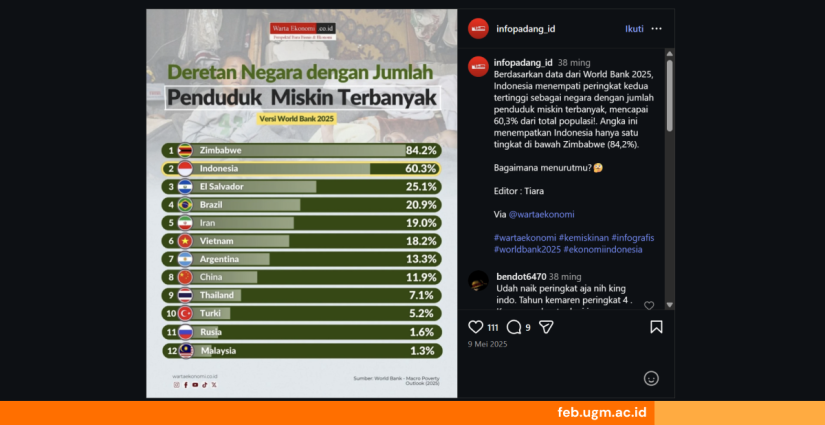
A widely circulated infographic on social media recently claimed that Indonesia ranks as the second-poorest country in the world, reporting a poverty rate of 60.3 percent, compared with Zimbabwe’s 84.2 percent, and attributed the figures to the World Bank.
Lecturer at the Department of Economics, Faculty of Economics and Business, Universitas Gadjah Mada (FEB UGM), as well as the Poverty and Inequality Research Division/EQUITAS (Equitable Transformation for Alleviating Poverty and Inequality), Wisnu Setiadi Nugroho, Ph.D., said that the World Bank has never issued any documents through the Global Poverty Line, Poverty and Inequality Platform (PIP), nor the Macro Poverty Outlook that mentions Indonesia as the second poorest country in the world.
“This narrative does not originate from the World Bank but rather from a misunderstanding and misinterpretation of the concept of purchasing power parity (PPP),” he explained on Thursday (4/2/2026) at FEB UGM.
Wisnu explained that the World Bank relies on purchasing power parity (PPP) based on a poverty line, such as USD 2.15 PPP per capita per day, to measure international poverty rather than converting it using the current exchange rate.
However, many infographics on social media make mistakes, such as multiplying the PPP USD value by the rupiah market exchange rate (±Rp16,000/USD). In fact, the correct conversion must use the Indonesian PPP conversion factor, which is around Rp4,700–Rp5,300 per PPP USD.
“As a result, the poverty line is inflated by almost three times. The number of poor people becomes so distorted that extreme claims arise, such as that more than 60 percent of Indonesia’s population is poor,’ he explained.

So, is Indonesia prosperous enough? Wisnu emphasized that Indonesia records a relatively low rate of extreme poverty. However, the country has a large economically vulnerable population that lives very close to the poverty line. Drawing on data from Statistics Indonesia (Susenas), he noted that raising the current national poverty line to around 1.5 times its present level would classify more than 50 percent of the population as poor or vulnerable. This finding indicates that more than half of Indonesians are not statistically poor but remain highly susceptible to falling into poverty. Increases in food and energy prices, health shocks, job losses, or reductions in working hours can quickly push this group below the poverty line. In welfare economics, scholars refer to this group as the near-poor or the economically vulnerable, and their numbers far exceed the official poverty count.
Wisnu also explained that economists use multiple approaches to determine whether a country is rich or poor. At present, Indonesia defines its national poverty line using a minimum basic needs approach, which focuses primarily on minimum calorie intake and essential non-food needs such as housing, clothing, and basic education. However, many researchers argue that this measure fails to capture contemporary living standards because it does not adequately account for key needs, such as transportation, digital access, decent housing, and protection against economic risks.
For example, reasonable transportation costs, internet and communication access costs, safe and non-overcrowded housing costs, and protection against risks such as savings and social security.
“Therefore, revising or supplementing the poverty line, for example, through a living wage, vulnerability line, or multidimensional poverty approach, is a very relevant discussion and should not be equated with the false claim that Indonesia is the poorest country in the world,” he said.
When asked about Indonesia’s global ranking, Wisnu emphasized that the World Bank does not compile official rankings of the poorest countries. He stated that the World Bank classifies Indonesia as an upper-middle-income country and that Indonesia’s extreme poverty rate remains far lower than that of low-income countries in Sub-Saharan Africa.
“Indonesia is clearly not one of the poorest countries in the world, let alone the second poorest. However, the issue of vulnerability remains a challenge for Indonesia. Moreover, Indonesia is currently experiencing a middle-class crisis, with fewer people moving up to the upper class and more people falling into the lower class,” he explained.
Reportage by: Kurnia Ekaptiningrum
Sustainable Development Goals