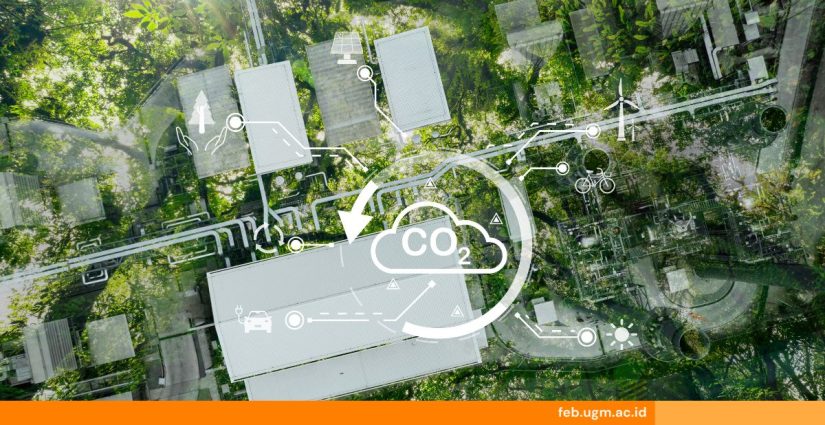
Climate change and carbon emission reduction have become growing global concerns. Commitments from various countries to limit global temperature rise are driving companies to be more transparent in reporting the environmental impacts of their business activities. In Indonesia, these efforts receive further support from policies and sustainability reporting standards that promote the Net Zero Emission (NZE) target.
A lecturer from the Department of Accounting at FEB UGM, Ahmad Zaki, S.E., M.Acc., Ph.D., explained that attention to carbon emission reduction has been developing for decades through various global agreements, such as the Kyoto Protocol and the 2015 Paris Agreement, which have been adopted by nearly all countries worldwide.
As a signatory country, Indonesia has a responsibility to contribute to reducing carbon emissions. One of the steps taken is adopting sustainability reporting standards aligned with international frameworks.
“In Indonesia, sustainability standards based on the International Sustainability Standards Board (ISSB), namely IFRS S1 and IFRS S2, have been adopted and are known as PSPK 1 and PSPK 2,” Zaki stated in the FEB UGM Podcast titled Carbon Intelligence: Measuring and Managing Emissions with AI.
PSPK 1 and PSPK 2 are adaptations of international standards focusing on corporate sustainability disclosures. These standards have been ratified by the Sustainability Standards Board of the Indonesian Institute of Accountants (DSK IAI) and will be implemented starting January 1, 2027. In this context, artificial intelligence (AI) has significant potential to assist companies in collecting, processing, and presenting carbon emissions data.
One of the main challenges in sustainability reporting is the variation in methods and frameworks across companies, making comparisons difficult.
“Entity A, Entity B, and Entity C within the same industry may all disclose their sustainability initiatives related to carbon emissions, but the information is not comparable for investors and creditors,” he explained.
Zaki also made the point that there are usually three categories of carbon emissions: 1, 2, and 3.

Scope 1 refers to direct emissions generated from a company’s operations, such as manufacturing processes. Scope 2 includes indirect emissions from the energy consumed by the company, such as electricity usage. Meanwhile, scope 3 covers indirect emissions from external parties, including suppliers, distribution activities, and team member mobility.
“Scope 3 is the most challenging because the data lies outside the company, such as from suppliers or consumers. It is where technologies like AI can play a role in data collection and analysis,” he added.
In addition to AI, Zaki highlighted that integrating technologies such as the Internet of Things (IoT) can help companies monitor carbon emissions in real time. It allows companies to make quicker decisions without waiting for annual sustainability reports, which are typically released months later.
As the implementation of PSPK 1 and PSPK 2 in 2027 approaches, Zaki emphasized the importance of companies starting to prepare their sustainability strategies now. These strategies should inform not only reports, but also business plans and budgets.
“It is vital that sustainability strategies are a part of the company’s strategic planning. Their manifestation should be in the form of programs with allocated budgets,” Zaki stated.
Additionally, companies need to ensure that their internal systems can accommodate sustainability indicators. For example, if a company uses an Enterprise Resource Planning (ERP) system, sustainability performance indicators should be integrated into it. This alignment helps ensure that sustainability goals are consistent with existing management control systems.
Zaki also highlighted the importance of human resource readiness in responding to the growing relevance of sustainability practices in business. He believes that industry interest in sustainability issues will continue to rise as standards and regulations develop. Therefore, students need to be equipped with relevant knowledge and competencies, particularly in sustainability accounting.
The full video of the FEB UGM Podcast Carbon Intelligence: Measuring and Managing Emissions with AI can be accessed via: Carbon Intelligence Measuring and Managing Emissions with AI
Author: Dwi Zhafirah Meiliani
Editor: Kurnia Ekaptiningrum
Sustainable Development Goals