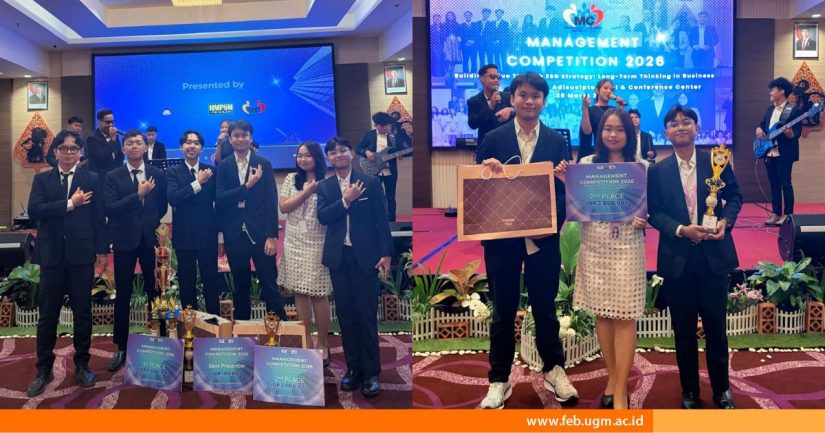
Students from the Faculty of Economics and Business, Universitas Gadjah Mada (FEB UGM), have once again achieved remarkable success in the Management Competition 2026: National Business Case Competition. In the competition organized by Universitas Atma Jaya Yogyakarta on Saturday night (March 28, 2026), two FEB UGM teams secured 1st and 2nd place, as well as the Best Speaker award.
The team Kacamata Baru Aryo, consisting of Muhammad Fatih Putra Nugraha (Economics 2025), Hilal Afif Fauzan (Economics 2025), and Ahmad Fahrel Aldito (Economics 2025), won 1st place. Muhammad Fatih Putra Nugraha was also awarded Best Speaker. Meanwhile, team Apa Ya, consisting of Hanwinartha Haryono (Management-IUP 2025), Amy Koh Jia Chi (Management 2025), and Ibnu Khafi (Management 2025), secured 2nd place.
In this competition, participants were challenged to solve real-world problems related to green energy by using used cooking oil (UCO) to convert it into aviation fuel. They were required to design strategies for managing the supply chain from the community to Greenera, the start-up serving as the case partner in the competition.
The competition consisted of three stages: a quiz round, a paper submission, and a final pitching session. Through these stages, both teams proposed different solutions. Team Kacamata Baru Aryo adopted a direct community approach through door-to-door outreach, while team Apa Ya proposed developing an application to integrate UCO collection points more effectively.
Behind their achievements, both teams faced several challenges throughout the competition. For Team Kacamata Baru Aryo, one unexpected challenge was the language used during the pitching session.
“We only found out 30 minutes before that the pitching session would be conducted in English, so we had to prepare at that very moment,” explained Fahrel.
In contrast, Team Apa Ya identified time constraints as their biggest challenge.
“At that time, due to our busy schedules, the proposal had to be prepared in a very short time,” said Hanwinartha.
Despite these challenges, both teams completed every stage and advanced to the final round. During their preparation, they relied on course materials, internal team discussions, and various external references to strengthen their analysis. Clear role distribution also ensured that each stage was completed in a structured manner.
“We learned from various sources, and I also gained materials from an organization I joined at FEB, the Gadjah Mada Business Case Club, to support our analysis,” Hanwinartha added.
For both teams, this achievement is not merely about winning, but also about the learning process. They admitted they did not expect to win, considering their preparation was done amid tight schedules. Nevertheless, the experience has become a valuable reflection for continuous growth. They also hope that their journey will inspire other students to take part in competitions during their academic years.
Report by: Najwa Anggi Namira
Editor: Kurnia Ekaptiningrum
Sustainable Development Goals