Accounting is often perceived as merely dealing with numbers and bookkeeping. In fact, accounting is an information system that serves as the foundation for business decision-making. Understanding the fundamentals of accounting is essential for recording transactions accurately and making more effective business decisions.
Head of Accounting Research and Development at the Faculty of Economics and Business, Universitas Gadjah Mada (FEB UGM), Haryono, Drs., M.Com., Ak., CA., explained that accounting is an information system designed to generate financial information for various stakeholders. The accounting process consists of three main activities: identifying transactions, recording transactions, and preparing and communicating financial statements.
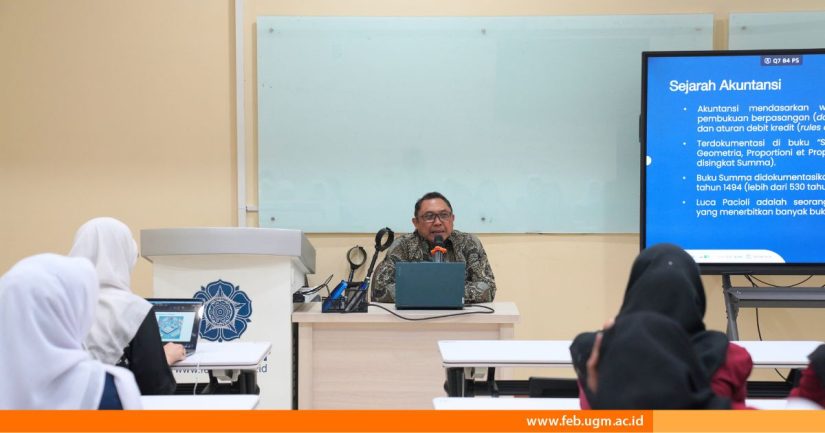
“The information generated through the accounting process is not only used by company management but also by external parties such as investors, creditors, tax authorities, regulators, and others according to their respective needs,” he said during his presentation on Service and Trading Accounting and Accounting Digitalisation at the SIDEK-ERP Implementation Training for Strengthening the Digital Accounting Ecosystem in the Teaching Factory (TEFA) Collaboration with Vocational High Schools (SMK) on Tuesday (7 July 2026) at FEB UGM.
Haryono also highlighted the importance of understanding the fundamental accounting equation as the basis of business finance. He explained that every business activity affects assets, liabilities, and equity, as reflected in the accounting equation. Therefore, all transactions must be recorded systematically to ensure that a company’s financial position is represented accurately.
To strengthen participants’ understanding, the session continued with an analysis of various business transactions commonly encountered in company operations. These included asset purchases, credit purchases, service revenue receipts, operating expense payments, debt repayments, and accounts receivable collections.
“Through this analysis, participants were encouraged to understand how each transaction affects a company’s financial position while maintaining the balance required by the accounting equation,” Haryono explained.
Furthermore, Haryono emphasized that the entire transaction recording process ultimately leads to the preparation of financial statements. The key financial statements that participants need to understand include the income statement, the statement of retained earnings, the statement of financial position (balance sheet), the statement of cash flows, and the statement of comprehensive income. Each financial statement is interconnected, forming a comprehensive source of financial information. Together, these reports provide a complete picture of an entity’s financial condition and performance.
Reporter: Najwa Anggi Namira
Editor: Kurnia Ekaptiningrum
Sustainable Development Goals