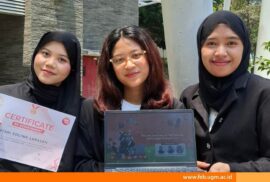
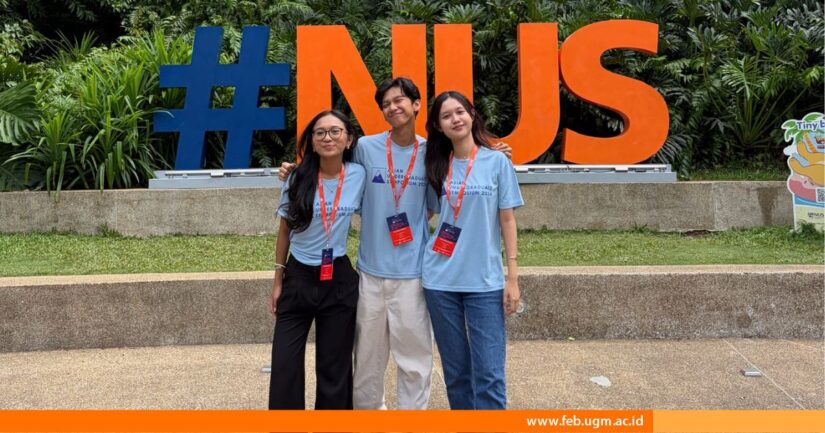
Three students from the Faculty of Economics and Business, Universitas Gadjah Mada (FEB UGM), had the opportunity to participate in the Asian Undergraduate Symposium (AUS) 2026, organized by NUS College (NUSC) in Singapore. The three students were Fazmi Rizki Al Ghifari (Management, 2024), Clairina Elvina Indrian (Accounting, 2024), and Jovita Melinda Susanti (Management, 2024).
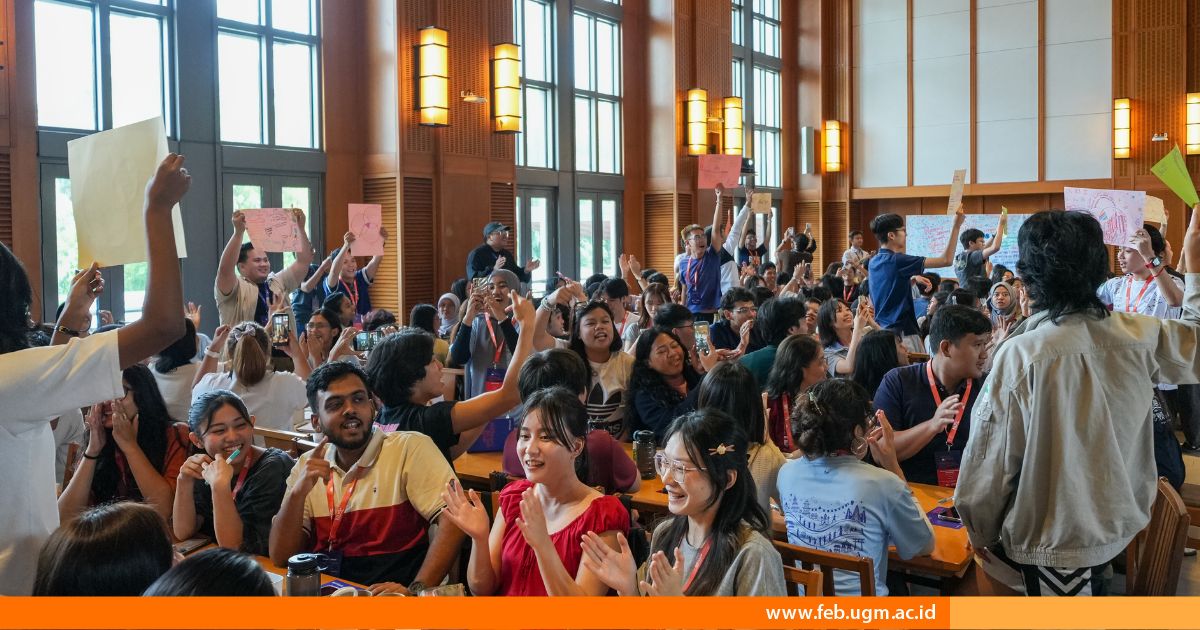
Held from July 5–18, 2026, the program brought together 300 participants from various Asian countries to learn, exchange cultures, build networks, and develop their capacities through cross-border collaboration. Participants came from various countries, including ASEAN member states, China, India, Japan, and South Korea.
The desire to participate in a summer course was one of the reasons Fazmi and Jovita applied for AUS 2026. Clairina later became interested after receiving further information about the program through the Office of International Affairs (OIA) and GREAT FEB UGM.
According to the three students, preparation was an important part of the application process. In addition to demonstrating their English proficiency through the English Proficiency Test (EPT), applicants needed to prepare a CV, motivation letter, and travel documents such as a passport.
“The preparation had to be really thorough, starting from the EPT, CV, and motivation letter, to making sure that our passports were still valid. The documents also needed to be proofread before submission,” Clairina said.
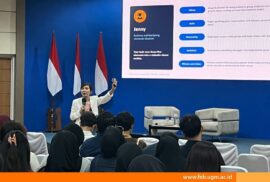
During the first week, participants took part in a series of learning activities, including panel sessions and learning journeys, covering the three sub-themes of AUS 2026. The learning journeys were among the most memorable parts of the program, as participants not only gained theoretical knowledge but also visited communities and businesses directly related to the topics they studied.
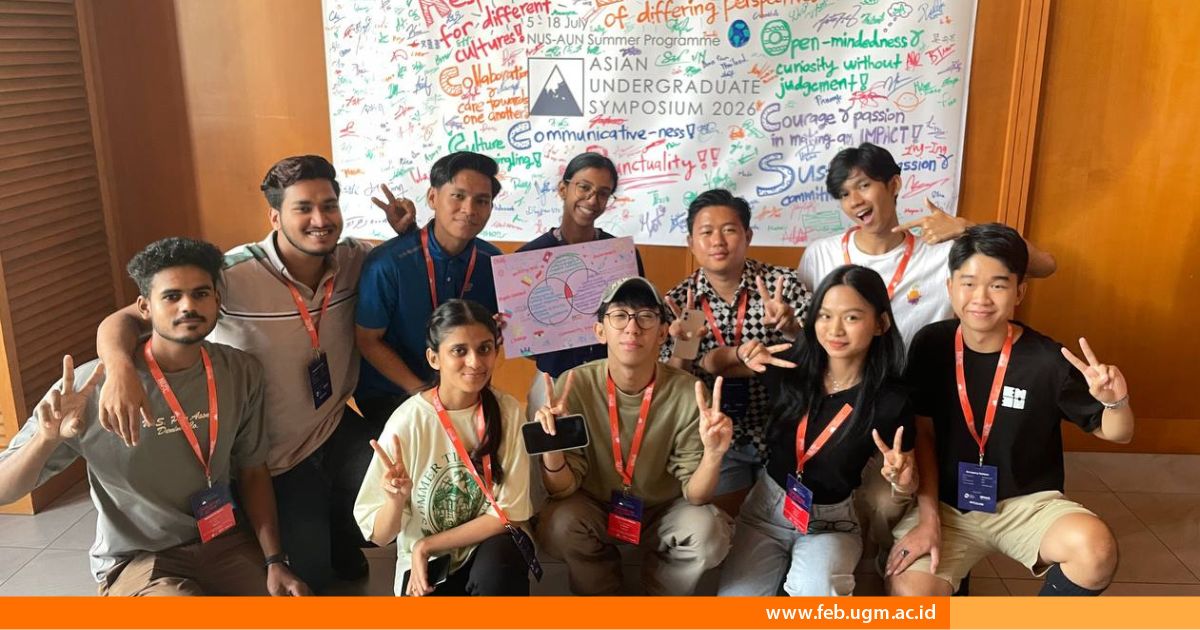 For Jovita, these activities provided a more interactive learning experience while strengthening connections among participants.
“What I found most memorable was the learning journey because we could learn directly from communities or businesses that applied the sub-themes we had studied. It made the learning process more interactive, and we also felt more connected with the other participants,” Jovita said.
Meanwhile, Fazmi participated in several learning journeys focusing on sustainability, heritage, and culture. One of the sessions that left the strongest impression on him was Growthbeans, which was designed in a board-game format and centered on mental health.
According to Fazmi, the session was particularly engaging because participants from different countries were actively involved in the discussions.
“What I found most memorable was Growthbeans because it was designed like a board game about communities and mental health. The discussions were quite intense, and participants from different countries were really active in contributing,” Fazmi explained.
After completing the week-long learning activities, participants began developing projects under the guidance of mentors.
For her project, Clairina chose to address the circular economy by using banana leaves. Together with her team, she developed an idea called “Piring Ijo,” a project that uses banana leaves as raw materials for producing plates and tableware.
The abundant availability of banana leaves in the Mangunan area of Yogyakarta inspired the idea. By processing them into economically valuable products, the project aims to improve the local economy while empowering the surrounding community.
“Piring Ijo” successfully advanced to the online presentation stage, where the team presented their project to investors alongside 30 other teams. From this stage, Clairina’s team was selected as one of 15 recipients of a seed grant.
“The process was quite intensive because we had to complete the proposal within two to three days. However, we were supported by mentors throughout the process, which was very helpful,” Clairina said.
After receiving the seed grant, Clairina and her team will continue implementing the project in the target area for 6 months under the guidance of mentors. Fazmi also became one of the seed grant recipients through his project, “AlirCita,” which focuses on flood disaster mitigation.
The project aims to strengthen communities vulnerable to disasters by digitizing early warning and reporting systems. The solution utilizes Artificial Intelligence (AI)-based technology to support systems that are currently still operated manually in Majalaya, Bandung.
“The project was inspired by the fact that the flood early warning and reporting systems in Majalaya are still operated manually. We are trying to utilize technology and workshops so that communities can receive education and early warnings,” Fazmi explained.
Like Clairina’s team, Fazmi’s team will also undergo a six-month implementation phase in the target area. The seed grant program provides SGD 5,000 in funding to support project development.
Throughout the preparation process and their departure for Singapore, the three students received support from GREAT FEB UGM, particularly in obtaining information about administrative procedures and program requirements. According to them, the prompt responses they received when consulting about procedures and requirements helped facilitate their preparation.
In addition to administrative support, participation in AUS 2026 can also be converted into academic credits (SKS). This allows the international program experience to be integrated into the academic process at FEB UGM.
The experience became an important part of their journey throughout AUS 2026. Beyond gaining academic and international exposure, the three students also had the opportunity to develop projects focused on community-based action.
Reflecting on their experience, the three students encouraged FEB UGM students interested in international programs not to hesitate to seek information and explore the opportunities available.
“Do not be afraid to try. Keep looking for information, have a clear plan, and be brave enough to take the opportunities available,” Fazmi said.
Report: Dwi Zhafirah Meiliani
Editor: Kurnia Ekaptiningrum
Sustainable Development Goals