
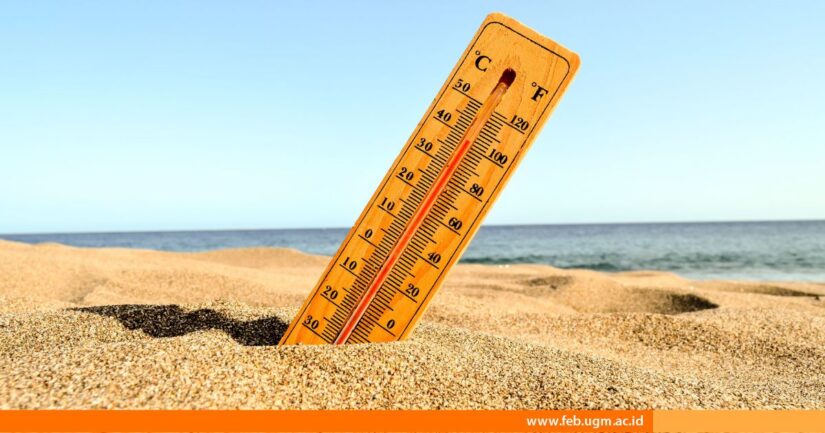
Rising temperatures do not merely make the weather feel hotter; they also affect the income of small businesses in Indonesia. This is one of the findings of a recent study conducted by lecturers from the Faculty of Economics and Business, Universitas Gadjah Mada (FEB UGM).
Wisnu Setiadi Nugroho, S.E., M.Sc., Ph.D., Elan Satriawan, S.E., M.Ec., Ph.D., and Esa Azali Asyahid, S.E., M.Sc., conducted the research together with researchers from the Department of Economics at the College of William and Mary. The study, titled Climate Change and Small Business Productivity, examines the impact of temperature changes on the productivity of household businesses in Indonesia.
The study analyzed data from the Indonesia Family Life Survey (IFLS) and combined it with historical temperature and rainfall data from various regions across Indonesia. This approach was used to examine how climate change affects the productivity of household businesses.
Household-based small businesses were selected as the focus of the study because of their significant role in the economy and their relatively limited capacity to adapt to extreme weather. In Indonesia, approximately 99 percent of business units fall under the MSME category, with most of them operated by households.
The findings show that rising temperatures are associated with a decline in business income. The magnitude of the decline depends on the change in temperature from a region’s normal conditions.
“We found that a 1-degree Celsius increase in annual temperature from normal conditions causes business income to decline by around 13 to 14 percent. Meanwhile, income per worker can decrease by as much as approximately 20 percent,” Esa said during the Research Series titled “Climate Change and Small Business Productivity.”
For example, for an MSME with a normal annual turnover of IDR 60 million, a 1-degree Celsius increase in temperature is estimated to reduce its income to below IDR 52 million. This figure demonstrates that the impacts of climate change extend beyond the environment and are directly felt by business owners.
The study also found that the relationship between temperature and productivity is not linear, but instead follows an inverted U-shaped pattern.
“Productivity tends to be optimal at an average annual temperature of around 25 to 26 degrees Celsius. However, when temperatures continue to rise beyond this point, productivity begins to decline significantly,” he explained.
These findings become increasingly important when considering current temperature conditions in Indonesia. The average temperature in many parts of Indonesia has already reached 26.6 degrees Celsius. Daily maximum temperatures in the Greater Jakarta area have recently reached as high as 36 degrees Celsius. Small-scale businesses and labor-intensive sectors such as construction, manufacturing, and food businesses experience the greatest pressure on productivity.

“Exposure to high temperatures causes physical stress, which makes workers slow down and take more frequent breaks. Hot temperatures also impair workers’ cognitive abilities when making decisions, slowing their reactions and reducing work accuracy,” he said.
Despite declining productivity, business owners must continue operating while bearing the same costs. This condition has the potential to widen economic inequality, as the groups most vulnerable to climate impacts often have the most limited capacity to adapt. According to Esa, these findings highlight the need for more responsive policies to the conditions of the informal sector.
“Climate change is no longer merely an environmental issue, but also a matter of productivity, welfare, and economic development,” he emphasized.
He noted that the government’s climate adaptation strategies to date have focused primarily on large industries and the agricultural sector. At the same time, regulations for small businesses have not explicitly accounted for temperature-related risks. He called for several forms of intervention, including financial incentives, access to cooling technologies, more flexible working hours, and social protection that is responsive to weather-related shocks.
The video of the Research Series titled “Climate Change and Small Business Productivity” can be accessed through the following link: http://ugm.id/DampakPerubahanSuhuTerhadapUSaaRumahTanggaIndonesia.
Report: Dwi Zhafirah Meiliani
Editor: Kurnia Ekaptiningrum
Sustainable Development Goals