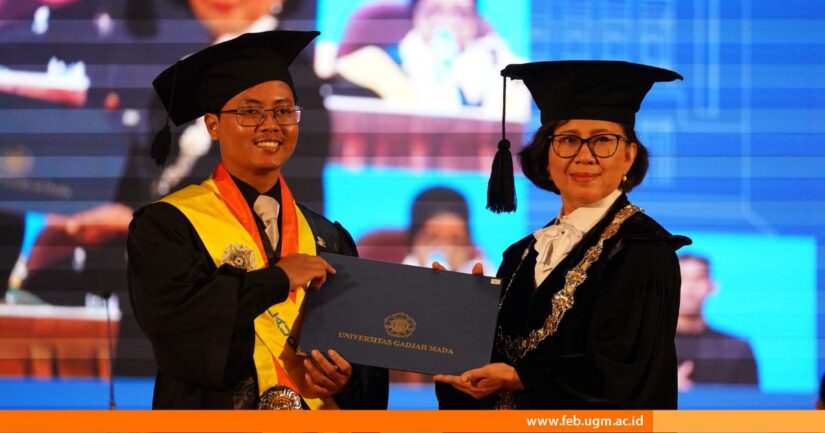
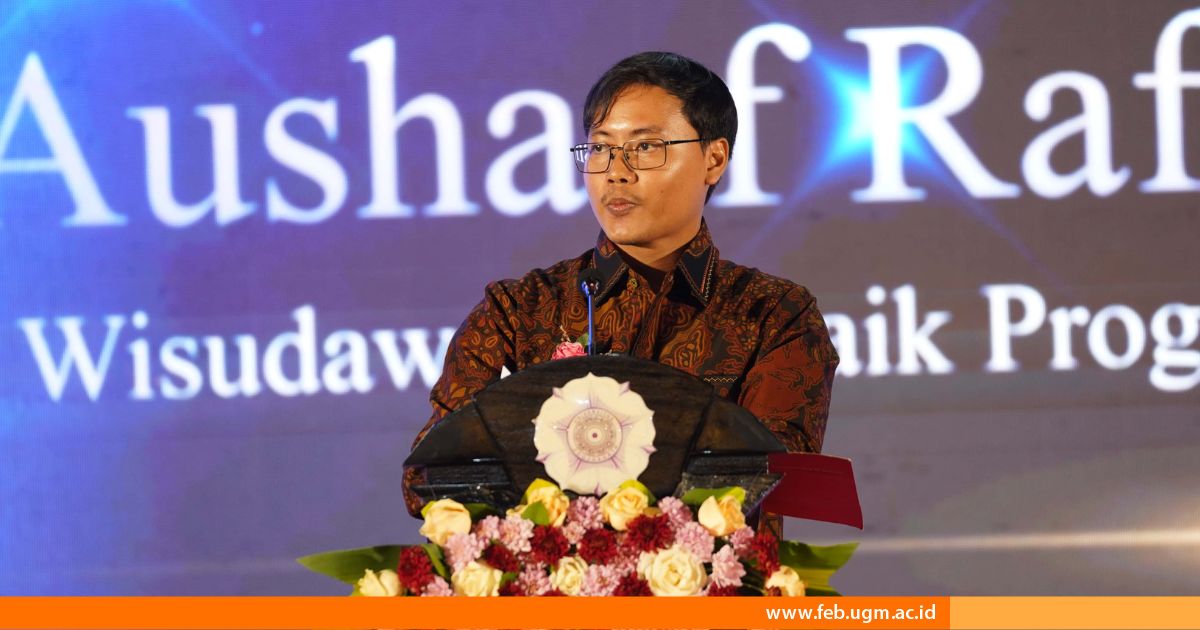
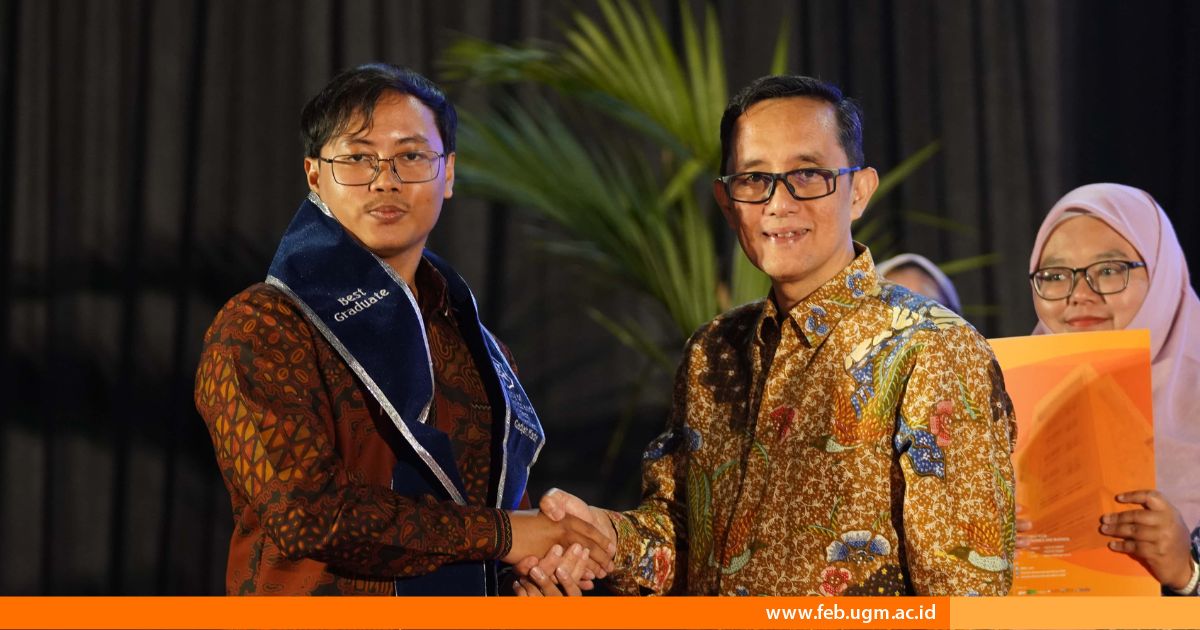
Aushaaf Rafif Keane Pribadi (Economics 2022) never expected to pursue Economics and eventually become the best graduate of the Faculty of Economics and Business, Universitas Gadjah Mada (FEB UGM), for the Fourth Graduation Period of the 2025/2026 Academic Year. Rafif completed his studies in the Economics Undergraduate Program in 3 years, 11 months, and 5 days with a GPA of 3.95. This achievement earned him the distinction of being named the best graduate.
However, his journey toward this achievement began with an unplanned experience. While in high school, all students at Rafif’s school were required to take a selection test for the National Science Olympiad (OSN) in all subjects, including Economics. Unexpectedly, the Bantul native passed the selection and was chosen to participate in the Economics Olympiad. From there, he began studying Economics more deeply, despite being on the science track.
Over time, his curiosity continued to grow. He realized that Economics was not merely about formulas and numbers, but a field that involved various considerations rooted in the real world. This curiosity eventually convinced him to choose the Economics Undergraduate Program at FEB UGM.
“When we talk about social issues, it’s not just about numbers. There are so many factors that influence how something actually happens in the real world,” he said.
After beginning his university studies, his interest in Economics increasingly encouraged him to understand the subjects he was studying. He was not particularly focused on achieving specific academic accomplishments, but was instead driven by curiosity.
“When there was material that I didn’t understand, I would study it on my own, look into it, and make sure I really understood it because of my curiosity,” he explained.
Challenges During His Studies
However, Rafif’s university journey was not always easy. In his second semester, he sustained a knee injury that kept him from traveling to campus for more than a year. He also had to undergo surgery and physiotherapy during his recovery.
The condition required Rafif to adjust various aspects of his activities, from attending classes to participating in student organizations. He also had to find ways to continue his academic activities despite his limited mobility.
According to Rafif, the support he received from various parties at FEB UGM was very helpful during his recovery. The academic administration accommodated his classes and examinations through online arrangements, while his friends helped him with mobility whenever he needed to come to campus.
Entering his fifth semester, Rafif faced challenges that shifted toward his academic workload. Several courses with demanding materials and assignments had to be taken within the same semester. To manage them, Rafif chose a simple approach. He tried to complete every assignment as soon as possible, particularly while he was still on campus. For him, postponing all assignments until the weekend would only make the workload feel heavier.
He also regularly used a to-do list to organize his work. Rather than setting a detailed hourly schedule, Rafif would write down what he needed to accomplish each day.
“Before the next day, either in the evening or the afternoon before, I would make a list of what assignments I had to do, what I needed to study, or what I needed to prepare,” he explained.
This approach helped him keep track of which tasks had been completed and which needed to be done on subsequent days.
Active in Organizations, Social Projects, and Competitions
Outside academics, Rafif was active in the Economics Student Association (HIMIESPA), particularly in the Department of Studies and Research (DKP). He chose the department to develop his writing skills. Through this experience, his research interest continued to grow.
In addition to his organizational activities, Rafif was also a Tanoto Scholar. Through the Tanoto Scholars Association (TSA) UGM, he participated in various regular training programs organized by the Tanoto Foundation. During his fifth and sixth semesters, he served as a project leader for a social project on waste banks in Yogyakarta. The project was initiated in response to marketing challenges faced by several waste banks in Yogyakarta in promoting their recycled products.
“People work with incentives, and that became one of the things I incorporated into the social project we worked on for approximately one year,” he explained.
His research interests also deepened as he entered his final semesters. Under the guidance of several lecturers, including Elan Satriawan, Rafif began working as a research assistant. He also served as a teaching assistant for several courses.
Alongside his academic and research activities, Rafif participated in several competitions, ranging from business plans and business cases to academic papers. One of his achievements was winning third place in the PYC International Energy Conference Essay Competition 2023. Together with a team of five students, he also explored the theme of the people’s economy through the Student Creativity Program (PKM), leading the team to qualify for the 37th National Student Scientific Week (PIMNAS).
For Rafif, having many activities does not mean that everything has to be done simultaneously. Instead, he chooses his focus at the beginning of each semester and avoids taking on too many activities at once.
“Time management starts with planning. It’s not only about how we manage our time once activities have already started, but also about preparing from the beginning, before we decide to take on an activity,” he said.
The Meaning Behind an Achievement
For Rafif, being named the best graduate is an honor. Nevertheless, he does not view the title simply as a measure of being the best student. According to him, students have different achievements and areas of focus. Some may be more active in organizations, preparing for their careers, or developing particular projects. Therefore, he sees the distinction of being the best graduate as an opportunity to represent other students on their own journeys.
To FEB UGM students, Rafif advised them to begin finding their own direction midway through their university journey. He believes students should begin determining what they want to achieve and prepare themselves before embarking on their respective paths after graduation.
“Feel free to find your own path. Once you’ve reached the middle of your studies, you can already start imagining what you want to achieve at FEB and after graduation,” he advised.
Reporting: Dwi Zhafirah Meiliani
Editor: Kurnia Ekaptiningrum
Sustainable Development Goals