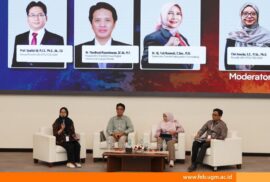

Student success in higher education is determined not only by the quality of learning but also by a supportive academic environment that responds to students’ needs. Counseling services, peer support, and stress management skills play an essential role in helping students navigate challenges throughout their studies. The student support service practices implemented by Eötvös Loránd University (ELTE), Hungary, have provided valuable insights for the Faculty of Economics and Business Universitas Gadjah Mada (FEB UGM) in strengthening its student support services.
In collaboration with Eötvös Loránd University (ELTE) in Hungary, FEB UGM organized a series of training sessions on student support and service development from 3 to 6 November 2026. Held at Pertamina Tower, FEB UGM, the program involved lecturers, administrative staff, and students as part of the Staff Mobility for Training program funded through the Erasmus+ Mobility Agreement.
The training featured Albert Mihály, a Counseling Psychologist at the Student Support Center, Faculty of Informatics, ELTE University. Over four days, Albert delivered four training sessions designed to enhance the academic community’s capacity to support student well-being and academic success.
Albert explained that ELTE University has developed various student support services at both the university and faculty levels. At the university level, these services include the Career Center, Student Counseling Center, peer counseling groups, psychological consultations, disability support services, and student accommodation facilities.
Meanwhile, at the faculty level, student support services include student organizations, peer support groups, tutorial activities, and community-building programs. At the Faculty of Informatics in particular, psychological counseling services have become a key priority in helping students address various challenges throughout their higher education journey.
Albert highlighted that the development of these services is closely linked to efforts to reduce student dropout rates, particularly during the first year of university. First-year students often face various challenges, including stress, anxiety, difficulties in time management, social issues, and uncertainty about their future career paths.
“Student support services not only help students when they encounter difficulties but also play a preventive role in addressing potential problems that could hinder their academic success,” Albert explained.
To address these challenges, ELTE University has developed several mentoring and support programs focused on improving student well-being and academic success. One approach involves orientation and mentoring programs for first-year students. These programs introduce students to university life, study skills, socialization in academic and professional environments, and mentorship. Interactions between mentors and students are expected to help students build social connections, become familiar with the academic environment, and develop essential skills throughout their studies.
These insights into student support service management formed part of four training sessions designed for FEB UGM lecturers, administrative staff, and students. In addition to Student Support Services at the University, the training covered Stress and Time Management Training, The Practice of Supportive Conversations, and Communication and Conflict Management Training.
The four topics highlighted the importance of involving various members of the university community in creating a supportive academic environment. Lecturers and administrative staff need to develop the skills to recognize students’ needs and establish supportive communication. Meanwhile, students need to be equipped with skills in stress management, time management, communication, and conflict resolution to navigate academic and social life.
One of the training participants, Nadya Salmadevi, a psychologist at FEB UGM, shared that the presentation on student support services at ELTE University offered new perspectives on the development of student support systems in higher education.
“Both institutions place students’ needs as a priority, whether through psychological support or community activities such as arts and sports. This program has provided us with new perspectives to develop services that respond to students’ needs continuously,” Nadya said.
Reporter: Dwi Zhafirah Meiliani
Editor: Kurnia Ekaptiningrum
Sustainable Development Goals